
Are Korean Sunscreens FDA Approved? A 2026 Guide
Most Korean-market sunscreens are not FDA-approved over-the-counter drugs, because the United States regulates sunscreen as a drug under Monograph M020 and several UV filters common in Korean formulas are absent from that permitted list. The US-shelf version of a Korean brand is frequently a different formula, rebuilt from monograph-legal filters. One thing genuinely changed in 2026: FDA added bemotrizinol (sold internationally as Tinosorb S) to the monograph on June 9, with the order effective August 9, 2026.
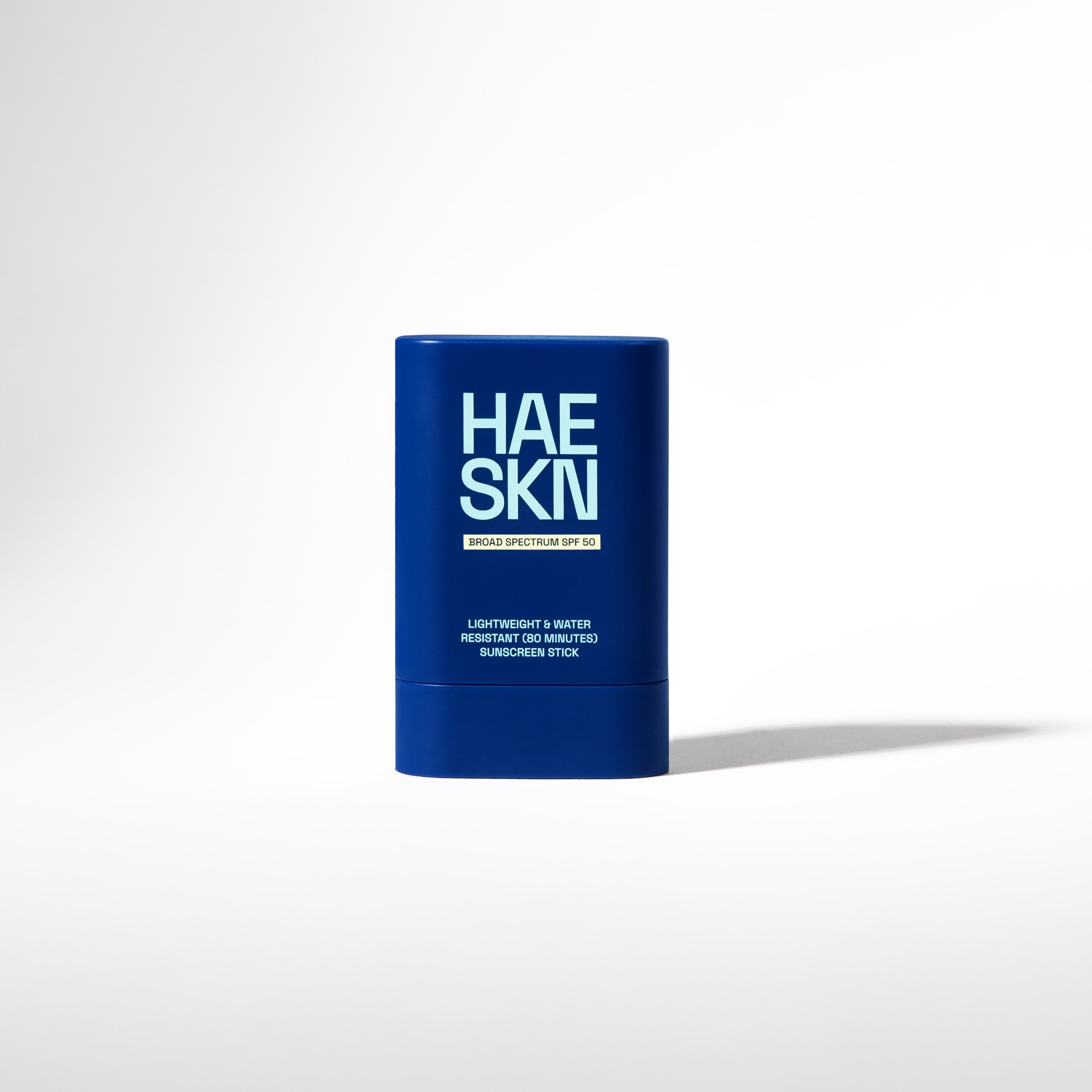
We publish this guide and we sell the HAESKN Sunscreen Stick SPF 50, a US-manufactured sunscreen that is formulated and labelled as an FDA-compliant OTC drug. Read the rest with that in mind: we build inside the monograph system described below, so we have a commercial interest in how you understand it. Our aim here is to give you the label-reading rules rather than a verdict on any competitor.
The question behind the question
"Are Korean sunscreens FDA approved" usually means one of two things. Either you are holding a Korean-brand bottle and wondering whether it is legitimate, or you have read that Korean formulas offer better UVA protection and want to know why they are hard to find at Target.
Both answers come from the same place. A sunscreen in the US is a drug, and the drug rules constrain the ingredient list before anyone argues about texture.
Drug in the US, functional cosmetic in Korea
The FDA governs sunscreens through an OTC monograph, currently M020, which specifies the permitted active ingredients, their maximum concentrations, and the required labelling. Everything downstream of that, including the Drug Facts panel and the manufacturing standard, follows drug rules rather than cosmetic rules.
Korea uses a category the US system has no equivalent for. According to the University of Miami's International and Comparative Law Review (2024), Korea's Ministry of Food and Drug Safety classifies sunscreen as a functional cosmetic, a designation that carries pre-market review but sits outside the lengthier drug pathway the FDA applies, which has historically included animal safety testing.
That single classification difference explains most of the gap people attribute to formulation skill. Korean formulators have had a larger palette of filters to work with for years, because approving a new filter there does not require clearing a drug review.
The permitted filter list is the real bottleneck
OTC Monograph M020 permits a fixed set of actives at fixed ceilings, including avobenzone up to 3 percent, homosalate up to 15 percent, octinoxate up to 7.5 percent, and octisalate up to 5 percent.
Until August 2026, avobenzone was the only organic filter on that list positioned primarily at UVA. Writing for Bright Girl, double board-certified dermatologist Dr. Angela Casey describes avobenzone as the only chemical sunscreen ingredient FDA-approved for UVA protection, and notes that it is an unstable compound often paired with stabilizers such as octocrylene or vitamin E to hold up in the bottle. FDA's own scientific review record for the bemotrizinol order cites the photostabilization literature on avobenzone, including Chatelain and Gabard (2001), which is a fair signal that photostability is a recognised formulation problem rather than an internet talking point.
Dr. Casey also names the filters that Asian and European formulas commonly use for UVA coverage: Mexoryl SX, Mexoryl XL, Tinosorb M (bisoctrizole), and Tinosorb S (bemotrizinol). She characterises them as superior to avobenzone for UVA protection. Treat that as a dermatologist's assessment in a brand-published article rather than a head-to-head clinical measurement, and note the practical limit she adds in the same piece: the same brand can sell very different formulas in its US and overseas lines, and plenty of Asian and European sunscreens contain exactly the same actives US ones do. Country of origin is a weak predictor of anything.
The 2019 headlines about sunscreen safety still confuse this. FDA's deemed final order and proposed order treated 16 actives as GRASE consistent with the 1999 monograph, while the proposed order said that avobenzone, homosalate, octisalate, octocrylene and several others need additional data to support a positive GRASE determination. Those ingredients remain legal to market while FDA waits for that data, which is a pending-evidence state rather than a ban.
What bemotrizinol changed in 2026
On June 9, 2026, FDA added bemotrizinol to the list of permitted sunscreen active ingredients, the first addition to the OTC sunscreen monograph since the late 1990s and the first new active to clear the streamlined administrative-order pathway created by the CARES Act. Per CIRS Group's summary of Final Administrative Order OTC000039, bemotrizinol is permitted at concentrations up to 6 percent, was determined GRASE for adults and children 6 months and older, is allowed in stick form among other dosage forms, and the order took effect August 9, 2026.
So the honest 2026 answer to "are Korean sunscreens FDA approved" has shifted by one filter, and only one.
A Korean formula built on bemotrizinol plus filters that remain off the list, such as bisoctrizole or Uvinul A Plus, still cannot be sold as a US OTC sunscreen drug without reformulation. Availability also lags approval. Supply is the limiting factor for now. MD Anderson Cancer Center (2026) reports that for the first 18 months only one manufacturer is approved to make bemotrizinol, which then sells the ingredient on to sunscreen makers, and that the first US products containing it are expected in fall 2026.
If you are weighing filter chemistry more broadly, our guide on mineral or chemical sunscreen for daily use covers the tradeoffs that survive this regulatory change.
SPF and PA answer different questions
Two labels, two jobs. SPF is a UVB-weighted number. PA grades UVA protection on a + to ++++ scale derived from persistent pigment darkening, and it appears on Korean and Japanese packaging while never appearing on a US Drug Facts panel.
Dr. Casey's criticism of the US approach is specific: in the US, a product demonstrating even a small amount of UVA protection may be labelled "broad spectrum," whereas a PA grade gives a more concrete reading of how much UVA protection is present. PA is still a category rather than an exact figure, so PA++++ tells you "high" and not "this many times baseline."
Why should an active person care? Dr. Casey writes that the majority of UV reaching the earth's surface is UVA, that it penetrates more deeply than UVB, and that it drives much of the collagen and elastic fibre breakdown, sagging, discoloration and wrinkling seen in photoaged skin. Long training blocks are a UVA exposure problem as much as a burn problem.
Reading the bottle in thirty seconds
A product sold legally as a US sunscreen drug has to tell you what it is. Four checks:
- Find the Drug Facts panel. A separate "Active ingredients" block listing filters with percentages is drug labelling. A single combined ingredient list with no such block is cosmetic labelling from another market.
- Check SPF against PA. SPF with "Broad Spectrum" and no PA grade indicates a US-market formula. SPF 50+ PA++++ indicates Korean or Japanese notation.
- Read the actives themselves. Cross-reference against the M020 list. A filter that is not there means the product is not a monograph-compliant US sunscreen drug, whatever the marketplace listing says.
- Assume the US version differs. If you loved a formula bought in Seoul, verify the actives on the American bottle before assuming you are repurchasing the same thing.
Availability on a marketplace proves only that someone shipped it. Plenty of Korean SPF products reach US buyers as third-party imports rather than through FDA-cleared OTC drug distribution, which leaves the four checks above as your only real signal about what the panel promises.
Where HAESKN sits
We are a US brand and we say so plainly. The HAESKN Sunscreen Stick SPF 50 is manufactured in the US and formulated as an FDA-compliant OTC drug, with four organic filters as its actives: avobenzone, homosalate, octisalate and octocrylene. It contains no zinc oxide or titanium dioxide, and no bemotrizinol or bisoctrizole. We do not publish the concentrations, because they are not disclosed on a HAESKN-named public source and we would rather leave a gap than fill it with a number we cannot stand behind.
When we describe the stick as K-beauty-informed, we mean the texture and finish philosophy: a clear, lightweight, no-white-cast wear across every skin tone, including deep tones, in a pocket format you can reapply one-handed mid-activity. It does not mean Korean manufacture, and it does not mean non-US filters. Those are claims we are not entitled to.
The honest tradeoff sits right there in the actives. We work from the same monograph palette every other US-compliant brand works from, so our advantage has to be format and finish rather than a filter nobody else can use. If your priority is the highest-graded UVA filter system available anywhere in the world, that currently lives in markets outside the US monograph, and we would rather tell you so than pretend otherwise.
HAESKN Sunscreen Stick SPF 50
24.00 USD
Shop now
What this means if you train outdoors
Filter regulation is the part of sun protection you cannot control. Reapplication is the part you can, and it is where most outdoor protection actually fails. A monograph-legal SPF 50 you reapply at the turnaround point outperforms a PA++++ import sitting at home in a drawer because it felt too precious to carry.
Use the regulatory knowledge for what it is good for: sorting real drug labelling from cosmetic labelling, and setting expectations about UVA coverage. Then pick on whether you will actually use the thing. Our guide to what "reef-safe" really means works through a similar case of a label that sounds regulatory and is not.
FAQ
Is it illegal for me to buy a Korean sunscreen online?
Personal purchase is a different question from lawful US distribution. The constraint falls on marketing a sunscreen drug in the US without monograph-compliant actives, labelling, and manufacturing. Many Korean SPF products reach American buyers through third-party marketplace imports, which is a compliance grey area rather than FDA clearance.
Does PA++++ mean better protection than a US SPF 50?
It means a high UVA grade, measured on a scale the US does not use. The two ratings are not interchangeable, and per Dr. Casey's explanation of PA grading, PA still reports a band rather than a precise number. A US SPF 50 labelled Broad Spectrum has met the American UVA threshold, which she argues is a lower bar.
Does "K-beauty" on a US label mean the product was made in Korea?
No. The phrase is marketing language with no regulatory definition, and it can describe formulation philosophy, texture goals, or nothing at all. Country of manufacture appears elsewhere on the packaging, and the actives appear in the Drug Facts panel. Check both.
Will Tinosorb M or Mexoryl be approved next?
Nobody can promise that. What the bemotrizinol order established is a working route: FDA moved from a December 2025 proposed order to a final order on June 9, 2026, roughly seven months, through the CARES Act administrative-order pathway. Other internationally established filters would need their own requests and their own safety data packages.
Should I switch sunscreens because of the 2026 approval?
Not yet, on availability grounds alone. Bemotrizinol-containing US products are rolling out gradually under a single-supplier exclusivity window. When they arrive, judge them the way you judge any sunscreen: actives on the panel, stated water-resistance window, and whether the format survives your actual routine.
If you want a US-compliant stick you can reapply without stopping, the HAESKN Sunscreen Stick SPF 50 is $24 and the actives are printed on the Drug Facts panel where you can check them against the monograph yourself.