
Best Sunscreen Stick for Your Face for Outdoor Workouts
For a face you plan to sweat on, pick a broad-spectrum SPF 50 stick that prints "Water Resistant (40 minutes)" or "(80 minutes)" on its Drug Facts panel and that you can apply one-handed without a mirror. The solid format matters because liquids move with sweat and a wax-based solid mostly does not. The filter chemistry inside the stick is a separate decision, and it is the one to think hardest about if sunscreen has stung your eyes before.
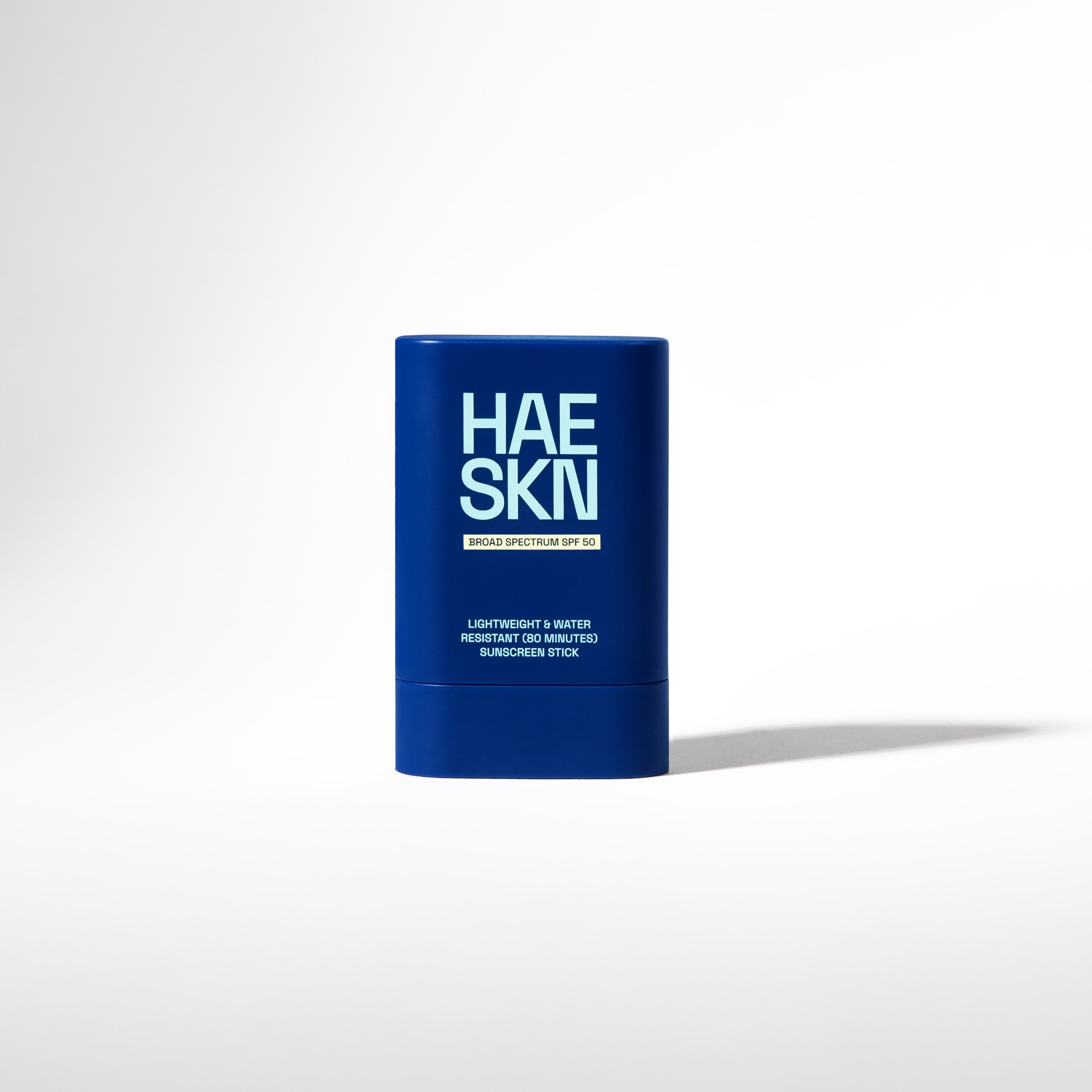
We publish this guide and we sell the HAESKN Sunscreen Stick SPF 50, so read the criteria below before you read our placement against them. Every one of them is something you can check on a pack in a store, which is the point.
Five criteria, in the order we weight them
- Format you will actually use mid-workout. A product you skip at minute 70 protects nothing. One-handed operation, no rub-in, no mirror.
- A printed water-resistance window. Either 40 or 80 minutes has to appear on the front label. A stick with no number tested for none.
- Broad spectrum, SPF 50. Broad spectrum is a tested claim about UVA protection measured relative to UVB.
- A finish you will wear on your face. White cast, grease, and a film that creeps under a hat brim are all reasons people stop reapplying.
- Filter chemistry matched to your own eye history. This one is personal, and it overrides criterion 4 if you have a track record of stinging.
The order matters. Compliance beats chemistry for most people, because the realistic failure is a skipped reapplication rather than an insufficient filter. If you are in the minority whose eyes react, move criterion 5 to the top and accept a heavier finish.
Why liquids leave your face and solids mostly stay
Sunscreen on the face fails differently than sunscreen on an arm. The forehead is a high-sweat surface angled straight at the sun, and whatever you put on it drains downhill toward the brow.
Lotions and sprays start as liquids held in an emulsion. On a warm, sweating forehead that emulsion thins and travels. One explanation of the mechanism, from All About Vision, is that sweat and skin oils carry filters and the surrounding base into the tear film, where the burning starts almost immediately.
A stick is a wax and ester solid. You deposit it as a film that sits where you pressed it, and it does not have a liquid phase waiting to be mobilized. SolRX, which sells a competing zinc face stick, describes the same physics from the other side of the shelf: a solid applied to the forehead, brow bone, nose and cheekbones creates an edge that routes sweat around the eye area rather than through it. Two brands with different formulas agreeing on the mechanism is a reasonable signal that the mechanism is real.
Worth keeping in proportion: the edge effect is a physical argument about format, and no label on the market carries a tested claim for it, ours included. We have covered the format comparison in more depth in sunscreen stick vs. spray vs. lotion, and the eye-sting chain specifically in why sunscreen stings your eyes when you sweat.
What "Water Resistant (80 minutes)" actually measures
The number on the front of the pack is the most useful thing on it, and almost everyone reads it wrong.
US rules permit exactly two water-resistance claims. Per the FDA, a water-resistance claim on the front label must state whether the sunscreen remains effective for 40 minutes or 80 minutes while swimming or sweating, and the agency's 2011 rule removed "waterproof," "sweatproof," and "sunblock" from US labels entirely.
The protocol behind the number is mechanical. The FDA's compliance guide describes alternating 20-minute immersions and 15-minute drying periods, two cycles to substantiate a 40-minute claim and four to substantiate 80, with the SPF test run afterward on what survived. The resulting value is the SPF retained after that much immersion.
For a workout, 80 minutes is the ceiling, not a description of your session. 21 CFR 201.327 requires the label to direct reapplication after the stated 40 or 80 minutes of swimming or sweating, immediately after towel drying, and at least every two hours regardless. An 80-minute rating covers a tempo session. It has expired somewhere inside a half marathon, and the film has been thinning before that.
The test is also immersion in still water without toweling. Your face on a run adds friction from a hat band, a sleeve wipe, and salt crystallizing as sweat evaporates. Treat the printed minutes as an upper bound produced under friendlier conditions than yours. Our own reapplication math is laid out in how often you should reapply during the day.
SPF 50 over SPF 30, for a reason that has nothing to do with time
The American Academy of Dermatology puts SPF 30 at 97% of UVB filtered and recommends SPF 30 as the floor, noting that no sunscreen filters 100%. Higher SPF numbers block slightly more.
On a spec sheet the upgrade looks trivial. The reason to take it anyway is dose. The AAD's sunscreen FAQ page reports that many people apply only 20 to 50% of the amount needed to achieve the SPF on the label, and that a high-SPF product helps compensate for that under-application. The same page is blunt that a higher number does not last longer or buy extra time outdoors.
Applied to a face stick, that means the SPF 50 on the pack is insurance against the three quick swipes you will actually manage at an aid station. It buys margin on dose, and it still has to be reapplied on the same schedule as an SPF 30.
The filter tradeoff we cannot argue our way out of
Our stick uses chemical filters: avobenzone, homosalate, octisalate, and octocrylene. That is a fact about the formula and it carries a real tradeoff, which we would rather state than bury.
Several dermatology and vision sources point at chemical filters when people describe eye stinging. All About Vision attributes a higher likelihood of eye burning to chemical formulas. Lauren Penzi, MD, FAAD, of MDCS Dermatology, told TODAY that the skin around the eyes is far thinner and more reactive than the rest of the face, which is part of why a product that behaves on the cheeks can still cause trouble at the brow.
The split is personal history. If sunscreen has burned your eyes on past runs, a fragrance-free zinc oxide face stick is the conservative choice and you should expect some white cast in exchange, more of it on deeper skin tones. If stinging has not been your failure mode, a chemical stick gives you a clear finish with no cast, which for many people is the difference between reapplying and not.
We make no claim that our stick is non-irritating, eye-safe, or dermatologist-tested. We have not run the testing that would support any of those words, and we are not going to imply them.
Where the HAESKN stick lands against these criteria
Against criterion 1, it is a pocket-sized stick that fits running shorts or a vest, applies one-handed, and takes a few seconds at a water stop.
Against criterion 2, it is formulated and tested for broad-spectrum SPF 50 with 80-minute water resistance under FDA protocols, which is the highest window US labeling allows, as documented on our own site. Check the Drug Facts panel on the pack you own and treat that as the governing number.
Against criterion 4, the clear chemical filters leave no white cast on any skin tone, which is the whole reason the formula exists.
Against criterion 5, see the section above. We lose to a zinc stick for anyone whose eyes react, and we would rather send that reader to zinc than sell them a product they will stop using.
It is $24, manufactured in the US as an FDA-compliant OTC drug. If you want a second signal for rising UV, our SOLCHECK sticker changes color with ambient UV. It reads the environment and cannot see the film on your face, so pair it with a timer rather than trusting it to tell you when to reapply.
HAESKN Sunscreen Stick SPF 50
24.00 USD
Shop now

HAESKN SOLCHECK
15.00 USD
Shop now
How to apply a face stick so it survives the sweat
Clean, dry skin first. A stick deposited over existing sweat or a damp moisturizer sits on the moisture rather than on you, and it comes off with it.
Then go around twice. A single swipe lays down a film far thinner than the dose the SPF was tested at, which is exactly the under-application the AAD describes. Cover the forehead, both cheekbones, the nose, both ears, and the back of the neck, then repeat the whole circuit before you leave.
Cover the brow bone and stop there. Keep the product on the bony orbital rim rather than the lid or lash line, which reduces how much has to travel before it reaches the tear film.
Mid-session, blot sweat with the back of a hand or a shirt hem before reapplying, and blot rather than wipe across the face. A wipe drags the film you still have toward your eyes.
FAQ
Is a stick enough sun protection for my whole face on a long run?
Yes, if you apply enough of it and reapply on schedule. The catch is the dose: one thin swipe per zone delivers well under the tested amount, and the AAD notes most people apply only a fraction of what the SPF number assumes. Two full circuits before you head out is the practical fix.
Can I use a body sunscreen stick on my face?
Check the label rather than assuming. Some sticks are labeled for face and body, others are formulated for body use with heavier emollients that migrate more once you sweat. Facial skin, and eyelid skin especially, is thinner and more reactive than the skin on your shoulders.
Does a sunscreen stick expire faster in a hot car or a gym bag?
Heat is hard on a wax-based solid. Repeated softening and resetting can change the texture and how evenly it lays down, and every OTC sunscreen carries an expiration date on the pack. Store the stick in a bag rather than on a dashboard, and replace it when the surface no longer glides cleanly.
Do I still need sunscreen for an early-morning or overcast workout?
UV is lower at dawn and under cloud, though not absent, and the AAD advises reapplying roughly every two hours outdoors even on cloudy days. For a short, low-sweat session a 40-minute water-resistance rating is enough. Save the 80-minute product for the sessions where you will be soaked.
What should I do about the rest of my face and head?
A stick handles the forehead, nose, cheekbones, and ears well. Scalp partings, the back of the neck, and lips need their own attention, and a cap plus sunglasses does more for the eye area than any reformulation will.
If you want a clear SPF 50 stick with an 80-minute water-resistance window that you can reapply one-handed mid-workout, the HAESKN Sunscreen Stick SPF 50 is $24. If your eyes have a history with chemical filters, buy a zinc stick instead and reapply it religiously. The one that ends up back in your pocket at mile ten is the one that worked.