
How Often to Reapply Sunscreen When You're Sweating
Every two hours is the floor for dry skin, and it is the wrong clock once you are working. When you are sweating, the number that governs you is the one printed on your pack: reapply after 40 or 80 minutes of swimming or sweating, and immediately after towel drying. For most outdoor sessions that lands reapplication somewhere between 40 and 90 minutes, and the amount you put back on matters as much as the timing.
We publish this guide at HAESKN and we sell the HAESKN Sunscreen Stick SPF 50, so read the recommendations with that in mind. The label rules below are federal directions that apply to every sunscreen sold in the United States, ours included.
What your label is legally required to say
United States sunscreen labeling is specified in 21 CFR 201.327. A product that passes the water-resistance test must carry directions to reapply after either 40 minutes or 80 minutes of swimming or sweating, immediately after towel drying, and at least every two hours. A product that does not pass that test carries a shorter instruction: reapply at least every two hours, and use a water-resistant sunscreen if you will be swimming or sweating.
Two phrases carry the weight for athletes. "Of swimming or sweating" means the window measures exposure time in water or heavy sweat rather than time elapsed since you applied. "Immediately after towel drying" means a single wipe of the face resets the schedule regardless of the clock.
The FDA is explicit that no sunscreen is waterproof and that all of them eventually wash off, which is why the agency banned "waterproof" and "sweatproof" claims in the first place. The 40 and 80 minute figures describe how long the film survived a standardized immersion test, so treat them as an outer bound on a good day.
Why two hours is a dry-skin number
The American Academy of Dermatology frames the two-hour interval as the requirement even when your skin stays dry, with the 40 or 80 minute window applying on top of it whenever water or sweat is involved. Read in that order, the two-hour rule is the minimum for a desk day with a lunchtime walk.
Dr. Angela Casey, a double board-certified dermatologist and micrographic surgeon, writes that sunscreen actives break down over time and with sun exposure, that swimming and sweating make that worse, and that she recommends reapplying every two hours as the general rule. Her framing is useful because it separates two mechanisms that get blended together. Filters degrade chemically as they absorb UV. Sweat, water and friction remove the film physically. A hard hour outdoors runs both processes at once.
That is the part of the two-hour rule most people carry into a workout without adjusting. Your morning application is not aging quietly on your skin while you run.
The schedule, translated into sessions
Nothing below overrides what your own pack says. It is a practical reading of the same directions for the activities our customers actually do, and it assumes you started with a full application before you went out.
| Session | Sweat load | Practical reapplication point |
|---|---|---|
| Easy 45 minute run, mild weather | Low to moderate | Once at the end, or at the turnaround on a warm day |
| Long run or ride, 2 hours or more | High and continuous | Every 60 to 90 minutes, at an aid station or water stop |
| Padel, tennis or pickleball | High, with towel use | At the changeover after roughly an hour, and after any face wipe |
| Hike, 4 to 6 hours | Moderate, plus pack friction | Every 2 hours, sooner on shoulders and neck under straps |
| Swim or open water | Full immersion | At the labeled 40 or 80 minute mark, and immediately after towel drying |
The towel row is the one people skip. A face wipe at a changeover removes product from exactly the high points that burn first: nose bridge, cheekbones, ears, hairline. If you have ever wondered why the sting arrives at the same point in every session, the mechanics are in our guide to why sunscreen stings your eyes when you sweat.
Most people are behind before they start
SPF is measured in the lab at 2 mg/cm² of skin. Real-world application sits well below that. A review by Petersen and Wulf in Photodermatology, Photoimmunology & Photomedicine (2014) put typical use at roughly 0.39 to 1.0 mg/cm², and the authors noted that early reapplication or a very high SPF can partly compensate for the gap. Young and colleagues, in work indexed at PubMed, describe typical application as around 0.8 mg/cm² and found that holidaymakers using their own sunscreen without instruction developed daily erythema, while erythema was virtually absent when sunscreen was used at 2 mg/cm² or more.
Both findings are about dose, and both are limited: the Petersen paper is a literature review rather than a trial, and the Young study ran with small groups on a single high-UV holiday. Neither measured runners, and neither tested sticks.
Both still change how you should read a reapplication. When the morning coat went on somewhere in the 0.39 to 1.0 mg/cm² range these papers describe, the second coat is doing the work of getting you toward the dose the SPF on the pack was tested at, on top of replacing what sweat took off.
Dose per reapplication, by format
A reapplication only counts if enough product lands. Sticks make that harder to judge than lotions, and we would rather say so than pretend otherwise.
Michelle Wong, a chemistry PhD who publishes as Lab Muffin Beauty Science, weighed what sticks actually deposit against the American Academy of Dermatology's four-passes-per-area guidance. She found the amount varies with how much friction the formula has against skin: a very slippery stick leaves less product behind per pass than a grippier one, so identical pass counts do not mean identical doses.
Dermatologist Natasha Mesinkovska of UCI Health puts the practical consequence plainly, telling UCI Health that for users who apply a stick with just a few passes, "it is unlikely they will get full coverage compared to a liquid sunscreen."
So the working rule for a mid-session reapplication with a stick:
- Lay down overlapping passes until the area looks and feels coated. Treat four passes as the opening bid and keep going until the product is visibly sitting on the skin.
- Blend with clean fingers so the film is continuous across the high points.
- Do the perimeter people forget: ears front and back, hairline and part, the back of the neck, the tops of the feet in running shoes.
- Dry the skin first. Product applied over a sweat layer sits on water rather than on skin.
If you want the full format trade-off, we worked through it in sunscreen stick vs. spray vs. lotion, and the general-purpose version of the timing question lives in how often should you reapply sunscreen during the day.
Where our stick fits, honestly
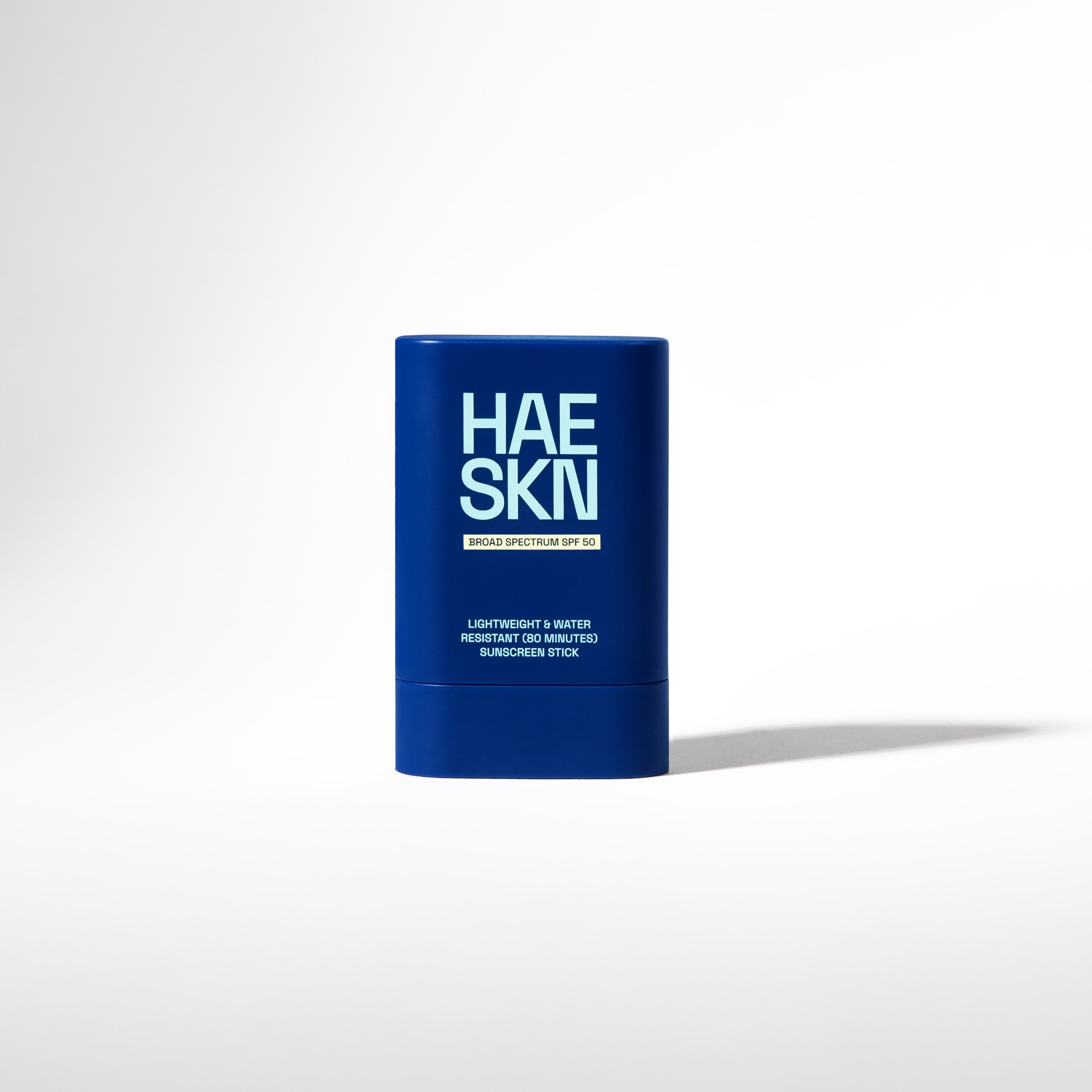
The HAESKN Sunscreen Stick SPF 50 is a $24 pocket-format stick built on four FDA-approved organic filters: avobenzone, homosalate, octisalate and octocrylene. It is a chemical sunscreen with no zinc oxide or titanium dioxide, which is why it goes on clear across every skin tone, including deep tones. That clear finish is why we designed it as a reapplication tool: a mid-session coat that disappears on skin is easier to justify at mile six or at 2-1 in the third set.
The honest limitation is the one above. A stick gives you no visual dose checkpoint the way a palmful of lotion does, so it asks more of your technique. For the first application of the day, on a full body, a lotion is easier to dose. For the eighth minute of a changeover with a sweaty grip hand, a stick you can operate one-handed is the one that actually gets used.
Check the Water Resistant (40 minutes) or (80 minutes) line on whatever you carry, including ours, and set your session timer to that number rather than to two hours.
HAESKN Sunscreen Stick SPF 50
24.00 USD
Shop now
HAESKN SOLCHECK
15.00 USD
Shop now
FAQ
Does a higher SPF let me reapply less often?
No. The labeled directions are the same at SPF 30 and SPF 50, because the interval is set by how long the film survives water, sweat and UV, not by the SPF number. A higher SPF buys you margin against under-application, which the Petersen and Wulf review identified as a partial compensation for real-world dosing, and it does nothing for the product that has already rubbed off.
Is SPF in my moisturizer or foundation enough to count as a reapplication?
Treat it as a supplement to a real dose. The dosing research above shows people fall short of 2 mg/cm² even with dedicated sunscreen, and cosmetic products are applied in far smaller quantities. Dr. Casey's guidance is to layer a dedicated sunscreen with SPF-containing products rather than substitute one for the other.
What about cloudy days and winter sessions?
The reapplication clock is driven by film loss and filter degradation, both of which continue under cloud. Sweat output is what changes with the weather, so a cold-weather long run with a high sweat rate still argues for reapplication inside the labeled window, while a cool, dry walk sits comfortably on the two-hour rule.
Do I need to wait after reapplying before going back out?
Directions for reapplication do not require a waiting period in the way the initial application guidance often suggests. Reapply at the break and return to play. If your skin is wet, dry it first, because product laid over sweat spreads unevenly and comes off faster.
How do I know whether my sunscreen is 40 or 80 minutes?
It is on the front panel. United States labels may only say "Water Resistant (40 minutes)" or "Water Resistant (80 minutes)", and, per the AAD, the word "sport" carries no separate FDA definition, so check the water-resistance line rather than the sport branding.
Set one timer for your labeled window, keep the stick where your hand goes at a break, and reapply thicker than feels necessary. If you want the pocket version of that plan, our Sunscreen Stick SPF 50 is built for it.