
Mineral or Chemical Sunscreen? What the FDA Label Tells You
The front of a US sunscreen tells you how well it protects: "Broad Spectrum," the SPF number and "Water Resistant" with a stated number of minutes. Whether it's mineral or chemical is in the Active Ingredients box on the back. Read both and this question gets easier to answer.
For daily use, either type works if the label meets the baseline the American Academy of Dermatology (AAD) sets out: broad-spectrum protection, SPF 30 or higher, and water resistance. The AAD also says the best sunscreen is the one you will use again and again. So pick the filter type for a specific reason. Mineral makes sense if you have sensitive skin or swim where local rules restrict non-mineral filters. Chemical makes sense if a clear, no-white-cast finish is what gets you to apply sunscreen every day.
This guide covers how to read a sunscreen label, what the FDA has and hasn't decided about each filter, and how to judge absorption headlines and ingredient-rating apps without panicking. For how zinc oxide itself works, see our mineral vs chemical breakdown.
The four label lines that matter more than "mineral" or "chemical"
In the US, sunscreen is regulated as an over-the-counter drug. The FDA explains that a monograph sunscreen can be sold without an approved drug application if it meets the conditions in its monograph, including permitted active ingredients, uses and doses. That's why the label follows a fixed format, and why reading it gets you further than reading the marketing.
| Label line | What it tells you | What to look for for daily use |
|---|---|---|
| Broad Spectrum | The product protects against both UVA and UVB rays | Required. Don't buy a daily sunscreen without it |
| SPF number | How well it filters UVB. The AAD notes SPF 30 blocks 97% of UVB rays | SPF 30 or higher |
| Water Resistant (stated minutes) | How long the labeled SPF holds up while swimming or sweating | 80 minutes if you train, commute on foot or spend long stretches outside |
| Active Ingredients box (Drug Facts) | Which filters are in the product | Check here to confirm whether a sunscreen is mineral, chemical or hybrid |
Two label details trip people up:
- No sunscreen is waterproof. According to the AAD, no sunscreen is "waterproof" or "sweatproof," and manufacturers aren't allowed to use those terms. With a water-resistant sunscreen, you still reapply after swimming or sweating.
- The Active Ingredients box settles the question. The AAD's rule is simple: if the active ingredient is titanium dioxide, zinc oxide or both, you have a physical (mineral) sunscreen. If it contains neither, it's a chemical sunscreen. A product that combines actives from both groups is called a hybrid.
What the FDA has actually decided about each filter type
One claim worth unpacking: "only mineral sunscreen is FDA-recognized as safe." It contains a real fact, but it's often repeated without the context.
In its 2019 proposed rule, the FDA sorted 16 monograph ingredients into three groups. The FDA fact sheet lists them:
| FDA proposed category (2019) | Ingredients |
|---|---|
| GRASE (generally recognized as safe and effective) | Zinc oxide, titanium dioxide |
| Not GRASE | PABA, trolamine salicylate (not currently marketed) |
| Insufficient data | Avobenzone, cinoxate, dioxybenzone, ensulizole, homosalate, meradimate, octinoxate, octisalate, octocrylene, oxybenzone, padimate O, sulisobenzone |
The key word in the third group is insufficient. In the Federal Register proposal, filters with enough public data for a positive finding went into Category I, and filters that needed more data went into Category III. Even EWG, which is critical of chemical filters, describes the decision this way: the FDA proposed the 12 filters as not GRASE "primarily due to insufficient data rather than an affirmative finding that they are not safe." EWG also notes that these ingredients are still allowed in products sold in the US.
What changed in 2026: on June 9, 2026, the FDA added bemotrizinol to the list of permitted sunscreen actives. It's the first new US sunscreen filter in about 20 years. It adds a new option to the list of permitted actives. It doesn't mean you need to replace a sunscreen that already meets the label baseline.
How to read the absorption studies
Most chemical-filter worry traces back to FDA-run absorption trials. The 2020 trial, published in JAMA, had 48 healthy participants. It measured blood levels of avobenzone, oxybenzone, octocrylene, homosalate, octisalate and octinoxate after lotion and spray sunscreens were applied under single-use and maximal-use conditions.
Three details matter when you read a headline about it:
- What was measured. The outcome was the peak concentration of each filter in blood plasma. It wasn't a measure of harm or illness.
- What the 0.5 ng/mL line means. As Healio reported, the FDA recommends additional safety testing for actives whose blood levels go above 0.5 ng/mL. That threshold triggers more toxicology studies. It isn't a toxicity limit.
- The test conditions. Healio describes maximal-use conditions as reapplying at least every 2 hours. That's a heavier routine than one morning application to the face and neck.
A review in the International Journal of Women's Dermatology notes that the study authors said their findings showed no evidence of systemic toxicity and should not stop people from using sunscreen. The honest summary: these filters are absorbed, the FDA wants more data, and current US guidance still says to use sunscreen.
Ingredient-rating apps: hazard vs. risk
Ingredient-scanner apps are useful for one thing: showing you what's in a product. Before you let a red score decide for you, keep two concepts separate.
- Hazard is what a substance could do under some conditions.
- Risk is the chance it actually does that at the dose, route and frequency you're exposed to.
A rating built mostly on hazard data, or on an ingredient's regulatory status, can't tell you your real-world risk from a specific finished product. Use a flag as a prompt to check the Drug Facts box and the regulator's status for that ingredient. Weigh it against the exposure you know about: unprotected UV.
If a specific ingredient is a real problem for you, act on it directly. Check both the active and inactive ingredient lists for it. For sensitive skin, the AAD recommends mineral sunscreen.
Which to choose: a label-first decision table
| Your situation | Better fit | Label check |
|---|---|---|
| Sensitive or reactive skin | Mineral (zinc oxide / titanium dioxide) | Broad Spectrum, SPF 30+ |
| Swimming in places where local rules restrict non-mineral filters | Mineral | Check the local rule, then the Active Ingredients box |
| Prone to dark spots or hyperpigmentation | Tinted broad-spectrum sunscreen. The AAD says tinted formulas with iron oxide help protect against visible light | "Tinted" plus SPF 30+ |
| Daily wear where a white cast stops you from applying | Chemical or a clear hybrid | Broad Spectrum, SPF 30+ |
| Workouts, runs and long days outside | Either type, with water resistance | Water Resistant (80 minutes) |
Where HAESKN fits, stated plainly
Our HAESKN Sunscreen Stick SPF 50 is a chemical sunscreen. Its Drug Facts actives are avobenzone, homosalate, octisalate and octocrylene. It contains no zinc oxide or titanium dioxide, so it isn't a mineral sunscreen and doesn't claim to be. All four filters are in the FDA's 2019 "insufficient data" group described above. They're permitted in US sunscreens while the FDA collects more data, but they don't yet have the GRASE status that zinc oxide and titanium dioxide have.
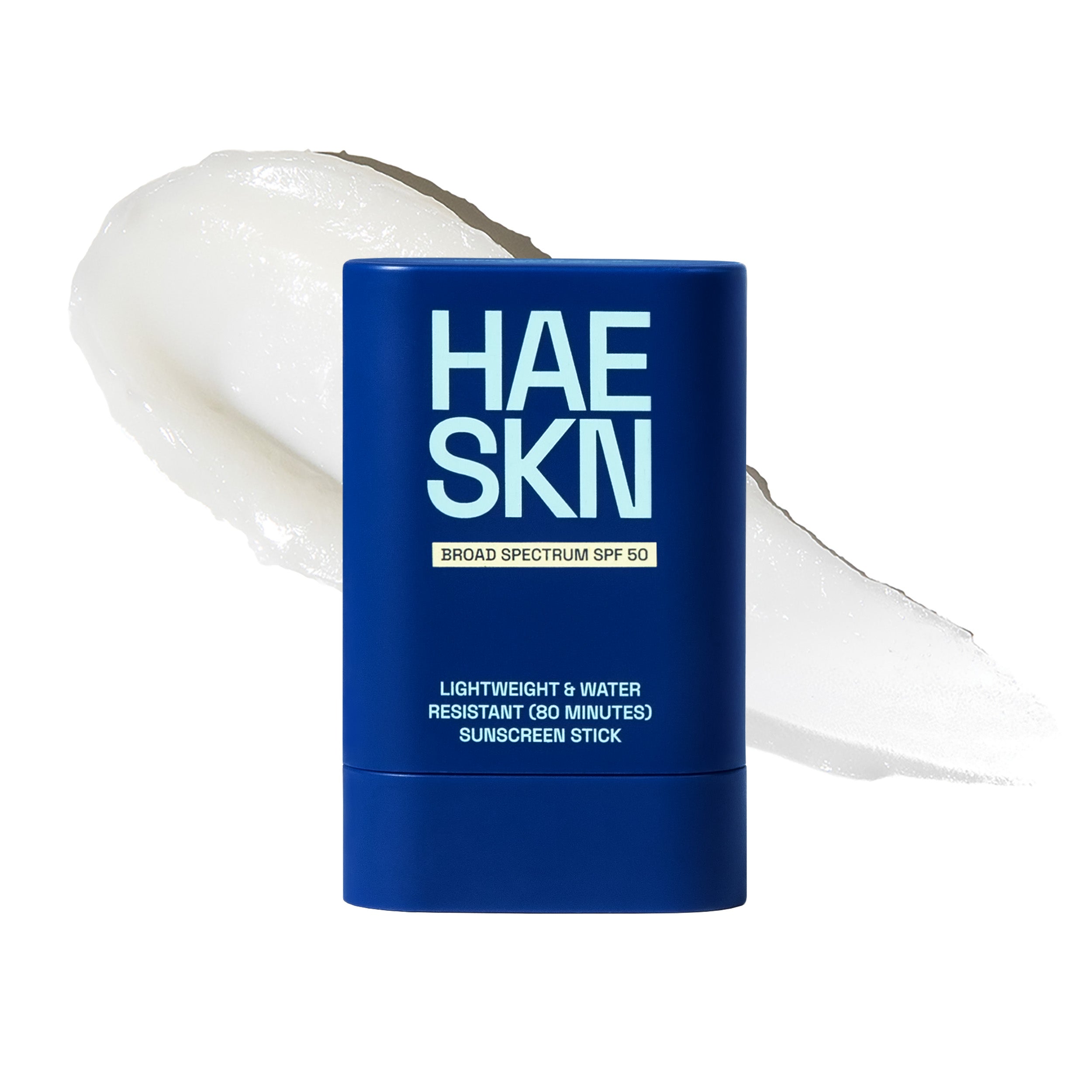
Here's what the stick offers instead:
- Broad Spectrum SPF 50 protection against UVA and UVB
- Water Resistant (80 minutes) for sweat and water
- A clear, no-white-cast finish that's meant to disappear on every skin tone, including brown and deep tones
- A pocket-size stick that's easy to reapply during a run, a match or a commute
We make no reef-safe claim. It doesn't contain oxybenzone or octinoxate, but "reef safe" isn't a regulated term. If you're swimming where non-mineral sunscreens are restricted, use a mineral product there. If you have sensitive skin, the AAD's mineral recommendation above applies. Want to know what "no white cast" really takes on deeper skin? Read our guide on which sunscreens really have no white cast on brown skin.
HAESKN Sunscreen Stick SPF 50
24.00 USD
Shop now
FAQ
Is chemical sunscreen safe to use every day?
Chemical filters sold in the US are permitted in OTC sunscreens while the FDA collects more safety data, and the AAD says chemical, physical and hybrid sunscreens can all protect you if they're broad spectrum, water resistant and SPF 30 or higher. Absorption into the blood has been measured, but the JAMA trial measured blood levels, not harm. If you'd prefer filters that already have GRASE status, choose zinc oxide or titanium dioxide.
Does the new filter, bemotrizinol, mean I should wait to buy sunscreen?
No. The FDA's June 2026 order added bemotrizinol to the list of permitted actives. A sunscreen that already meets the Broad Spectrum, SPF 30+ and water-resistance baseline protects you now.
How often should I reapply a daily sunscreen?
When you're outdoors, the AAD advises reapplying about every two hours, or after swimming or sweating. Water-resistant labels state how many minutes the protection lasts in water or sweat. Our breakdown of what "reapply every 2 hours" means covers the details.
The bottom line
Choose mineral or chemical for a reason that's specific to you: skin sensitivity, local water rules, finish or how you move through your day. Then let the label make the final call. Broad Spectrum, SPF 30 or higher and a stated water-resistance time are the lines that count. If you want a clear, chemical-filter SPF 50 you'll actually reapply when you're out moving, the HAESKN Sunscreen Stick SPF 50 is built for that.