Mineral vs. Chemical Sunscreen for Daily Use: A Framework
Mineral vs. Chemical Sunscreen: 3 Scenarios That Matter
For most people, the mineral-vs-chemical debate isn't really about ingredient safety — both filter classes are FDA-recognized for topical use. It's about which formula actually gets reapplied correctly under real conditions: a short commute, a 90-minute run, or daily wear on a deeper skin tone. That distinction is the one most comparison pages skip, and it's the one that actually determines protection.
Scenario 1: Short, low-intensity daily exposure
If your UV exposure is a walk to the car, a lunch break outside, or incidental light through a window, either filter type works. Mineral filters (zinc oxide, titanium dioxide) sit on the skin's surface and reflect/scatter UV, so they're active the moment they're applied. Chemical filters absorb UV and convert it to heat, but most need roughly 20 minutes on skin before they reach full effectiveness — a real gap for anyone who applies and walks straight out the door (NCBI Bookshelf, Standard Procedure). For low-stakes, low-duration exposure, that 20-minute lag rarely matters in practice.
Scenario 2: Sustained outdoor activity (60–90+ minutes)
This is where the filter conversation changes. Avobenzone is the only FDA-approved long-range UVA filter in the US, but it is also chemically unstable: it begins losing UV-absorbing capacity within roughly an hour of continuous UV exposure unless it's paired with a stabilizer (ScienceDirect). That's a meaningful detail for anyone on a 90-minute hike or long run, because it means the UVA protection you applied at minute zero may not be the UVA protection you have at minute 75 — regardless of SPF number, which is calibrated to UVB, not UVA durability.
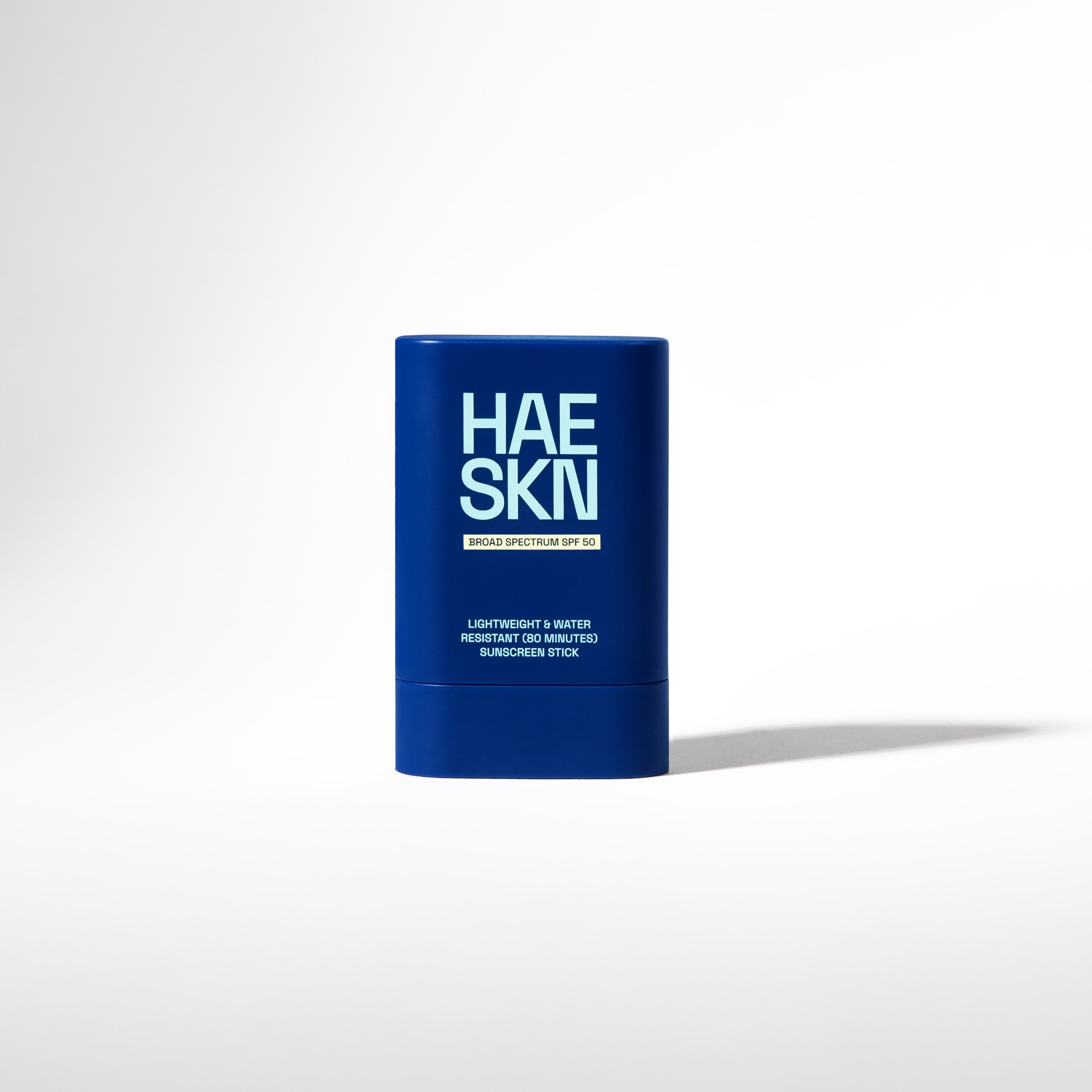
Two things offset this in practice. First, formulation: pairing avobenzone with octocrylene is one of the combinations the sunscreen chemistry literature identifies as improving avobenzone's photostability (ScienceDirect). HAESKN's SPF 50 Sun Stick uses four FDA-permitted chemical filters — avobenzone, homosalate, octisalate, and octocrylene — so its avobenzone is not sitting unstabilized in the formula. Second, behavior: reapplication resets the clock on degraded filter, which is why reapplication cadence matters more for any avobenzone-containing sunscreen — HAESKN included — than the SPF number on the label. Mineral filters don't carry this specific photodegradation profile, which is one real advantage they hold for long, continuous exposure. It is also the honest tradeoff of choosing a clear, cosmetically elegant chemical formula over a mineral one: you gain wearability, and you inherit avobenzone's stability ceiling as something to manage through stabilized formulation and disciplined reapplication.
Scenario 3: Daily wear on medium-to-deep skin tones
The assumption that white cast is a "dark skin" problem specifically doesn't hold up. A 2025 peer-reviewed study in PLOS One measured white cast objectively (via L* colorimetry) across a range of skin tones and found that 20% and 30% zinc oxide formulations produced statistically significant lightening changes across the full volunteer panel — not only in tan and brown skin-tone categories, though the effect was visually more pronounced there (PLOS One / PMC). The same study noted something practical: consumer compliance with sunscreen tracks directly with cosmetic elegance, not just SPF number — people skip products that look bad on their skin, at any skin tone.
That finding is also why the sunscreen industry is actively trying to engineer around it. In 2026, UCLA researchers described a redesigned zinc oxide particle — a microscopic four-armed "tetrapod" shape — that maintained UV protection while producing visibly less white cast than conventional zinc oxide in lab and skin testing. The study's senior author, UCLA's Paul S. Weiss, put the stakes plainly: "This isn't just about cosmetics" — better wearability is what determines whether people apply sunscreen consistently enough to get its protective benefit (UCLA Newsroom). That technology is not yet a shelf product. Until it is, clear chemical filters remain the more reliable way to get a genuinely invisible daily finish across every skin tone — which is the entire premise behind HAESKN's stick format: a transparent, chemical-filter formula built so the no-white-cast promise holds on light, medium, and deep skin tones alike, not just tones where mineral formulas happen to blend in more easily.
Format matters as much as filter chemistry
Filter type gets most of the attention, but application format decides whether either filter actually gets used correctly. Spray formats make it easy to under-apply or miss spots — ears, hairline, the backs of hands — compared to creams or sticks, and inhalation risk is a separate concern regulators have flagged for sprays generally (MD Anderson). Chemical formulas in general also carry a documented risk of eye stinging on contact, which is one reason people avoid reapplying around the eye area mid-activity even when they should (Cleveland Clinic). A solid, twist-up stick format sidesteps both failure points: it can be applied precisely to missed spots without drips, and it reapplies over makeup, sweat, or a race bib without the aerosol or run-off issues that undermine spray compliance. That's the practical, unglamorous reason HAESKN ships as a stick rather than a spray or lotion — the format is chosen to fix compliance failures, not just to feel premium.
A simple way to decide
| Your situation | Filter to prioritize | Why |
|---|---|---|
| Short daily exposure, indoor-outdoor day | Either — mineral if you want instant-on protection | Chemical's ~20-min activation window matters less at low exposure |
| Documented chemical-filter sensitivity or allergy | Mineral (zinc oxide / titanium dioxide) | Physical filters avoid the allergens some chemical filters carry |
| Long runs, hikes, or matches (60–90+ min) | A stabilized chemical formula (avobenzone + octocrylene) with a reapplication plan | Photostability is a formulation and behavior problem, not a filter-class-only one |
| Daily wear, any skin tone, cosmetic elegance a priority | Clear chemical formula, stick format | No engineered white-cast-free mineral product is commercially available yet |
What this means for HAESKN specifically
HAESKN's SPF 50 Sun Stick is a chemical, not mineral, formula — it contains zero zinc oxide or titanium dioxide, using avobenzone, homosalate, octisalate, and octocrylene instead (see Is HAESKN Sun Stick Mineral or Chemical Sunscreen? for the full ingredient breakdown). That choice trades away mineral's instant-on photostability for a clear, no-white-cast finish and a portable stick format built for reapplication mid-activity. The honest tradeoff is that its avobenzone, like any avobenzone-based sunscreen, needs both stabilizing formulation and consistent reapplication to hold up over long exposure — which is exactly why the label and usage guidance point back to reapplication as the real lever, not a one-and-done application.
FAQ
Can a single sunscreen combine mineral and chemical filters?
Yes — many "hybrid" sunscreens combine a lower percentage of zinc oxide or titanium dioxide with organic filters to balance photostability and cosmetic finish. This is a distinct formulation category from a pure-mineral or pure-chemical product and isn't the format HAESKN uses.
Does a lower zinc oxide percentage avoid white cast entirely?
Not entirely. The PLOS One data showed volunteers had difficulty distinguishing white cast between 5% and roughly 14.7% zinc oxide formulations, but visible whitening became statistically significant starting around 20% ZnO — so lower concentrations reduce, but don't eliminate, the effect (PLOS One / PMC).
How long should I wait after applying a chemical sunscreen before going outside?
General guidance is about 20 minutes to let chemical filters bind and activate on the skin before UV exposure begins (NCBI Bookshelf). Mineral filters don't require this wait.
Is HAESKN Sun Stick mineral or chemical sunscreen?
Chemical. It uses four FDA-permitted organic filters — avobenzone, homosalate, octisalate, and octocrylene — with no zinc oxide or titanium dioxide, which is why it applies clear with no white cast on any skin tone. Details are in HAESKN's own ingredient explainer.
If reapplication logistics — not just filter choice — are your actual daily obstacle, the HAESKN SPF 50 Sun Stick is built as a clear, twist-up format specifically to make that part easier.