
Mineral vs Chemical Sunscreen: What Zinc Oxide Really Does
For daily active use, mineral (zinc oxide) and chemical filters can both give broad-spectrum protection, so the right pick depends on your skin, the finish you need and whether you will actually reapply it. Zinc oxide has the stronger FDA safety status and suits sensitive or filter-allergic skin, yet its particles can leave a visible white cast, most noticeably on brown and deep skin. Chemical filters such as avobenzone and homosalate typically apply clear and sit in an FDA category that is waiting on more safety data.
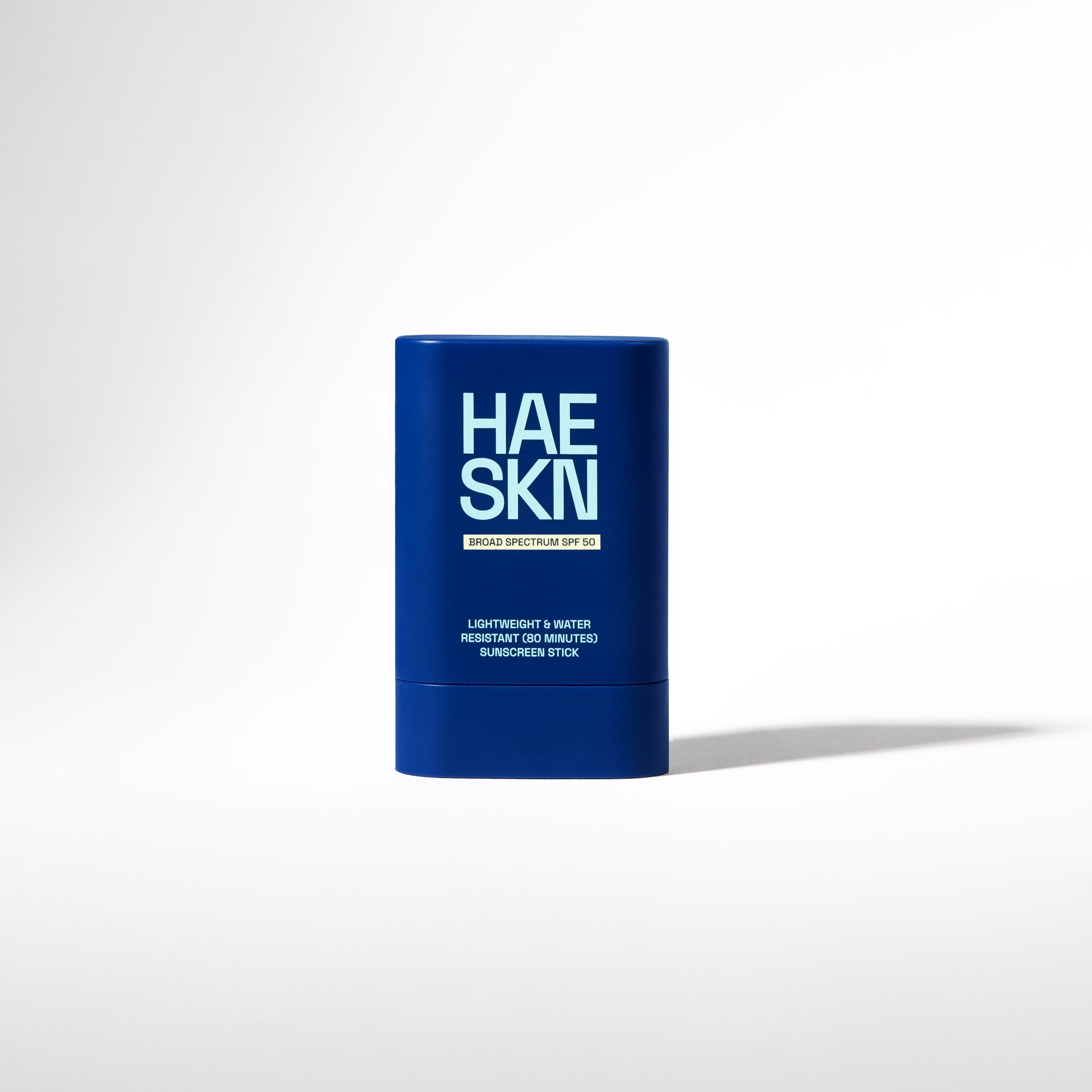
We make the HAESKN Sunscreen Stick SPF 50, and it uses chemical filters. That gives us a stake in this comparison, so we will show you where zinc oxide comes out ahead as plainly as where it struggles. Our earlier piece, Mineral or Chemical Sunscreen for Daily Use?, covers the basic definitions. This one goes a level deeper: what zinc oxide physically does on skin, why the white cast happens, and what the FDA has and has not concluded about each side.
What zinc oxide actually does on your skin
Many public descriptions treat zinc oxide as a tiny mirror that bounces UV away. The measurements say otherwise. In a study published in Photodermatology, Photoimmunology & Photomedicine, Curtis Cole and colleagues used an optical integrating sphere to measure how much UV zinc oxide and titanium dioxide reflect. Across the UV range, reflection averaged only 4-5%, which the authors put at less than SPF 2 (Cole, Shyr & Ou-Yang, 2016). The rest of the protection comes from absorption: the zinc particle is a semiconductor, and UV photons carry enough energy to be absorbed across its band gap.
So mineral and chemical filters do the same basic job. Both absorb UV before it reaches living skin.
The same study explains the white. At longer wavelengths, in the long-UVA and visible range, the metal oxides stop absorbing and become reflectors of up to 60% of the light (Cole, Shyr & Ou-Yang, 2016). Visible light bouncing off the film is what your eye reads as a white or gray layer. The cast and the UV protection come from different physics, which is why formulators work on particle size to cut the cast while keeping UV absorption.
Where zinc oxide falls short
The white cast scales with particle size and dose
Zinc oxide particles start small (5-20 nm as synthesized) but clump in a formula into 30-150 nm aggregates and larger agglomerates above 1 μm. A 2024 review in ACS Accounts of Materials Research notes that the largest agglomerates produce the most visible white cast, and that keeping particles under 100 nm can reduce it (ACS, 2024). The authors behind a white-cast scoring method add that higher zinc oxide and titanium dioxide concentrations can increase white cast (medRxiv preprint, 2025). The FDA allows zinc oxide at up to 25% of a formula (Federal Register, 2019), so a high-SPF mineral formula can carry a heavy particle load.
Deep skin tones see it most
Contrast matters. The peer-reviewed version of that white-cast paper, published in PLOS One, reports that mineral white cast often discourages people from following sunscreen directions, especially people with darker complexions (PLOS One via PMC, 2025). The same authors point out there is no official method to quantify white cast. In practice, "sheer" or "clear zinc" on a label is a marketing description with no standard test behind it, so the only reliable check is your own skin in daylight.
Reapplication rules do not change for zinc
You may have read that zinc oxide needs less frequent reapplication. Dermatology guidance makes no such distinction. The American Academy of Dermatology tells everyone to reapply about every two hours outdoors, or after swimming or sweating (AAD Sunscreen FAQs). For anyone training outside, the format you will reach for mid-session matters as much as the filter. We break down the timing in How Often to Reapply Sunscreen When You're Sweating.
Where chemical filters stand with the FDA
In its 2019 proposed rule, the FDA reviewed 16 marketed sunscreen actives. It proposed zinc oxide and titanium dioxide as generally recognized as safe and effective (GRASE), proposed PABA and trolamine salicylate as not GRASE, and said 12 ingredients lacked enough data for a determination (FDA, 2019). That group of 12 includes avobenzone, homosalate, octisalate and octocrylene (FDA fact sheet).
Those four are exactly the actives in our stick. Sunscreens with these filters are sold in the US today, and the "insufficient data" category is the FDA asking industry for more safety data (FDA, 2019). It is a gap in the record, and you deserve to know it before you choose.
FDA scientists have since published absorption data. A 2020 randomized trial published in JAMA applied sunscreens at 2 mg/cm² under maximal-use conditions and found that avobenzone, oxybenzone, octocrylene, homosalate, octisalate and octinoxate all exceeded 0.5 ng/mL in blood after a single application (JAMA, 2020). That 0.5 ng/mL figure is the FDA's screening threshold: crossing it calls for further safety testing. The FDA said people should keep using sunscreen (Healio, 2020).
HAESKN contains no oxybenzone and no octinoxate. Our stick still contains four filters the FDA is waiting on data for, and we would rather you weigh that with full information.
Mineral vs. chemical: side by side
| Zinc oxide (mineral) | Chemical filters (e.g. avobenzone, homosalate, octisalate, octocrylene) | HAESKN Sunscreen Stick SPF 50 | |
|---|---|---|---|
| How it protects | Mostly absorbs UV; reflects only 4-5% of UV (Cole, 2016) | Absorbs UV | Chemical filters: avobenzone, homosalate, octisalate, octocrylene |
| FDA 2019 status | Proposed GRASE (FDA) | Insufficient data; more studies requested | Same as chemical filters |
| Finish on brown and deep skin | Can leave visible white cast, worse with large agglomerates and high doses (ACS) | Usually clear | Clear, no-white-cast finish |
| Body absorption data | FDA cites minimal absorption (Federal Register) | Detected above 0.5 ng/mL in blood under maximal use (JAMA) | Contains filters studied in that trial |
| Label protection | Varies by product | Varies by product | Broad Spectrum SPF 50, Water Resistant (80 minutes) |
| Strongest fit | Sensitive or filter-allergic skin; mineral-only waters | Daily wear where a clear finish matters | Workouts and outdoor routines with on-the-go reapplication |
Which one fits your day?
The AAD's baseline applies to both types: broad-spectrum, SPF 30 or higher, and water resistant (AAD Sunscreen FAQs). The academy also offers a useful tiebreaker: "The best type of sunscreen is the one you will use again and again." Beyond that baseline, match the filter to the situation.
- You have sensitive skin or have reacted to chemical filters before. Choose mineral. The PLOS One authors describe zinc oxide and titanium dioxide sunscreens as suitable for people with sensitive skin or allergies to chemical filters (PLOS One via PMC). Mineral sticks such as Blue Lizard Sensitive Mineral Sunscreen Stick SPF 50 and Neutrogena Ultra Sheer SPF 50 Zinc Mineral Sunscreen Stick are two examples in this format.
- You want the lowest absorption of active ingredients into your body. Choose mineral, based on the FDA's proposed finding of minimal zinc oxide absorption.
- You swim where local rules require mineral sunscreen. Use mineral. HAESKN makes no reef-safe claim.
- You have brown or deep skin and skipped sunscreen because of the cast. Test a clear chemical formula. Consistent use beats an ideal ingredient list you leave at home. Our no-white-cast guide for brown skin covers how to check finish in daylight.
- You sweat through long sessions and reapply on the move. Look for an 80-minute water resistance claim. Per the AAD, that means reapplying after 80 minutes of swimming or sweating, and at least every two hours even if you stay dry (AAD label guide).
Where HAESKN fits in the lineup
Our Sunscreen Stick SPF 50 is built for that last group: runners, hikers, surfers and racket-sport players who want protection that disappears on every skin tone and slides back on mid-session. The label carries Broad Spectrum SPF 50 and Water Resistant (80 minutes), and the stick is $24 on our product page, where we note it glides on even over makeup. The texture follows K-beauty finish philosophy: lightweight and clean.
The stick is the wrong pick if you need a mineral-only product, and we will say so. For timing reapplication, SOLCHECK is a UV-reactive sticker that turns blue as UV intensity rises, a visual cue to check your coverage.
HAESKN Sunscreen Stick SPF 50
24.00 USD
Shop now

HAESKN SOLCHECK
15.00 USD
Shop now
FAQ
Does nano zinc oxide get into your body?
Current evidence says very little does. EWG, an advocacy group that rates sunscreens, states that few if any zinc or titanium particles appear to penetrate skin to living tissue (EWG). The FDA's 2019 proposal treated zinc oxide as GRASE regardless of particle size, up to 25% (Federal Register, 2019).
Is titanium dioxide the same as zinc oxide?
Both are mineral filters, both work mainly by absorption, and both were proposed as GRASE. The FDA did ask for comment on whether titanium dioxide's potential photocatalytic effects affect sunscreen performance (Bergeson & Campbell summary of the proposed rule).
How can I tell whether a "clear zinc" product is really mineral-only?
Read the Active Ingredients section of the Drug Facts panel on the box. A mineral-only product lists just zinc oxide, titanium dioxide or both. Anything else listed there, such as avobenzone or octocrylene, makes it a chemical or hybrid formula.
Can a sunscreen be waterproof or sweatproof?
No. The FDA no longer allows "waterproof" claims because sweat and water wash sunscreen off. US labels show water resistance as either 40 or 80 minutes (AAD label guide).
Pick the one you'll reapply
If a mineral formula fits your skin and your finish standards, use it. If white cast or texture has kept you from wearing sunscreen outdoors, try the clear option. See the HAESKN Sunscreen Stick SPF 50 for a pocket-sized, no-white-cast SPF 50 built for reapplying on the move.