
Reapply Sunscreen Every 2 Hours? What FDA and AAD Mean
Reapply sunscreen at least every two hours while you are outdoors, and sooner after swimming, sweating or towel drying. The FDA and the American Academy of Dermatology agree on that rule, and a water-resistant label narrows the window to 40 or 80 minutes of swimming or sweating. A 2001 modeling study in the Journal of the American Academy of Dermatology adds a step the two-hour rule leaves out: a second coat 15 to 30 minutes after you head out.
Two hours. The FDA and the AAD land on the same number, and most people miss it. The American Academy of Dermatology (AAD) found that only about a third of Americans reapply every two hours while outside, and 65% say they often forget to reapply at all, according to its common sunscreen mistakes guide.
We make a portable SPF 50 stick for people who train and play outside, so reapplication is the problem our product is built around. Below is what the FDA and AAD actually say, where the two-hour number comes from, and how to turn it into a real day outdoors.
What the FDA puts on your label
The FDA treats two hours as the longest gap you should allow. Its consumer guidance is to reapply at least every two hours and more often if you are swimming or sweating, and manufacturers may not claim protection for more than two hours without reapplying (FDA, Tips to Stay Safe in the Sun).
The exact wording on a US label is set by federal regulation. A product that passes the water-resistance test must tell you to reapply after 40 or 80 minutes of swimming or sweating, immediately after towel drying, and at least every 2 hours. A product that fails the test must say to reapply at least every 2 hours and to use a water-resistant sunscreen if swimming or sweating (21 CFR 201.327).
Two details matter here:
- "At least" sets a ceiling on the gap. Two hours is the latest point to reapply.
- The 40 or 80 minutes counts time spent swimming or sweating. The FDA says these claims tell you how long to expect the labeled SPF while swimming or sweating (FDA). The agency also bans "waterproof" claims because all sunscreens eventually wash off (FDA Q&A).
What the AAD adds
The AAD gives the same interval with two practical conditions. Its Sunscreen FAQs say to apply sunscreen to dry skin 15 minutes before going outdoors, then reapply approximately every two hours when outdoors, or after swimming or sweating, according to the directions on the bottle. The same page says the two-hour rule holds on cloudy days and applies to moisturizers and cosmetics with SPF too.
Dr. Angela Casey, a double board-certified dermatologist, explains the reason in a guide published by skincare brand Bright Girl. Sunscreen active ingredients break down over time and with sun exposure, and swimming and sweating can make that worse. She recommends reapplying every 2 hours, and also reapplying before you head outdoors for any activity.
The rules side by side
| Source | Maximum gap | Water and sweat trigger | Extra condition |
|---|---|---|---|
| FDA consumer guidance | At least every 2 hours | More often if swimming or sweating | No label may claim more than 2 hours without reapplying |
| FDA label regulation | At least every 2 hours | After 40 or 80 minutes of swimming or sweating, per the test result | Reapply immediately after towel drying |
| AAD | Approximately every 2 hours outdoors | After swimming or sweating, per bottle directions | Apply 15 minutes before going out; cloudy days count |
| Diffey, JAAD 2001 (model) | Not a fixed interval | Further reapplication after swimming, toweling, heavy sweating or rubbing | Second coat 15 to 30 minutes after sun exposure begins |
Where the two-hour number comes from, and what it misses
The two-hour rule is a common public health recommendation, and one researcher modeled whether it is the best timing. Brian Diffey of the Regional Medical Physics Department at Newcastle General Hospital noted in the Journal of the American Academy of Dermatology (2001) that many public health agencies recommended reapplying every 2 to 3 hours. He built a mathematical model using typical real-world application amounts and how well sunscreen stays on skin, then simulated several hours of strong midday sun.
His results changed the timing question:
- For sunscreens that bind moderately or well to skin, the kind he described as typical of water-resistant products, skin exposure was lowest with early reapplication, not at 2 to 3 hours.
- Reapplying at 20 minutes typically produced 60% to 85% of the UV exposure that reapplying at 2 hours would allow. That works out to 15% to 40% less UV.
- A sunscreen that comes off the skin easily gave little protection no matter when it was reapplied.
His conclusion was to apply liberally 15 to 30 minutes before going out, reapply 15 to 30 minutes after sun exposure begins, and reapply again after vigorous activity such as swimming, toweling, or heavy sweating and rubbing. A later BMJ letter by Taylor and Diffey gave the same advice in simpler terms: reapply one finger's worth within half an hour of the first application (BMJ via PMC).
The model explains why an early second coat matters. It started from the amounts people really apply, and the AAD says most people apply only 25-50% of the recommended amount (AAD). A second coat soon after the first helps make up for that thin first layer.
Keep the limits in view. This is a model of exposure in strong sun, not a trial measuring sunburn in active people. It adds an early coat to the official schedule. It does not replace the two-hour maximum or your label's water-resistance minutes.
How to turn the rules into an active day
Put together, the FDA directions, the AAD guidance and Diffey's model give a simple plan. This plan is our reading of those sources:
- Before you go: apply to dry skin about 15 minutes before heading out (AAD). The FDA puts a full-body dose at about one ounce, roughly a shot glass (FDA). Dr. Casey uses 1/2 teaspoon, or two finger-length strips, for face and neck.
- Early top-up: add a second coat 15 to 30 minutes after sun exposure begins (Diffey).
- Then follow whichever clock runs out first: two hours since your last coat, or your label's 40 or 80 minutes once you are sweating or swimming.
- Reset after any towel-off: the label says to reapply immediately after towel drying, whatever the clock says.
A worked example. You apply an 80-minute water-resistant sunscreen at home at 8:45 and start a trail run outside at 9:00, sweating steadily. Your early top-up comes at 9:20. Counting from 9:20, the two-hour clock runs to 11:20 and the 80-minute sweat clock runs to 10:40, so your next coat is due by 10:40. You finish at 11:00 and towel off, so you reapply again at 11:00. If you then sit outside at a dry café, the two-hour clock applies and your next coat is due by 1:00.
Why SPF 50 does not stretch the interval
A higher SPF number does not buy you more time. The FDA rule against claiming more than two hours without reapplying applies to every SPF (FDA). What a higher SPF does is cover for under-application. Dr. Casey tells patients to "aim high," and in her guide she writes that people using SPF 40 or above usually apply enough to reach at least SPF 25. That margin is about dose, and the timing rules stay the same.
Where our stick fits
The HAESKN Sunscreen Stick SPF 50 is labeled Broad Spectrum SPF 50 and Water Resistant (80 minutes). In the plan above, that means an 80-minute clock while you sweat or swim and a two-hour clock on dry skin, plus a fresh coat after every towel-off. It uses four FDA-approved chemical filters (avobenzone, homosalate, octisalate and octocrylene) with no zinc oxide or titanium dioxide, so it goes on clear with no white cast across every skin tone, including deep tones. It costs $24 and fits in a pocket, which makes the early top-up and mid-session coats easy to fit into a run or a changeover.
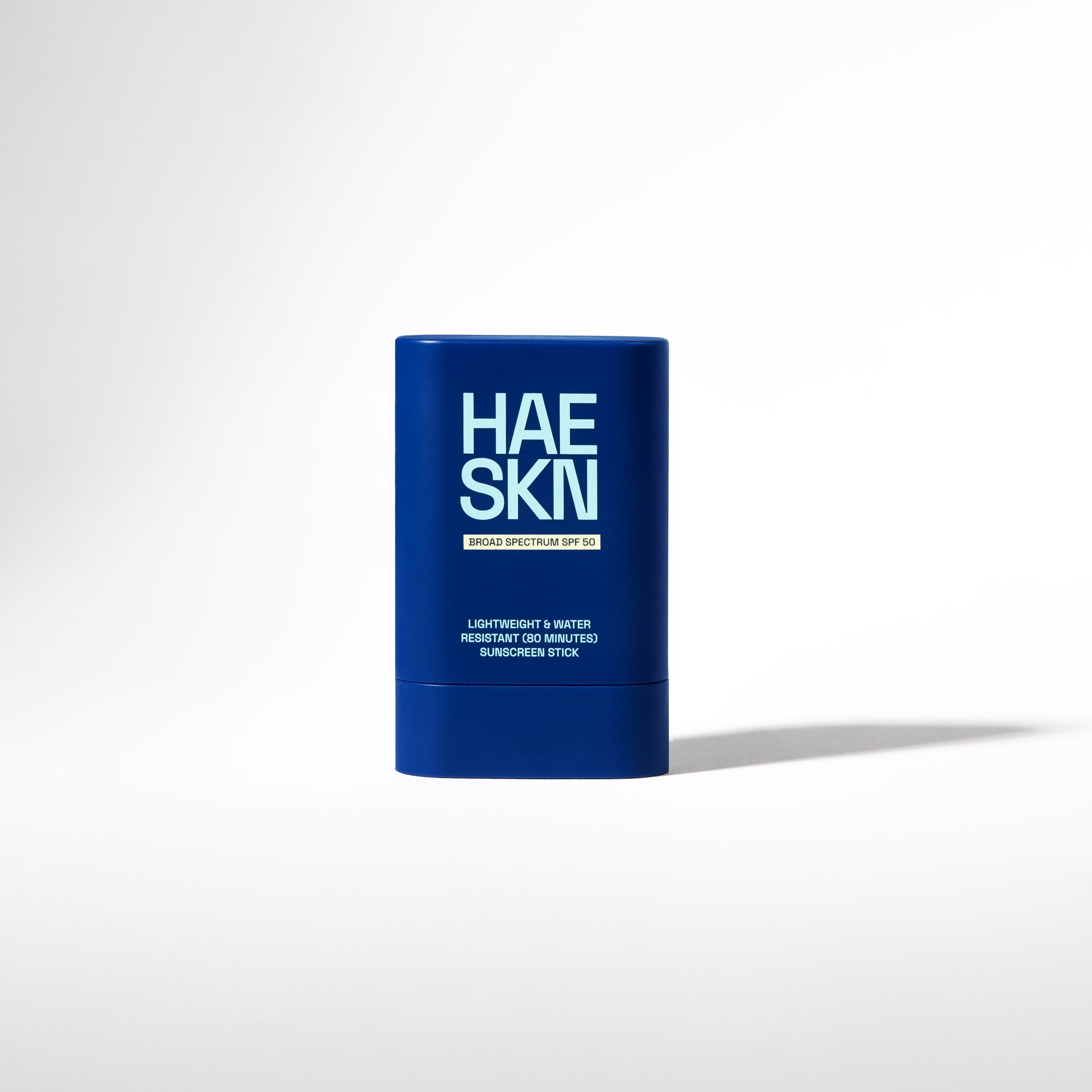
One tradeoff: a stick does not show you the dose the way a palmful of lotion does, so use enough overlapping passes to leave a visible layer and then blend. We cover stick technique and sport-by-sport timing in how often to reapply sunscreen when you're sweating.
HAESKN Sunscreen Stick SPF 50
24.00 USD
Shop now
FAQ
Does the 80-minute window start when I apply sunscreen?
It counts time spent swimming or sweating. The FDA describes the 40- and 80-minute claims as how long you can expect the labeled SPF while swimming or sweating (FDA). The two-hour maximum and the towel-drying rule still apply on top of it.
Does SPF in my moisturizer or foundation count as a reapplication?
Only if you apply enough, and most people do not. The AAD reminds people that SPF moisturizers and cosmetics still need reapplying about every two hours outdoors (AAD). Dr. Casey says most people apply too little of these products to get the SPF on the label, and she suggests layering a dedicated sunscreen with them (Bright Girl).
Should I still reapply on a cloudy day?
Yes. The AAD's guidance is to reapply approximately every two hours outdoors, even on cloudy days (AAD).
For the dry-day version of this schedule, see how often should you reapply sunscreen during the day. If you want a stick you can keep in your pocket for the early top-up, start with the HAESKN Sunscreen Stick SPF 50.