
Sunscreen Running Into Your Eyes? How Runners Stop It
Mile four, and your eyes start burning. It isn't bad luck. Sunscreen is moving.
The AAD notes that sticks are convenient under the eyes and recommends broad-spectrum, water-resistant sunscreen with SPF 30 or higher. Keep the product away from the eyes and lash line, and reapply according to its label. Each piece deals with one of the ways sunscreen reaches your eyes: product sliding down with sweat, and product placed too close to them. One honest caveat comes before anything else: if sunscreen makes your skin sting, the American Academy of Dermatology advises a formula with only zinc oxide and titanium dioxide. Our stick isn't one, and we'll explain why below.
We make no claim that our sunscreen stays put through every run or is sweatproof. What you can control is the label you buy, the format you choose and how you apply it.
Why sunscreen gets into your eyes on a run
The sting often starts mid-run, not at the door. As sweat builds on your forehead and brow, it runs down your face and can take sunscreen with it.
So there are two separate things going on:
- Migration. How much product travels from your forehead into your eyes. Format, water resistance, placement and sweat control are the levers you have here.
- Reaction. How your skin and eyes respond once product gets there. For skin that stings or burns with sunscreen, the AAD points to mineral-only formulas and avoiding fragrance.
If sunscreen makes your skin sting or burn, the AAD recommends a formula with only zinc oxide and titanium dioxide and avoiding fragrance.
What to look for in a running sunscreen
| Criterion | Why it matters for eye sting | How to check |
|---|---|---|
| A water-resistance time on the label | US sunscreen labels state water resistance as a tested time, for example "Water Resistant (80 minutes)." Water-resistance labels specify 40 or 80 minutes; check the product label and reapply as directed. | Front label. Look for the minutes, not the word "sport." |
| Solid stick format | A stick sunscreen can be useful for targeted application, making precise placement near the eyes easier. | Format on the pack. |
| Broad Spectrum, SPF 30 or higher | The basic protection floor. The AAD notes that if you use a tinted sunscreen, it should also offer SPF 30 or higher, broad-spectrum protection, and water resistance. | "Broad Spectrum SPF" on the front. |
| Filter type, if your skin stings | For skin that "stings or burns" with sunscreen, the AAD says to use only zinc oxide and titanium dioxide and to avoid fragrance. | Active ingredients in the Drug Facts box. |
The last row is a fork in the road, not a ranking point. If chemical filters have never bothered your skin, migration control is the main job. If sunscreen makes your skin sting or burn, the AAD recommends a mineral-only formula.
Where HAESKN fits, and where it doesn't
We built the HAESKN Sunscreen Stick SPF 50 for running and sports. Here is how it lines up against the table above:
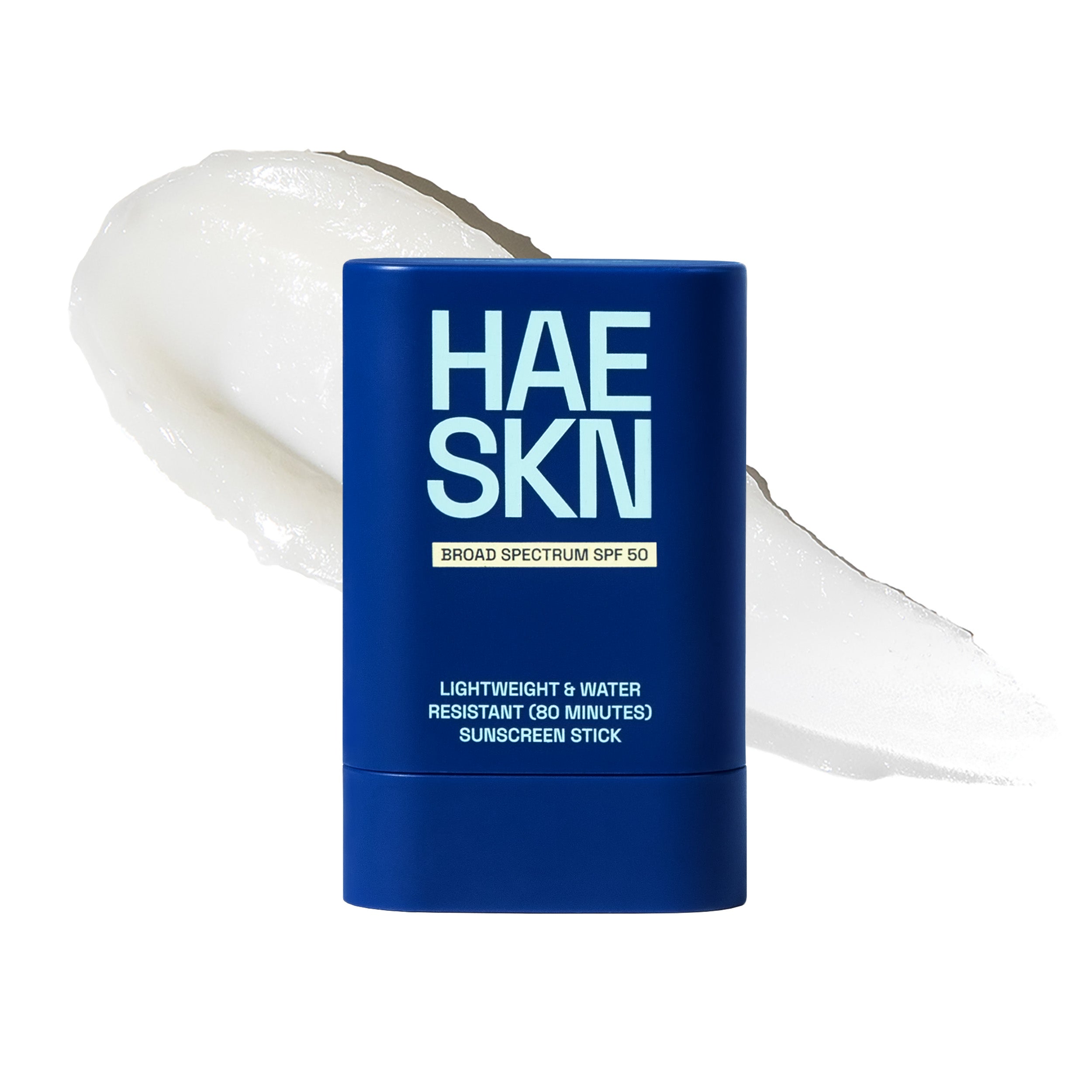
- Water Resistant (80 minutes) on the label, and Broad Spectrum SPF 50. The product page lists 80-minute sweat and water resistance.
- Stick format. A pocket-size SPF 50 sunscreen stick.
- Clear finish. The product page describes a lightweight, no-white-cast finish.
- $24 for a single stick on our site.
Here's the part that decides whether it's right for you. HAESKN is a chemical (organic-filter) sunscreen. The actives are avobenzone, homosalate, octisalate and octocrylene, with no zinc oxide or titanium dioxide. As with other chemical sunscreens, keep it out of your eyes; if it gets in, rinse with water. We don't claim it can't sting eyes.
So:
- Chemical filters have never bothered you, and the problem is product running off your forehead? A stick can be useful for targeted application, and HAESKN's product page lists 80-minute sweat and water resistance.
- Your skin stings with sunscreen? If sunscreen makes your skin sting or burn, the AAD recommends a mineral-only formula and avoiding fragrance.
How to apply it so it stays out of your eyes
- Apply before you start sweating. Put it on dry skin at least 15 minutes before sun exposure, before the warm-up begins.
- Stop at the brow bone. Don't run the stick along your eyelids or right up to your lash line. A stick makes this kind of precise placement easy.
- Cover the eye area with gear, not more sunscreen. A hat and UV-blocking sunglasses can help protect the skin around your eyes from the sun.
- Dab sweat, don't drag it. Dab sweat gently rather than dragging a sleeve across your forehead. If you do wipe, treat that as a cue to reapply.
- Reapply on the label's clock. Follow the label: reapply after 80 minutes of swimming or sweating, immediately after towel drying, and at least every two hours.
- Reapply with dry hands and on a dry face. Pat your forehead dry first. The AAD recommends four back-and-forth passes over each area with a stick, then rubbing the sunscreen into an even layer; keep it away from the eyes.
If it gets in your eyes mid-run
Stop and rinse with cool, clean water, which can help wash away irritation. If the discomfort doesn't settle, or your vision changes, stop running and get medical advice. Next time, look at the placement and sweat-control steps above before you blame the SPF.
FAQ
Should runners just use mineral sunscreen?
The AAD recommends a mineral-only formula when sunscreen makes your skin sting or burn. If your issue instead is sweat carrying product down your face, focus on water resistance, format and placement, whichever filter type you choose.
The short version
Pick broad-spectrum, Water Resistant (80 minutes) and a stick you can place precisely. Keep it off your eyelids, let a cap and sunglasses guard your eyes, and reapply on the label's clock. If chemical filters suit your skin and you want a clear finish that fits in a pocket, start with the HAESKN Sunscreen Stick SPF 50.