
What to Look for in a Sunscreen for Outdoor Sports
The Sunscreen Checklist Most Athletes Never Finish
Broad-spectrum coverage, SPF 30 or higher, water resistance, a formula that won't sting your eyes, and a reapplication schedule — that's the standard checklist for sports sunscreen, and it's correct as far as it goes. But it doesn't explain why 96% of collegiate athletes agree sunscreen helps prevent skin cancer, and over 50% never use it anyway. Knowing the right five criteria isn't the problem. The sixth criterion — format and finish — is what decides whether the other five ever make it onto your skin during a workout.
The Five Criteria Everyone Already Knows
Every dermatology-backed sunscreen guide converges on the same five specs, and for good reason:
| Criterion | What it means | Why it matters outdoors |
|---|---|---|
| Broad-spectrum | Filters both UVA and UVB | UVA drives photoaging and passes through cloud cover and glass |
| SPF 30+ | Minimum UVB-blocking threshold | Cumulative exposure adds up fast during multi-hour training |
| Water/sweat resistance | Rated for 40 or 80 minutes per FDA testing | Sweat and water are the main reasons film breaks down mid-activity |
| No eye sting | Formula doesn't run into eyes | Sweat carries sunscreen toward the eyes during exertion |
| Reapplication schedule | Every 2 hours, or sooner after heavy sweating | A single morning application doesn't cover a long session |
None of these five is wrong. The problem is that an athlete can know all five, intend to follow all five, and still not use the product — which is exactly what the research on athlete behavior shows.
The Compliance Gap the Five Criteria Can't Explain
The gap between knowledge and behavior is well documented and consistent across sports. In the original NCAA athlete survey of 290 Duke and Stanford competitors, 96% agreed sunscreen helps prevent skin cancer, yet more than half never used it and 75% used it three or fewer days a week — despite training outdoors an average of four hours a day, ten months a year. That's not a knowledge gap. It's a use gap.
The same pattern shows up sport by sport. A review of photoprotection adherence across outdoor sports found that 66.5% of trail runners reported sunburn and 49.7% never reapplied sunscreen at all; among NCAA golf and tennis players, only 4.8% reapplied during play; and 35% of cyclists training more than seven hours a week reported no sunscreen use whatsoever. A separate survey of NCAA Division I golf and tennis teams asked athletes why they skipped reapplication, and the top answer — cited by 70.2% of respondents — was that sunscreen made their hands slippery. Forgetfulness came second, at 63.4%.
Read those barriers again: slippery hands, sticky feel, product running into the eyes. None of them are about SPF number, broad-spectrum rating, or water-resistance minutes. They're about what the product physically does to your hands and face while you're moving. Barrier research summarized at AAD 2026 groups these under one heading: perceived impact on performance. That's format and finish — and it's the variable the standard five-point checklist doesn't measure at all.
Criterion Six: Format and Finish Decide Whether the Other Five Get Used
Slippery hands and the case for a stick
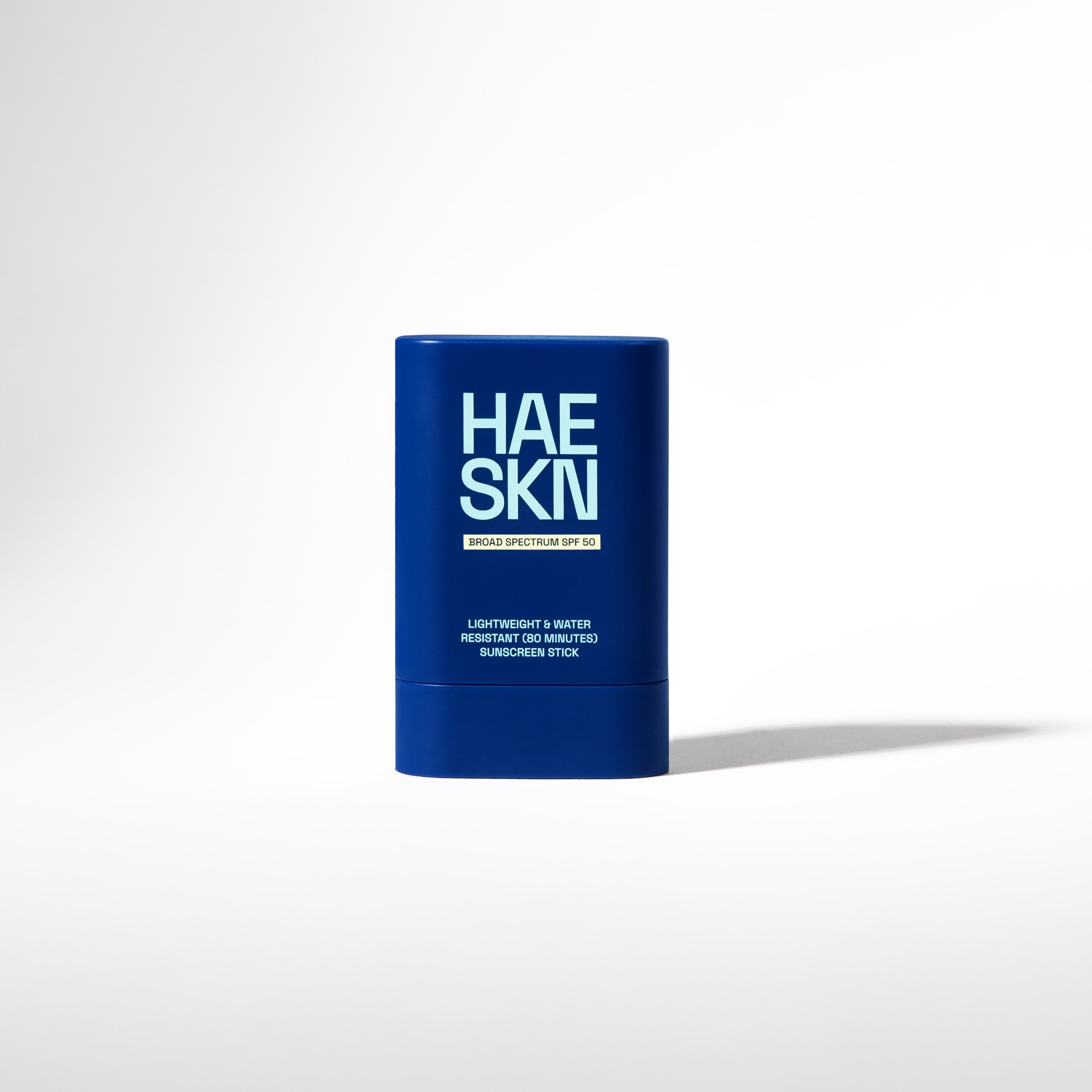
If 70.2% of athletes name slippery hands as the reason they skip reapplication, the fix isn't a better lecture about UVB — it's a format that doesn't require rubbing lotion into wet, sweaty hands mid-session. A twist-up stick applies directly to skin without transferring product to your palms, which is the mechanical reason stick formats show up repeatedly in sports-sunscreen recommendations from brands built around outdoor use, including Supergoop!, EltaMD, Banana Boat Sport, and HAESKN's own SPF 50 Sun Stick. The format doesn't change the SPF number. It changes whether a runner or tennis player actually reapplies at minute 90 instead of minute 0.
Disclosure: HAESKN publishes this guide and sells the HAESKN Sunscreen Stick SPF 50 ($24). This section is based on public barrier research and HAESKN's own product design; it doesn't claim independent clinical testing of reapplication rates.
White cast and who gets left out
Format solves the hands problem. Finish solves a different one. Peer-reviewed research on mineral sunscreen white cast documents that visible residue from zinc oxide and titanium dioxide "often deters consumers from complying with sunscreen application directions, especially those with darker complexions." HAESKN's own review of consumer sun-care data cites a related figure: 85% of people report worrying about white cast when applying sunscreen. For an athlete deciding whether to reapply mid-match, in front of teammates or opponents, a visible white film is a real reason to skip the second coat — not a vanity complaint.
This is where finish becomes a sixth criterion in its own right, separate from format. A clear, chemical-filter formula that doesn't leave residue on any skin tone removes one more reason to skip reapplication. HAESKN's SPF 50 Sun Stick uses FDA-approved organic (chemical) filters — avobenzone, homosalate, octisalate, and octocrylene — rather than mineral filters, which is the underlying reason it goes on clear rather than white. That's a formulation fact, not a claim about who should or shouldn't wear it: the promise is a clear finish across every skin tone, with deep tones as the strongest proof point given how visibly mineral white cast shows on darker complexions.
How Much SPF Number Actually Matters
It's worth being precise here, because SPF marketing often overstates the gap between numbers. According to MD Anderson Cancer Center, SPF 30 blocks about 97% of UVB rays and SPF 50 blocks about 98% — a one-percentage-point difference in a lab setting where sunscreen is applied evenly at a precise, generous thickness most people never match in real life. The bigger real-world driver isn't the SPF number on the bottle; it's under-application and skipped reapplication, which is exactly what the compliance research above measures. That's also the practical case for SPF 50 as a starting point for outdoor athletes: it builds in a small margin for the thinner, less frequent application that actually happens during a four-hour training day, rather than adding meaningful lab-tested protection over SPF 30. Our related guide on why sunscreen pills during exercise covers a related application failure mode — product breaking down into visible flakes under sweat and friction — that has the same root cause: real-world application conditions, not the SPF number, determine whether protection holds up.
Building a Six-Criterion Checklist for Outdoor Sports
Put together, the checklist an outdoor athlete actually needs looks like this:
- Broad-spectrum filtering, confirmed on the Drug Facts label.
- SPF 30–50, with 50 giving a small margin against the under-application that's typical during long sessions.
- Water/sweat resistance rating (40 or 80 minutes) appropriate to session length.
- A formula that won't run into your eyes while sweating — relevant for runners, cyclists, and racket-sport players alike.
- A reapplication plan built around session length, not a generic "every 2 hours" reminder that ignores sweat rate.
- Format and finish that survive contact with your actual hands and skin tone — because if the product is slippery to reapply or leaves a visible cast, criteria 1 through 5 stop mattering the moment you decide to skip the second coat.
Criterion six is the one that predicts behavior. It's also the one most "best sunscreen for sports" roundups skip entirely, because it's harder to summarize in a spec sheet — it shows up only when you ask why athletes who know the risk still don't reapply. For a marathon-specific breakdown of pacing reapplication around aid stations and pace bands, see our Marathon Sun Protection stick guide. For how sweat mechanically strips sunscreen film regardless of format, see Does Sweat Wash Off Sunscreen? The Sweatproof Truth.
FAQ
Is SPF 50 actually better than SPF 30 for outdoor sports?
Marginally, in lab terms — SPF 50 blocks about 98% of UVB versus 97% for SPF 30. The bigger real-world advantage is the buffer it gives against under-application, which is common during long training sessions.
Why do so many athletes skip sunscreen even when they know the risks?
Barrier research points to physical, not informational, reasons: 70.2% of surveyed athletes cited slippery hands as their top reason for skipping reapplication, with forgetfulness and product feel close behind.
Does a sunscreen stick perform differently than a lotion for sports?
The active filters and SPF rating can be identical; what changes is application mechanics. A stick applies without coating your hands, which barrier research links directly to higher reapplication rates among athletes who cite slippery hands as their obstacle.
Is white cast really a performance issue, not just a cosmetic one?
Peer-reviewed research on mineral sunscreen formulations documents that visible white cast reduces compliance with sunscreen application, particularly for people with darker skin tones — which makes finish a factor in whether protection is actually applied and reapplied.
How often should outdoor athletes reapply sunscreen?
Every two hours is the standard baseline, but heavy sweating or swimming shortens that window. Reapplication frequency should be matched to your water-resistance rating (40 or 80 minutes) and sweat rate, not a fixed clock.
Where can I see HAESKN's SPF 50 Sun Stick?
Details on the formulation, filters, and $24 pricing are on the HAESKN Sunscreen Stick SPF 50 product page.