
What to Look for in Sport Sunscreen: The Spots You Miss
For outdoor sports, look for a broad-spectrum sunscreen with SPF 30 or higher, a tested water-resistance window of 40 or 80 minutes, and a format you will actually carry and reapply to the five zones people routinely miss: hairline, ears, backs of hands and neck, lips, and eyelids. A clear, lightweight stick handles the hairline, ears and hands well during a session. Lips need an SPF 30+ lip balm and eyelids need UV-blocking sunglasses, because a face sunscreen covers neither reliably.
HAESKN publishes this guide and sells the HAESKN Sunscreen Stick SPF 50. We covered the label basics in What to Look for in a Sunscreen for Outdoor Sports. This guide starts where application breaks down: the patches of skin that stay bare even after you "put sunscreen on."
What the UV-camera studies show
University of Liverpool researchers photographed 57 adults with a UV-sensitive camera before and after their usual sunscreen application. Their 2017 paper in PLOS ONE found the eyelid region was disproportionately missed: a median of 14% left uncovered, against 7% for the rest of the face. A short health-information statement improved eyelid coverage on a second visit, yet the inner corner of the eye near the nose was still frequently missed.
The same team ran a 2019 follow-up with 84 participants. Eyelid regions were missed 14.0% of the time with sunscreen and 20.9% with an SPF moisturizer, and a questionnaire showed participants were unaware of the gaps, according to the ScienceDaily summary of the PLOS ONE study.
Those gaps sit on high-risk skin. The 2017 PLOS ONE paper notes that 70-90% of basal cell carcinomas develop on sun-exposed head and neck regions, and 5-10% of all skin cancers occur on the eyelids. The American Academy of Dermatology estimates that about 1 in 5 Americans will develop skin cancer during their lifetime.
Limitations. Both studies imaged faces only, in UK volunteers, after one calm application. Neither measured athletes, sweat, or mid-session reapplication. Our expectation that a rushed reapplication at a water stop misses at least as much skin is an inference from these results.
Label specs come first
A product has to clear the basic label checks before coverage even matters.
| Label item | What the standard says | What to check on the pack |
|---|---|---|
| Broad Spectrum | Passing FDA's broad spectrum test shows UVA protection proportional to UVB protection (FDA) | "Broad Spectrum SPF [value]" on the front |
| SPF | The AAD recommends SPF 30 or higher (AAD) | 30 as the floor |
| Water resistance | Labels must state 40 or 80 minutes of protection while swimming or sweating, and "waterproof" or "sweatproof" claims are banned (FDA) | The minute number next to "Water Resistant" |
| Reapplication | Reapply about every two hours, or after swimming or sweating (AAD) | The Directions section |
For how the 40- and 80-minute test works, see Why Water-Resistant Sunscreen Says 40 or 80 Minutes. Every product that passes these checks can still leave the same five zones bare.
The five-zone coverage map
Cleveland Clinic dermatologist Jennifer Lucas, MD, lists the usual gaps: "Common places people miss are going to be the ears, your eyelids, your lips, your scalp, the top of your feet or places near the edges of clothing, such as straps" (Cleveland Clinic). For athletes in shoes, five zones on the head, hands and upper body matter most.
| Zone | Why it gets skipped | Feature that helps | Backup |
|---|---|---|---|
| Hairline and part line | Application stops at the forehead to keep hair clean | A lightweight texture you don't mind in your hair | Brimmed hat |
| Ears (rim, back, inner bowl) | Forgotten while doing the face | Narrow applicator that traces edges | Wide-brimmed hat |
| Backs of hands, back of neck, strap edges | Palms do the applying; straps shift during movement | A format that deposits product straight onto skin | UPF clothing |
| Lips | Rarely covered by face sunscreen | Dedicated SPF 30+ lip balm | Reapply with drinks |
| Eyelids and inner eye corner | Thin skin close to the eyes | UV-blocking sunglasses | Brimmed hat |
Hairline and part line
Texture decides whether product reaches the hair. Consumer Reports quotes New York City dermatologist Amy Wechsler, M.D.: "I tell my patients to use an oil-free facial sunscreen on their parts because it'll be the least greasy option for your hair" (Consumer Reports).
The Skin Cancer Foundation advises taking face and neck sunscreen all the way up to the hairline, and notes that thinning hair exposes scalp that was previously shaded. The AAD says people with thinning hair should either apply sunscreen to the scalp or wear a wide-brimmed hat.
At the shelf, a sunscreen you would happily drag through your hairline passes this test. Our product page describes the stick's finish as lightweight and no-white-cast, gliding on clean. We have not run a hairline-specific test, so judge the feel on your own hair.
Ears carry more risk than their size suggests
About 7% of head and neck melanomas are found on the ears, according to the Skin Cancer Foundation, which recommends covering the entire ear, top to bottom, including the inside crevice. Cleveland Clinic calls the ears the third most common location for skin cancers.
Commute time adds exposure. The Skin Cancer Foundation notes that car windshields are treated to block UV rays while side windows typically aren't, so the ear nearest the window takes sun on the drive to training.
A narrow stick tip suits this zone. Run one pass along the rim, one behind the ear and a dab into the bowl, then follow your product's label directions for spreading.
Hands, neck and strap lines
Dermatologist Joel Cohen, M.D., told Consumer Reports that the lips, backs of hands, upper back and ears are among the most commonly overlooked areas and also among those at highest risk.
The backs of the hands get missed because the palms do the applying. For cyclists, paddlers and racket players, a greasy palm is also a grip problem. A stick applied straight to the back of each hand keeps most of the product off the palm you hold the bar or racket with.
Strap edges are a separate gap. Running vests, sports bras and tank tops shift once you move, so check those edges after your warm-up and touch them up.
Lips and eyelids need their own tools
A face sunscreen is the wrong tool for both zones, and this applies to ours too.
Our stick's Drug Facts panel carries the standard warning to keep the product out of the eyes. For the eyelid zone, the Liverpool authors suggest alternatives such as UV-filter sunglasses (ScienceDaily). Johns Hopkins Medicine advises sunglasses labeled 100% UVA/UVB protection, which shield the eyelids and the eye itself.
Skin cancer can also form on the lips. The AAD recommends a lip balm or lipstick with SPF 30 or higher. The HAESKN stick is not labeled as a lip product, so carry a separate SPF lip balm.
Portability decides the second application
"The best type of sunscreen is the one you will use again and again," according to the AAD. In sport, again means mid-session: the AAD advises reapplying about every two hours, or after swimming or sweating. The American Cancer Society suggests setting a timer, and notes that sunscreen comes off when you sweat, swim or towel off.
Dose sets the limits of any pocket format. The AAD says most adults need about 1 ounce to cover skin not covered by clothing, and at least a teaspoon for the face. Our stick holds 16.5 g, less than one full-body ounce (about 28 g). Treat it as the face, ears, hands and touch-up tool, and use a lotion for full-body coverage before you start.
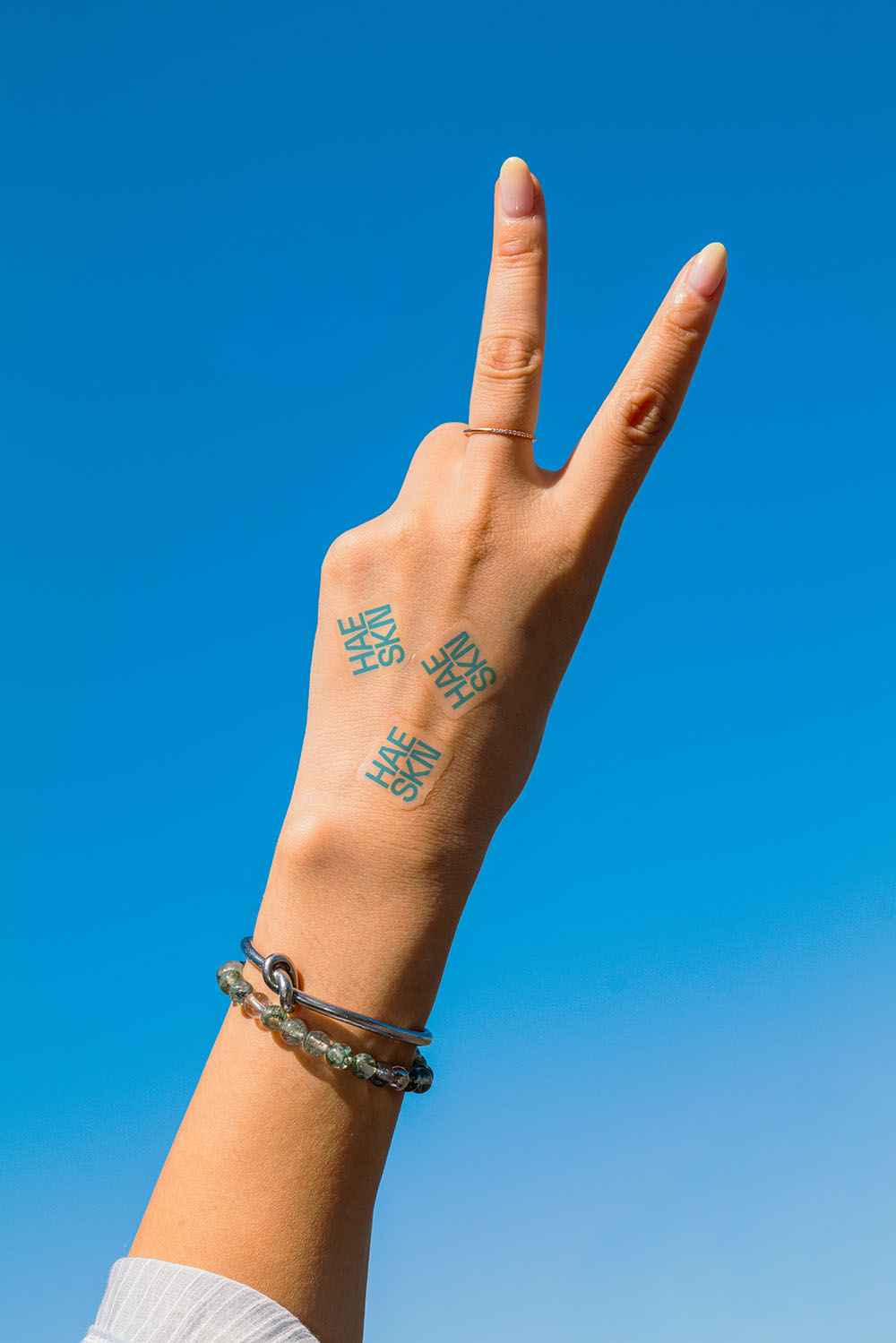
A visible cue can help with timing. HAESKN SOLCHECK is a UV-reactive sticker that turns blue as UV intensity rises. It shows how strong the sun is right now, not how much sunscreen is left on your skin.
HAESKN Sunscreen Stick SPF 50
24.00 USD
Shop now
HAESKN SOLCHECK
15.00 USD
Shop now
A two-minute pre-session routine
- About 15 minutes before you go out, apply sunscreen to dry, exposed skin, as the AAD recommends. Use lotion for the body and your stick or face sunscreen for the face.
- Trace the missed zones with the stick: hairline and part, each ear including rim, back and bowl, back of the neck, backs of both hands.
- Lip balm with SPF 30+ and UV-blocking sunglasses.
- After the warm-up, check strap edges and touch them up.
- During the session, reapply after heavy sweating or toweling and at least every two hours. Repeat step 2 each time, since the missed zones are where reapplication skips first.
Where HAESKN fits, and where it falls short
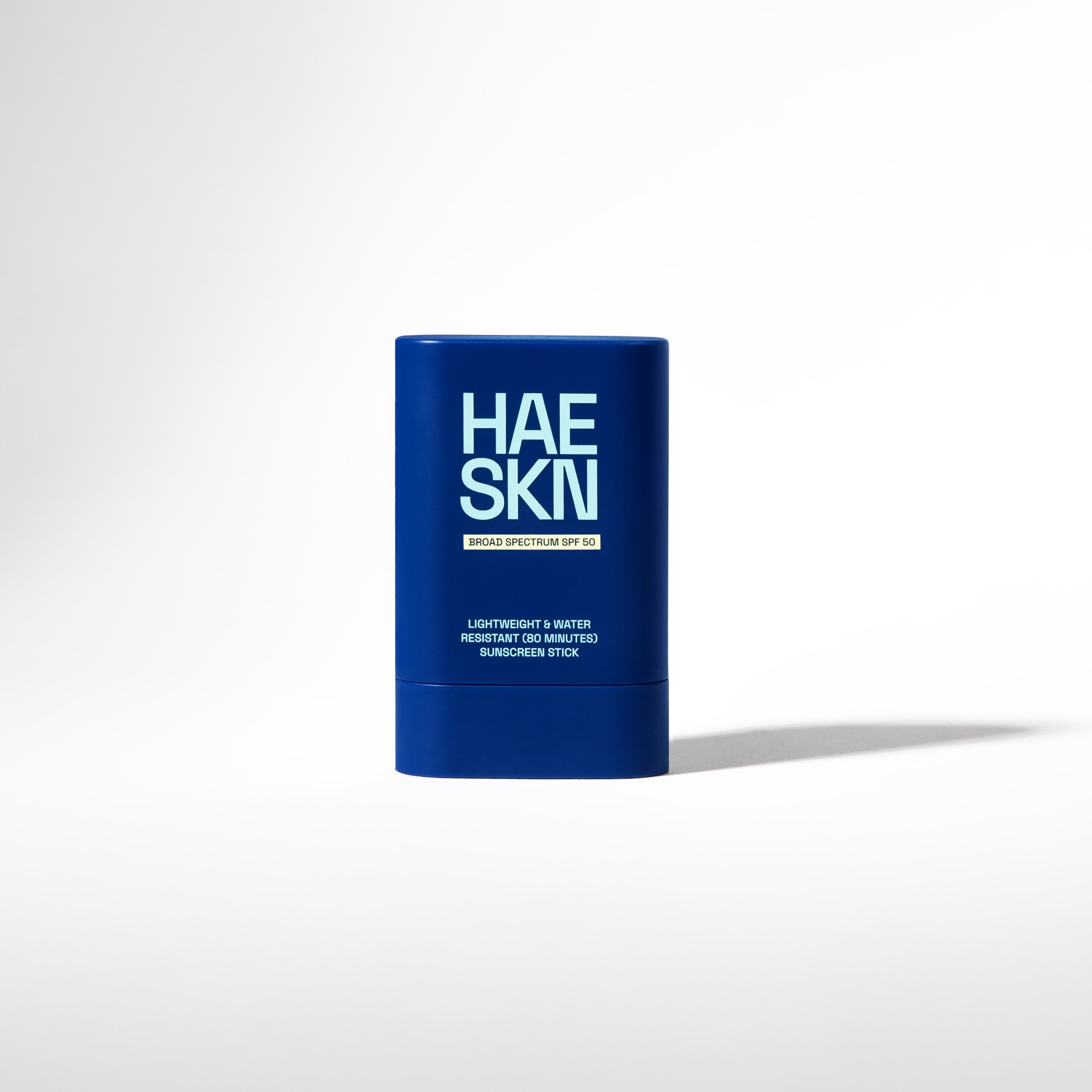
The HAESKN Sunscreen Stick SPF 50 carries a Broad Spectrum SPF 50 label with Water Resistant (80 minutes) on the pack, uses four FDA-approved chemical filters (avobenzone, homosalate, octisalate and octocrylene), and goes on with a clear finish across skin tones. Our product page lists it at $24.
Its limits are just as specific. It is a chemical-filter sunscreen, so choose a mineral product if you swim in waters that require one. It is not a lip product, it must stay out of the eyes, and one stick is less than one full-body dose. If you want visible-light protection from iron oxides, the AAD points to tinted sunscreens, and ours is clear. Our guide Which Sunscreens Really Have No White Cast on Brown Skin? compares clear and tinted options.
FAQ
Is SPF 50 meaningfully better than SPF 30 for sports?
Higher SPF numbers mean more protection, but the difference shrinks as the number rises. SPF 30 filters about 97% of rays, according to the American Cancer Society. Coverage of the missed zones and on-time reapplication usually matter more than the extra 20 points.
Does a baseball cap protect my ears and neck?
A cap shades the scalp and part of the face. Johns Hopkins Medicine advises hats that shade the face, ears and back of the neck, which describes a wide brim. With a standard cap, the ears and neck still need sunscreen.
Do I need sunscreen on my feet after a session in sandals?
Yes, if they are exposed. Cleveland Clinic notes the tops of the feet face the sun directly in flip-flops and other open shoes. The Skin Cancer Foundation reports that skin cancers on the feet are rare but occur more often in people of color.
The takeaway
Choose a broad-spectrum SPF 30+ sunscreen with a stated water-resistance window. Then pick the format you will carry and actually drag across your hairline, ears and hands at the halfway point. HAESKN publishes this guide and sells the HAESKN Sunscreen Stick SPF 50 for that job, with lip balm and sunglasses covering the zones a stick should not.