
Which Sunscreens Really Have No White Cast on Brown Skin?
Two formula routes reliably disappear on brown and deep skin: sunscreens whose active ingredients are not zinc oxide or titanium dioxide, which are colorless once spread, and tinted formulas carrying iron oxide pigments matched to your tone. The clear route wins on finish and on fast reapplication during activity, while the tinted route is the one with clinical evidence behind it for visible-light pigmentation. You can tell which one you are holding from the Active Ingredients panel, before you ever swatch it.
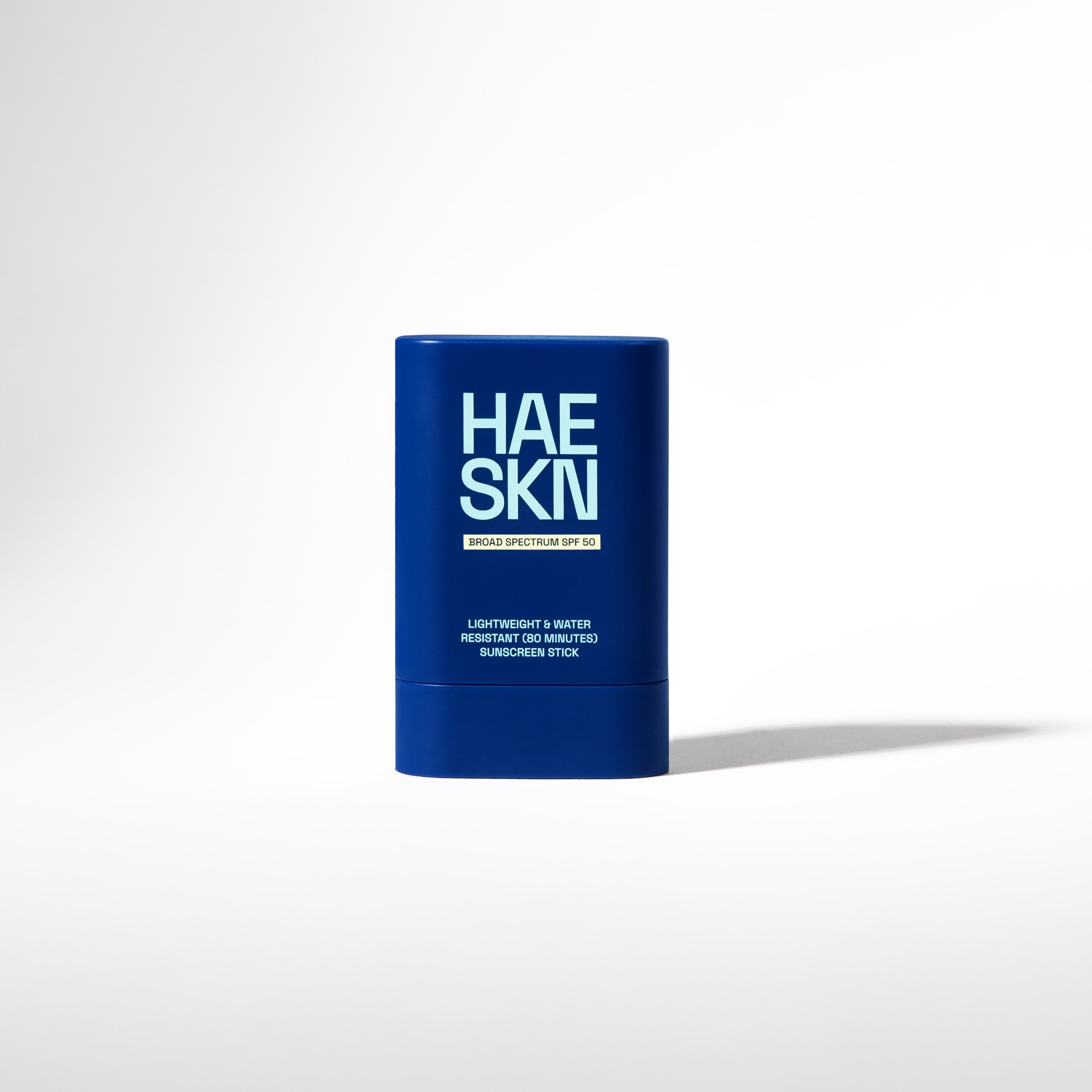
We publish this guide at HAESKN and we sell the HAESKN Sunscreen Stick SPF 50, a clear-finish stick built for outdoor sport, so treat our placement below as an interested party making its case on stated criteria. The criteria come first, the product comes last, and the evidence is linked so you can audit both.
Where the cast comes from
The American Academy of Dermatology defines the categories by what is on the ingredient panel: a physical or mineral sunscreen uses titanium dioxide or zinc oxide, a chemical sunscreen contains neither, and a hybrid mixes the two families. Physical filters both absorb and reflect the sun's rays, and the particles doing that reflecting are white powders sitting on the surface of the skin. Against a deep complexion, that film reads as grey.
Formulators treat this as a measurable property of the formula. A 2025 methods paper indexed on PubMed proposes a white cast scoring system built on volunteers' subjective perception plus L* colorimetry values, specifically so formulators can screen out chalky mineral prototypes early and improve compliance across diverse skin tones. The fact that researchers needed to invent a score tells you how uneven the current shelf is.
Work is under way on the mineral side. UCLA Health reported that changing the particle shape of zinc oxide produced formulations that appeared warmer and closer to natural skin tones in laboratory tests and controlled skin applications. That is promising laboratory work, not a product you can buy, and the team says it is still studying how the particles behave on real skin.
Route one: filters that are colorless to begin with
If a sunscreen's Active Ingredients list contains no titanium dioxide and no zinc oxide, there is no white pigment in it to leave behind. Avobenzone, homosalate, octisalate and octocrylene are the four organic filters in the HAESKN Sunscreen Stick SPF 50, which is why it finishes clear on brown, dark and deep tones rather than depending on a shade match.
Clear filters buy you finish and speed. They buy you nothing in the visible-light range, which matters more than most shelf copy admits.
Route two: tint as an active choice
Visible light (400 to 700 nm) makes up roughly 45% of solar radiation and drives skin darkening and worsening dyschromia, particularly in people with Fitzpatrick phototypes III and above, according to Dumbuya and colleagues in the Journal of Drugs in Dermatology (2020). In that study, expert grading and colorimetry showed iron-oxide containing formulations significantly protected against visible light-induced pigmentation compared with untreated skin or with a non-tinted mineral SPF 50+ sunscreen in Fitzpatrick IV participants. A high-SPF mineral product, the very thing that casts, delivered no visible-light benefit in that comparison. The iron oxide pigment did.
The AAD reaches the same practical conclusion in its Sunscreen FAQs, recommending shade, sun-protective clothing and a broad-spectrum sunscreen labeled "tinted" at SPF 30 or higher for visible-light protection. Board-certified dermatologist Henry W. Lim, MD, FAAD, former chair of dermatology at Henry Ford Hospital, framed it for outdoor use in an AAD release: "for those with darker skin, tinted sunscreens should be considered."
Shade matching is the catch. The 2021 practical guide to tinted sunscreens in the Journal of the American Academy of Dermatology advises broad-spectrum tinted SPF 30+ with iron oxides, and warns that products marketed as a "universal" shade may not suit users with very fair or very deep skin tones. A tint that misses your undertone is a cast wearing a different label.
Which route for which situation
| Clear filters (no ZnO/TiO2) | Tinted formula with iron oxides | |
|---|---|---|
| Finish on deep tones | Colorless, no shade match needed | Depends on matching tone and undertone (JAAD 2021) |
| UVA/UVB | Per label, when marked Broad Spectrum | Per label, when marked Broad Spectrum |
| Visible-light pigmentation | No meaningful added protection | Evidence of protection in Fitzpatrick IV skin (JDD 2020) |
| Mid-activity reapplication | Fast, no blending or color check | Slower, needs a mirror to avoid streaks |
| Best fit | Sport, sweat, reapplying in public | Melasma and post-inflammatory hyperpigmentation management |
Plenty of people are served by owning both and choosing by the day. Our own split: tinted for a pigmentation-focused daily routine, clear for the run.
Reading the panel instead of the marketing
"Invisible," "sheer" and "universal" are copy. Three things on the pack are defined by federal test methods, and they are the ones to check.
- Broad Spectrum. A product may only carry that phrase if an in vitro test shows a critical wavelength of at least 370 nm, per FDA guidance. A clear finish tells you nothing about this; the phrase does.
- Water Resistant (40 minutes) or (80 minutes). FDA rules require water-resistance claims to state which of the two windows was tested, and no product may be sold as waterproof or sweatproof. If a sport sunscreen prints no window, treat it as a daily product.
- Active Ingredients. This is the line that predicts cast. Titanium dioxide or zinc oxide present means a possible white film, iron oxides present means a tint that has to match you, and neither present means a colorless finish.
A five-minute check before you commit
You can run this in a store aisle or at your bathroom mirror during a return window.
- Swatch a full pass on your jawline, not your inner forearm. Jaw skin is closest to the tone others see, and forearm tests flatter almost every formula.
- Wait ten minutes. Mineral films and some tints shift toward grey as they set, so an immediate verdict is unreliable.
- Check it in daylight near a window, then under indoor light. Casts often appear in one and not the other.
- Press a clean tissue against the swatch. Heavy pigment transfer predicts transfer onto a collar or a racket grip.
- Rub the area briskly with a damp hand, the way sweat and a towel will. If the cast appears only after friction, that is what your second hour outdoors looks like.
For a broader look at how format influences whether you actually reapply, see our guide on choosing a sunscreen for outdoor sports and our breakdown of mineral versus chemical for daily use. For product-level picks across the category, we keep a running list of sunscreens for brown skin with no white cast.
Where our stick sits, honestly
The HAESKN Sunscreen Stick SPF 50 is a clear-finish, route-one product. Its four organic filters are avobenzone, homosalate, octisalate and octocrylene, with no zinc oxide or titanium dioxide, so it leaves no white cast across skin tones including brown, dark and deep ones. It is manufactured in the US as an FDA-compliant OTC drug, it costs $24, and the pocket-sized stick format exists so that a reapplication between sets or at a trail junction takes seconds and one hand.
What it does not do: it contains no iron oxides, so it adds no meaningful visible-light protection. If your priority is melasma or post-inflammatory hyperpigmentation, the evidence above points to a tinted iron-oxide product for your daily face routine, and we would rather say so than stretch our formula to cover a claim it was not built for. We also publish no dermatologist-testing or sensitivity claims for it, because we hold those claims to product-specific evidence.
For the part most people get wrong, timing, our guide on how often to reapply when you are sweating covers the intervals. SOLCHECK, our $15 UV detection sticker, is a separate tool for seeing when your exposure is climbing rather than guessing.
HAESKN Sunscreen Stick SPF 50
24.00 USD
Shop now

HAESKN SOLCHECK
15.00 USD
Shop now
FAQ
Does a clear sunscreen protect less than one that looks white on my skin?
Visible whiteness and UV protection are measured separately. Whether a product blocks UVA and UVB is established by the SPF and Broad Spectrum tests behind the label, and FDA guidance sets a critical wavelength of at least 370 nm as the bar for the Broad Spectrum phrase. A cast tells you about pigment on the surface, not about the UV numbers.
Is a "universal shade" tinted sunscreen a safe bet for deep skin?
Not automatically. The JAAD practical guide notes that universal shades may not be ideal for very fair or very deep skin tones, and advises matching both tone and undertone. Swatch on the jawline and judge it in daylight.
Do I need visible-light protection if I have no pigmentation concerns?
The AAD states that visible light can increase hyperpigmentation, particularly in darker skin tones, and its recommendation pairs a tinted SPF 30+ with shade and clothing. If you have no dyschromia to manage, a clear broad-spectrum product you will actually reapply is a reasonable daily choice, with tinted coverage added for long high-sun days.
What should I do when my sunscreen only casts after an hour outside?
That is usually pigment concentrating as the carrier wears and sweat moves it around. Run step five of the check above at home before a long day, and if a product passes at minute zero but fails after friction, it is a daily formula rather than a sport one.
Why does the same sunscreen look fine on my arm and grey on my face?
Facial skin is often a different tone from the inner forearm, and face products sit over oils and any makeup base, which changes how light reflects off the film. Test on the jawline, which is closest to what people see.
Ready to try the clear route on your own skin? The HAESKN Sunscreen Stick SPF 50 is $24, and SOLCHECK is $15 when you want your UV exposure measured on the spot.