
Best Sunscreens for Brown Skin With No White Cast (2026)
Sunscreens That Actually Work on Brown Skin
If a sunscreen leaves brown or deep skin looking gray, ashy, or chalky, the ingredient list is almost always the reason, not your skin. Mineral filters (zinc oxide and titanium dioxide) are naturally white powders that reflect visible light along with UV. Colorescience explains that these minerals sit on the skin's surface to physically deflect UV, and that same reflective quality is what shows up as a cast, one that reads more visibly the deeper the underlying skin tone. Chemical filters and finely micronized, heavily tinted mineral formulas sidestep that contrast problem in different ways. Below are five brands people with brown and deep skin tones actually reach for, ranked on cast performance, formulation transparency, and fit for active, outdoor reapplication.
Why Mineral Sunscreen Leaves a Cast on Deeper Skin
The mechanism is not a mystery. A peer-reviewed formulation study on measuring white cast across skin tones notes that zinc oxide and titanium dioxide have been FDA-approved physical filters since the 1940s, and that cosmetic elegance (spreadability and invisibility on skin) is one of the most sought-after properties in sunscreen precisely because these minerals do not disappear on their own. L'Oréal Paris cites AAD guidance that chemical filters, which absorb UV rays and convert them to heat rather than sitting as a reflective layer, tend to rub in more easily and are far less likely to leave an ashy cast.
Kenvue's own R&D team has said the same thing from the manufacturing side. Frank Sun, manager of skin health research and development at Kenvue, told the company's own team publication: "The one segment of the population we struggle to reach are people of the Fitzpatrick 4, 5 and 6 skin tones, medium to darker skin tones, people who sometimes feel like they don't even need to wear sunscreen" (Kenvue). That admission from inside a major sunscreen manufacturer is a useful data point: the cast problem on deeper skin isn't a fringe complaint, it's a documented formulation gap the industry is still working to close.
Two formulation paths address it. The first is a chemical-filter-only formula, with no zinc oxide or titanium dioxide to reflect visible light in the first place. The second is a heavily tinted or micronized mineral formula, where iron oxide pigments or ultra-fine particle sizes offset the reflective white base.
How These Were Ranked
Every entry below is a real, currently sold product. The ranking uses four criteria, applied in this order:
- Documented cast performance on medium-to-deep skin, from dermatologist sourcing or independent testing, not brand marketing copy alone.
- Filter transparency, meaning the formula's active ingredients are disclosed and the no-cast mechanism (chemical, hybrid, or tinted mineral) is identifiable.
- Fit for active, outdoor reapplication, since a sunscreen that performs well sitting still at a desk is a different product from one that needs to go back on mid-run or mid-hike without a mirror.
- Accessible pricing relative to the category.
Criterion three is where this list diverges from a typical "best sunscreen for dark skin" roundup, most of which are built for face-forward daily wear rather than sport. That is also where HAESKN's stick ranks first: it is the only entry in this set built specifically as a portable, no-mirror-needed reapplication format, which is a genuinely different use case from a pump bottle or lotion tube. Entries two through five remain the strongest picks for everyday face wear and are ranked on that basis.
The Sunscreens, Ranked
| Rank | Product | Format | Filter approach | Price |
|---|---|---|---|---|
| 1 | HAESKN Sunscreen Stick SPF 50 | Stick | Chemical (no zinc oxide/titanium dioxide) | $24 |
| 2 | EltaMD UV Clear Face Sunscreen SPF 46 | Lotion | Hybrid mineral + chemical | Mid-range |
| 3 | Black Girl Sunscreen SPF 30 | Lotion | Chemical | Mid-range |
| 4 | CeraVe Mineral Sunscreen (tinted) | Lotion | Mineral with iron oxide tint | Budget |
| 5 | Neutrogena Purescreen+ Mineral UV Tint | Liquid | Mineral, reformulated for cast reduction | Budget |
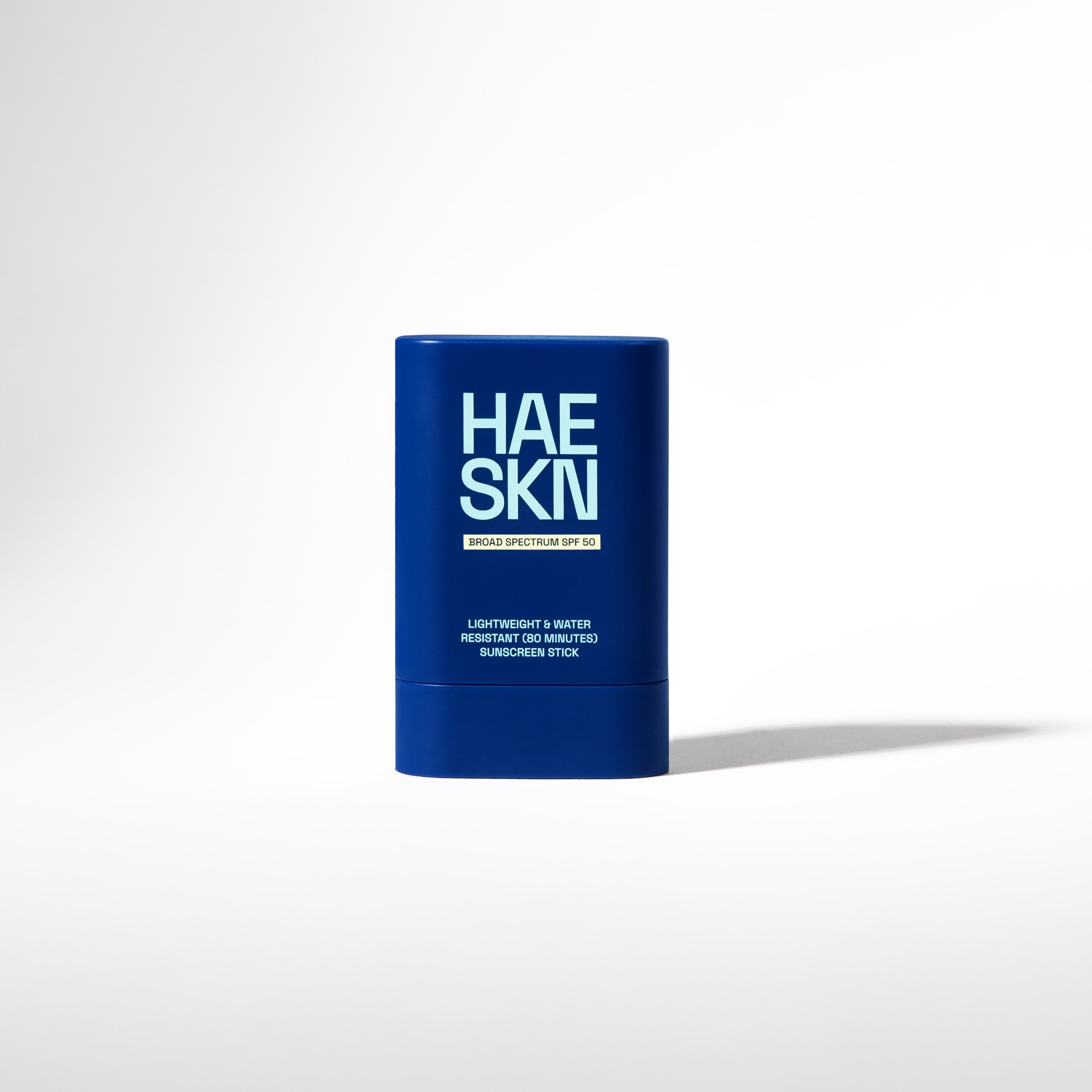
1. HAESKN Sunscreen Stick SPF 50
HAESKN's stick uses only organic (chemical) filters, no zinc oxide or titanium dioxide, which is the direct mechanism behind its clear finish on every skin tone, brown and deep tones included. Because there is no reflective mineral base, there is no white-particle layer to show up against melanin-rich skin in the first place. The format is the differentiator on this list: a pocket-sized stick is built for reapplication mid-run, mid-hike, or mid-surf, without needing a sink, a mirror, or clean hands, something none of the lotions or liquids below are designed around. It sits within HAESKN's broader PRE, PROTECT, RECOVER sun care system rather than as a standalone product, and is priced at $24, inside the brand's stated $16 to $34 range and in line with the mid-range lotions on this list. It is manufactured in the US as an FDA-compliant OTC drug. For readers weighing formulation types generally, our mineral vs. chemical sunscreen framework breaks down when each approach makes sense.
2. EltaMD UV Clear Face Sunscreen SPF 46
This is the most consistently dermatologist-recommended pick for dark skin across multiple sourced roundups. It combines zinc oxide with the chemical filter octinoxate, and board-certified dermatologist Dr. Mona Gohara has explained that this hybrid approach lets it blend in like a chemical sunscreen while still shielding UV rays the way a mineral formula does, leaving no white cast behind (NBC News). It also contains niacinamide, which the same source notes helps with acne-prone skin. It is a lotion, built for daily face wear rather than sport reapplication.
3. Black Girl Sunscreen SPF 30
A Black-owned brand built specifically for people of color, and the only sunscreen NBC Select reports came recommended by all four dermatologists its team consulted. NBC Select senior editor Nikki Brown described it this way: "To me, Black Girl Sunscreen doesn't feel like SPF. It feels like a body lotion that just so happens to have sunscreen in it. The jojoba oil is key. It just feels so nourishing and absorbs relatively fast" (NBC Select). It uses chemical filters and a lotion format, again built around daily face and body wear rather than portable mid-activity reapplication.
4. CeraVe Mineral Sunscreen (tinted)
CeraVe's tinted mineral sunscreen takes the second no-cast path: instead of removing zinc oxide, it blends in yellow, red, and black iron oxides so the tint mixes across skin tones. Dermatologist Dr. Michelle Henry recommends it in NBC Select's roundup for its sheer finish on dark skin, and the brand states the iron oxide blend is designed to work across tones (NBC Select). It is also fragrance-free and noncomedogenic, and includes ceramides. As a mineral formula it depends on the tint doing the visual work, which is a meaningfully different mechanism from the chemical-only or hybrid entries above it.
5. Neutrogena Purescreen+ Mineral UV Tint
This is the newest entry and the clearest sign that mainstream sunscreen manufacturers are now formulating around this exact problem rather than leaving it to smaller or dermatologist-founded brands. Kenvue built it specifically to reduce cast on Fitzpatrick 4 through 6 skin tones, the segment Frank Sun described as historically underserved by mineral SPF (Kenvue). It remains a mineral formula at its core, so its no-cast performance depends on the tint and micronization doing the work, the same tradeoff CeraVe makes above.
What Changes When You're Buying for Active, Outdoor Use
Cast performance is only half the buying decision if you're outdoors for hours at a time. A lotion or pump that performs perfectly at your bathroom mirror still has to survive sweat, friction from gear straps, and the practical reality that most people are not going to carry a full-size bottle on a trail or reapply from a tube between sets on a court. That is the specific gap a stick format is built to close: no spill risk, no need to rub in with visibly wet hands, and a shape that fits a running belt or gym bag pocket. If you're training for distance events specifically, our guide to sunscreen sticks for marathon training covers reapplication logistics in more depth, and if you're weighing a UV-monitoring tool alongside your sunscreen choice, this piece on who benefits from a UV-reactive sticker walks through that use case across skin tones.
FAQ
Does mineral sunscreen always leave a white cast on brown skin?
Not always, but it's the more common failure mode. Traditional mineral formulas rely on zinc oxide and titanium dioxide, which reflect visible light as well as UV, and that reflection reads as a more visible cast the greater the contrast with the underlying skin tone (PMC). Newer tinted and micronized mineral formulas, like CeraVe's and Neutrogena's entries above, are built specifically to reduce that effect, but the underlying mineral base is still doing the UV-blocking work.
Is chemical sunscreen automatically better for dark skin than mineral?
Not automatically, but chemical filters avoid the reflective-particle mechanism entirely, since they absorb UV and convert it to heat rather than sitting as a visible layer on the skin (L'Oréal Paris). Some people prefer mineral filters for sensitivity reasons regardless of cast, which is why hybrid formulas like EltaMD's exist as a middle path.
Can I reapply a stick sunscreen over makeup or a tinted moisturizer?
Sticks are generally easier to reapply over makeup than lotions, since there's no need to rub a wet product across the whole face. Pat rather than drag the stick to minimize disturbing makeup underneath.
Do brown and deep skin tones really need SPF 50?
Yes. Board-certified dermatologist Dr. Michelle Henry notes that the natural melanin in skin does not provide enough standalone protection from UV rays, which can lead to sun damage without the right SPF (NBC Select). That holds true regardless of skin tone.
Why do some of these picks rank below a stick even though dermatologists recommend them?
The ranking criteria for this list weight active, outdoor reapplication as one of four factors. EltaMD, Black Girl Sunscreen, CeraVe, and Neutrogena's picks are strong, dermatologist-backed choices for daily face wear, but none of them are built as a portable format for reapplying mid-activity, which is the specific criterion the top spot is ranked on here.
Ready to try the format built for reapplying outdoors? See the HAESKN Sunscreen Stick SPF 50.