
How Often Should You Reapply Sunscreen During the Day?
The Real Sunscreen Reapplication Schedule
Reapply sunscreen at least every two hours when you are outdoors, according to the American Academy of Dermatology. That is the floor, not the formula. Sweat, water, and toweling off reset the clock much faster, down to 40 or 80 minutes depending on the product, per FDA testing rules. The two hours everyone quotes is a public-health minimum for someone standing still in dry conditions. Almost nobody's actual day looks like that.
The Baseline: Every Two Hours, No Matter the SPF
The AAD states plainly that sunscreen should be reapplied approximately every two hours when outdoors, even on cloudy days, and after swimming or sweating. This applies regardless of SPF number. A higher SPF blocks a larger share of UVB per unit time, but it does not extend how long the film physically survives on skin. The American Cancer Society is explicit on this point: even a very high SPF does not mean you can apply it less often.
What actually ends protection before the two-hour mark is mechanical, not chemical. Sunscreen rubs off on clothing and straps, dilutes and runs with sweat, and washes away in water. None of that is a function of SPF strength.
What "Water Resistant (40 Minutes)" and "(80 Minutes)" Actually Mean
If a sunscreen label carries a water-resistance claim, the FDA requires the front label to say whether that protection lasts 40 minutes or 80 minutes of swimming or sweating. Those numbers are not marketing estimates. Under 21 CFR 201.327, a product earns the 40-minute claim by surviving two 20-minute water-immersion cycles with the SPF re-measured afterward on skin that was never toweled dry; the 80-minute claim doubles that to four cycles. No sunscreen is allowed to call itself "waterproof," because, as the FDA notes, every sunscreen eventually washes off.
Two details from that test protocol matter for how you should actually plan your day:
- The test never involves a towel. Real friction from a towel, a phone case, a backpack strap, or a padel racket grip removes sunscreen faster than the lab conditions that produced the 40/80-minute number.
- The clock restarts at zero water exposure, not zero sweat. A water-resistance rating describes performance in water or heavy sweat specifically. On dry land with no sweating, the general two-hour rule still applies on top of it, not instead of it.
So a sunscreen labeled "Water Resistant (80 minutes)" is not an 80-minute-then-2-hour combination. It means: reapply after 80 minutes of swimming or heavy sweating, immediately after towel drying, or at least every two hours, whichever comes first.
A Reapplication Schedule for Five Common Days
The two-hour rule is a starting point. The interval that actually protects you depends on what you are doing between applications.
| Day scenario | What shortens the interval | Realistic reapplication interval |
|---|---|---|
| Desk work with a midday outdoor walk | Minimal sweat, brief exposure | Every 2 hours of cumulative outdoor time |
| Errands, dog walks, outdoor lunch | Some friction from bags, clothing | Every 2 hours |
| Gym or outdoor workout, no water | Sweat, wiping face with a towel | More often than the standard two hours, and immediately after toweling or a heavy sweat |
| Running, hiking, or a padel match | Heavy sweat, straps, racket grip, repeated face-touching | Every 40 to 80 minutes depending on the product's water-resistance rating, and immediately after any toweling |
| Swimming or beach day | Direct water immersion | At or before the labeled 40- or 80-minute mark, and immediately after towel drying |
For the mechanics of reapplying mid-run without breaking stride, see our guide to what to look for in a sunscreen for outdoor sports. Hikers and trail runners face an added variable, UV intensity increases with altitude, which we cover in our sun protection guide for hikers and trail runners.
Signs Your Sunscreen Needs a Fresh Coat Before the Clock Runs Out
The two-hour and 40/80-minute numbers are averages, not guarantees for every body and every condition. Family medicine physician Dr. Amanda Valdes, interviewed by Cleveland Clinic, put it this way: "You'll start to notice when your skin no longer has the protection it needs." Her advice is to act on that signal rather than wait out the clock.
Practical signs it is time to reapply sooner than scheduled, drawn from the same Cleveland Clinic guidance:
- Your skin starts to feel warm or looks slightly pink, even before a visible burn
- You have visibly sweated through or wiped your face, arms, or neck
- You have been in or near water
- You can see the sunscreen has thinned, rubbed off on clothing, or pilled into flakes
If you notice stinging around your eyes specifically once you start sweating, that is a separate mechanism worth understanding on its own. We break down why that happens in why sunscreen stings your eyes when you sweat.
How to Actually Reapply Without Ruining Your Day
The AAD and FDA guidance above assumes you will actually stop and reapply, which is the part most people skip. A lotion reapplication mid-run, mid-match, or mid-meeting is genuinely inconvenient: it means wet hands, a mirror, and time you often do not have.
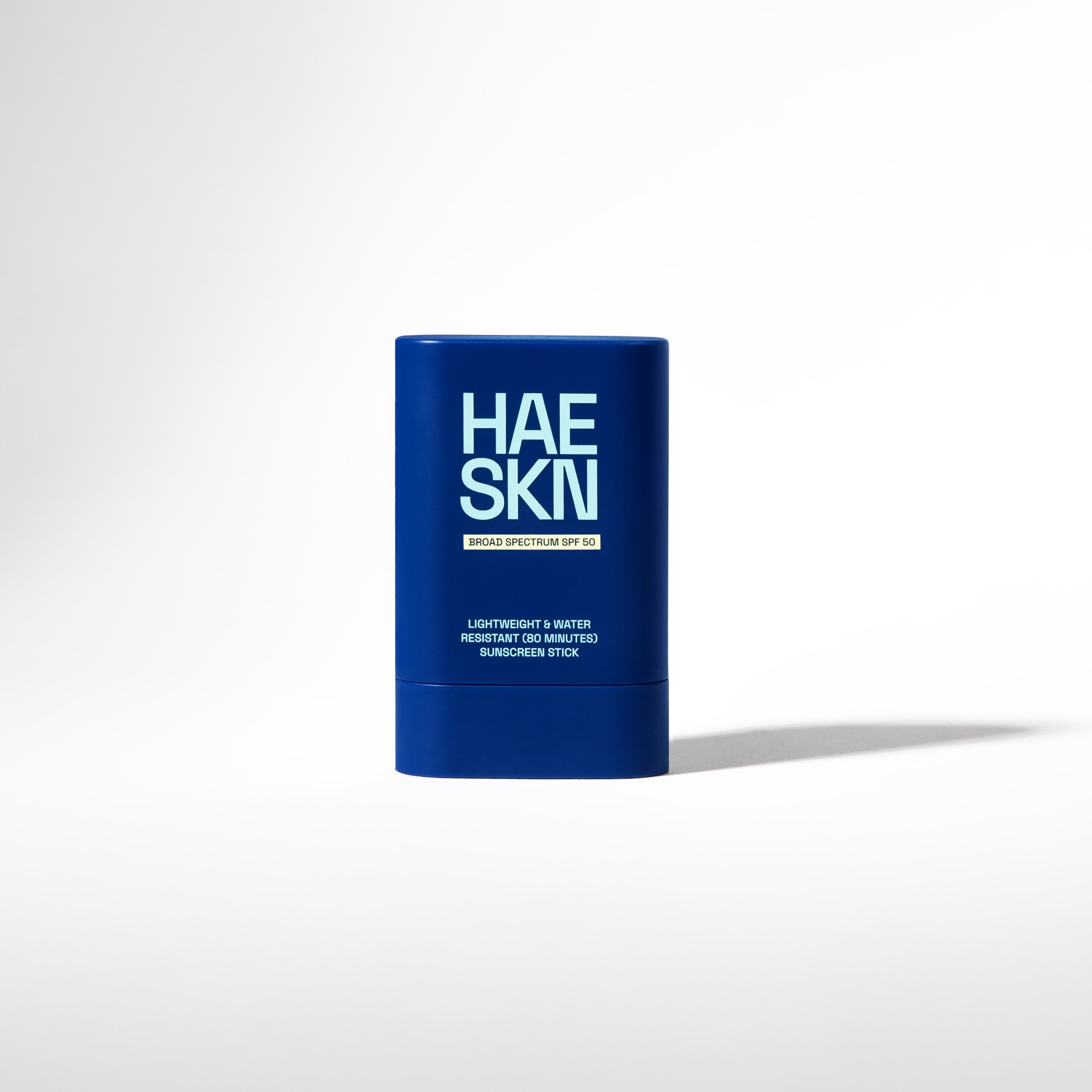
We built the HAESKN Sunscreen Stick SPF 50 around that specific friction point. It is a twist-up stick, not a lotion, so a midday touch-up takes seconds with no rubbing in, no mess on your hands, and no need for a mirror. The formula uses FDA-approved organic filters (avobenzone, homosalate, octisalate, and octocrylene) and leaves a clear finish with no white cast across skin tones, which matters because a visible white residue is one of the main reasons people skip reapplying in the first place. Competing brands including Supergoop!, EltaMD, Banana Boat Sport, and Neutrogena also sell stick and spray formats built around the same reapplication problem; the deciding factor for any of them is whether the format actually gets used on schedule, not just what is printed on the label.
Knowing when to reach for that stick is a separate problem from having it on hand. Our SOLCHECK UV sticker is a wearable UV indicator that changes visibly as ambient UV rises, which gives you an in-the-moment nudge to check the clock and reapply. It is a cue, not a substitute for a timer: as we explain in can a UV sticker tell you when to reapply sunscreen, the sticker reacts to UV hitting its own surface and cannot confirm that your sunscreen film on your ears, hairline, or under a strap is still intact. The two-hour rule, a water-resistance label, and a UV cue work best combined, not as a replacement for one another.
HAESKN publishes this guide and sells the products named above. The reapplication intervals and testing standards cited throughout are the AAD's and FDA's own public guidance, not brand-specific claims.
FAQ
Does sunscreen need reapplying if I'm indoors near a sunny window during the day?
Possibly, if you sit near the glass for long stretches. UVA rays, the type linked to premature skin aging, can pass through window glass, while UVB rays cannot. The two-hour rule above is built for direct outdoor exposure; there is no equivalent standardized indoor interval, but sitting for hours beside strong sun through glass is a reason to keep a stick within reach rather than assume indoor time is exposure-free.
Is "water resistant (80 minutes)" the same as being protected for 80 minutes total?
No. It means the product retained its labeled SPF through 80 minutes of water immersion in FDA-standardized testing. On dry land with no sweating, the general every-two-hours rule still applies independently of that rating.
Do I need to reapply sunscreen on a cloudy day?
Yes. The AAD notes that only about 20% of Americans use sunscreen on cloudy days, even though UV rays pass through cloud cover. The same two-hour reapplication interval applies regardless of visible sunshine.
What if I towel off instead of swimming?
Reapply immediately. The FDA's water-resistance testing protocol specifically excludes toweling, and both the AAD and American Cancer Society flag towel drying as a separate trigger for reapplication, distinct from the timed interval.
How much sunscreen should I use each time I reapply?
Use the same amount as your first application. The AAD recommends roughly 1 ounce (a shot glass) for the body and about 1 teaspoon for the face per application, whether it is your first coat of the day or a reapplication.