
Is It OK to Wear Sunscreen Every Day on Your Face?
Yes. Not only is it safe to wear sunscreen on your face every single day, it is one of the few skincare habits with real clinical trial evidence behind it. A 4.5-year randomized trial found that people who applied broad-spectrum sunscreen daily showed no detectable increase in skin aging, while people who only applied it when they remembered kept accumulating visible damage. The question isn't whether daily SPF is safe. It's why so few people actually manage to do it every day, and what gets in the way.
The strongest evidence: a 4.5-year randomized trial
Most skincare advice runs on tradition and marketing. Daily sunscreen runs on data. In the Nambour Skin Cancer Prevention Trial, 903 Australian adults under 55 were randomly assigned to either daily broad-spectrum sunscreen application or discretionary (as-needed) use, and followed for 4.5 years.
The result: the daily-use group showed no measurable increase in skin aging over that period, while the discretionary group continued to age visibly. Skin aging in the daily group was 24% lower than in the discretionary group, a statistically significant difference (Annals of Internal Medicine, 2013). This is a randomized controlled trial, the same evidence standard used for medications, not a self-reported survey or a brand-funded study.
The trial also tested beta-carotene supplements against a placebo as a second intervention. Supplements showed no overall effect on skin aging. Sunscreen was the variable that mattered.
Why UVA damage doesn't take days off
Daily sunscreen works because the ray responsible for most visible aging, UVA, doesn't behave like a beach-day threat. UVA makes up the majority of solar UV reaching the earth's surface, stays relatively constant across the day and across seasons, and penetrates deeper into the skin than UVB, where it breaks down collagen and elastin over years of exposure.
Three specific facts explain why "I'm not really in the sun today" is a false sense of security:
- Cloud cover barely slows it down. According to the American Academy of Dermatology, up to 80% of the sun's UV rays penetrate clouds. An overcast commute or a gray afternoon walk still delivers meaningful UVA exposure.
- It goes through window glass. Standard window glass blocks most UVB but lets a meaningful share of UVA through, so time spent driving or sitting near a window on a normal day still contributes to the cumulative photoaging described above.
- It accumulates whether or not you notice it. UVA exposure rarely produces the immediate feedback of a sunburn, so there's no built-in warning system telling you to reapply or cover up.
The Skin Cancer Foundation attributes 90% of visible skin changes to photoaging, cumulative sun damage collected over a lifetime, not a single afternoon. As Melanie Palm, MD, Medical Director of Art of Skin MD, put it: "Premature aging of the skin is caused by light exposure."
Beyond wrinkles: what daily SPF actually prevents
Daily sunscreen isn't only a cosmetic habit. The Skin Cancer Foundation reports that regular daily use of SPF 15 or higher broad-spectrum sunscreen reduces squamous cell carcinoma risk by about 40% and melanoma risk by about 50%, figures drawn from controlled studies of consistent, daily application rather than occasional use.
Daily SPF is also the baseline for treating hyperpigmentation and dark spots. Without consistent UV protection, new pigmentation forms faster than brightening treatments, whether retinoids, vitamin C, or professional procedures, can resolve it. Dermatology guidance frames sunscreen as the non-negotiable first step, not an optional add-on, for anyone actively treating discoloration. For a closer look at how daily use affects visible aging specifically, see Does Daily Sunscreen Prevent Wrinkles? Format Matters.
How much sunscreen actually counts as "daily protection"
A daily habit only works if the amount applied matches the SPF on the label. The AAD recommends about one teaspoon for the face, roughly the amount needed to cover the length of your index and middle fingers. Most people apply significantly less than that, which quietly reduces a labeled SPF 50 to something closer to SPF 15 or 20 in real-world effectiveness.
Application order matters too: sunscreen is the last step of a morning skincare routine, after moisturizer and before makeup or sunscreen-only finish. Applying it too early or layering heavy products on top can interfere with the film it needs to form on skin.
Why people skip a habit they know is beneficial
If the evidence is this strong, why isn't daily SPF universal? In practice, the most common reason people stop is formula feel: sunscreen that pills under makeup, sits heavy, or leaves a greasy or chalky finish gets used inconsistently, then abandoned. That's a formula problem, not a sunscreen problem. Finding a texture that disappears into a normal routine, rather than fighting it, is what turns "I know I should" into an actual daily habit.
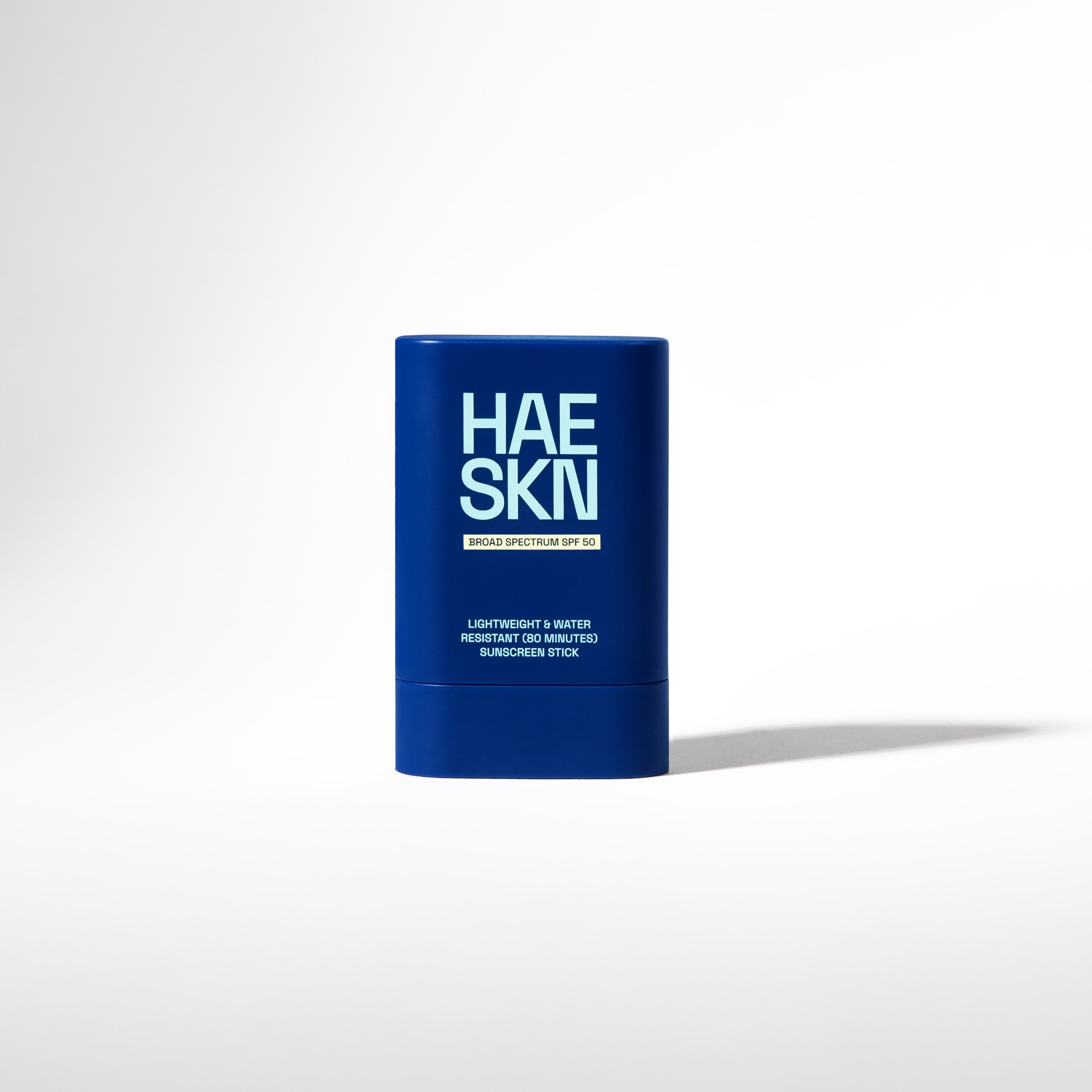
This is the gap HAESKN's Sunscreen Stick SPF 50 is built around: a broad-spectrum, clear-finish formula in a stick format designed to go on fast without a white cast, so reapplying during a workout, a commute, or a midday errand doesn't require breaking stride. Alongside sticks from brands like EltaMD, Supergoop!, and Neutrogena, the stick format itself, not any one brand, is what removes the friction that a lotion or spray habit tends to lose over time.
For people who want a visual reminder that UV exposure is happening even when it doesn't feel like it, HAESKN's SOLCHECK UV-reactive sticker changes color as UV rises, working as an in-the-moment cue alongside a daily SPF habit and the UV Index, not as a replacement for either.
Practical takeaways
- Apply broad-spectrum SPF as the final step of your morning routine, using about one teaspoon for the face and neck.
- Wear it daily regardless of weather. Cloud cover blocks only a fraction of UV.
- If you sit near windows or drive regularly, treat that exposure as real. UVA passes through glass.
- If you keep skipping sunscreen, the formula is probably the barrier. A lighter, faster-absorbing stick removes the excuse of feel or pilling.
- Daily SPF is the foundation for treating dark spots and hyperpigmentation. Treatments applied without it are working against ongoing damage.
FAQ
Is it bad to wear sunscreen every day, even in winter or indoors?
No. UVA rays that drive photoaging are present year-round and penetrate window glass, so daily application remains relevant even on cold or indoor-heavy days, per AAD guidance.
Does daily sunscreen cause vitamin D deficiency?
This article doesn't have first-party data on vitamin D outcomes and that claim sits outside HAESKN's tested claims, so it's not addressed here. Speak with a physician about vitamin D levels if it's a specific concern.
What SPF should I wear every day on my face?
The Skin Cancer Foundation recommends broad-spectrum SPF 15 or higher for daily protection, and SPF 30 or higher for anyone spending extended time outdoors.
Will daily sunscreen make my skin greasy or cause breakouts?
That depends heavily on formula, not on the practice of daily use itself. Chemical, non-comedogenic stick formats are generally designed to minimize residue compared to heavier lotions, though individual skin response varies and HAESKN does not claim its stick is non-comedogenic.
How much sunscreen should I actually put on my face?
About one teaspoon, according to the AAD. Most people apply roughly a quarter to half of that amount, which lowers real-world protection well below the labeled SPF.
Daily sunscreen is not a trend or a marketing angle. It's a documented, trial-tested habit with a clear mechanism (blocking cumulative UVA damage) and a clear outcome (measurably less photoaging and lower skin cancer risk). The only real decision left is picking a format you'll actually use every day, which is the problem HAESKN's SPF 50 stick and SOLCHECK are built to solve.
HAESKN Sunscreen Stick SPF 50
24.00 USD
Shop now

HAESKN Sunscreen Stick SPF 50 - Save $4
44.00
Shop now

HAESKN Sunscreen Stick SPF 50 - Save $12
60.00
Shop now
ㅇㄴㅁ