Does Daily Sunscreen Prevent Wrinkles? Format Matters
Yes. In the largest randomized trial on the question, adults who wore broad-spectrum SPF 15+ sunscreen every day showed 24% less visible skin aging over 4.5 years than adults who only wore it when they felt like it, according to the landmark Nambour trial published in Annals of Internal Medicine. The daily-use group showed no detectable increase in skin aging at all over the study period. That is strong evidence for a simple behavior: wear it every day.
But that finding raises a second, more practical question that most sunscreen content skips: does it matter whether that daily sunscreen is mineral or chemical? For most people applying it once in the morning and going to an office, the trial data suggests the filter type is close to irrelevant, consistency is what predicted the outcome. For people who sweat, move, and spend hours outdoors, the answer changes, and the variable that actually decides whether the anti-aging benefit shows up is not filter chemistry. It is whether the format gets reapplied. (For the full trial breakdown and the general case for daily use, see Does Daily Sunscreen Actually Prevent Wrinkles?.)
What the Trial Actually Measured
The Nambour Skin Cancer and Actinic Eye Disease Prevention Trial ran in Queensland, Australia from 1992 to 1996, enrolling 903 adults under age 55. Participants were randomly assigned to daily sunscreen use, discretionary sunscreen use, and either beta-carotene supplements or a placebo, in a 2x2 design. Researchers graded skin aging using a validated microtopography scale, with assessors blinded to which group each participant belonged to.
The result: skin aging in the daily-use group was 24% lower than in the discretionary-use group (relative odds 0.76, 95% CI 0.59-0.98), and beta-carotene supplementation made no measurable difference either way, according to the original trial results, a finding also summarized by CeraVe. The trial used SPF 16 sunscreen, not the SPF 30 or 50 formulas common today, and it did not compare mineral filters against chemical filters. It compared consistent use against inconsistent use. That distinction matters for how the rest of this article should be read: the strongest evidence for wrinkle prevention is about frequency of application, not about which active ingredients sit in the formula.
A more recent American Academy of Dermatology survey found that only 56% of Americans use sunscreen regularly, even though 73% actively use products or procedures to prevent premature aging, and four in ten adults report wrinkles or dark spots they believe come from sun exposure. The gap between wanting the outcome and doing the behavior that produces it is the real problem the Nambour trial data points to.
Does Mineral or Chemical Sunscreen Matter for Wrinkle Prevention?
Mineral and chemical sunscreen work through different mechanisms. Mineral filters (zinc oxide and titanium dioxide) sit on top of the skin and physically block or scatter UV rays, while chemical filters (like avobenzone, octisalate, and octocrylene) absorb UV radiation and convert it into small amounts of heat, per Cleveland Clinic's explanation of the two filter types. Both are FDA-recognized and both block UVA, the wavelength most responsible for photoaging, when the product is labeled broad-spectrum.
One real mechanical difference is worth naming honestly. Mineral filters are broad-spectrum immediately and by default, a point dermatologist Dr. Anthony Rossi of Memorial Sloan Kettering Cancer Center makes in NBC Select's roundup of mineral sunscreens: unlike chemical filters, mineral sunscreen offers broad-spectrum protection as a baseline no matter the brand. Chemical filters also work quickly in practice, but the formulation has to be built correctly to guarantee broad-spectrum coverage, and it is the finished, FDA-tested formula (not any single ingredient) that has to earn that claim.
The second real difference is durability under sustained UV exposure. Several organic UV filters, avobenzone in particular, are known to photodegrade with continued sun exposure, meaning the filter's UV-absorbing capacity declines over time as it does its job, according to a stability study of UV filters in sunscreen formulations. This is a real property of chemical filters, including the ones commonly used in stick and lotion formats, and it is one reason dermatology guidance treats scheduled reapplication (not just morning application) as non-negotiable for anyone spending hours outdoors, regardless of which filter type they chose. It does not make chemical sunscreen ineffective. It makes the reapplication interval matter more.
For daily, mostly-indoors use, this difference is close to academic: a morning application usually outlasts the day's incidental exposure. For runners, hikers, and anyone training outdoors for 60 minutes or longer, it is the reason dermatology guidance treats reapplication as non-negotiable rather than optional, whichever filter type is in the bottle.
The Real Failure Mode Isn't Filter Chemistry. It's Reapplication
Here is where the "mineral versus chemical" framing misses the point for active people. The Nambour trial's 24% reduction in skin aging came from consistent use, not from any particular filter. The same AAD survey found that just 20% of people apply sunscreen even on cloudy days, and a separate AAD-commissioned survey reported by Newswise found that while 80% of Americans know they should reapply every two hours outdoors, only 33% actually do, and 42% either never reapply or only reapply after getting wet. Awareness of the two-hour rule is not the bottleneck. Doing it mid-activity is.
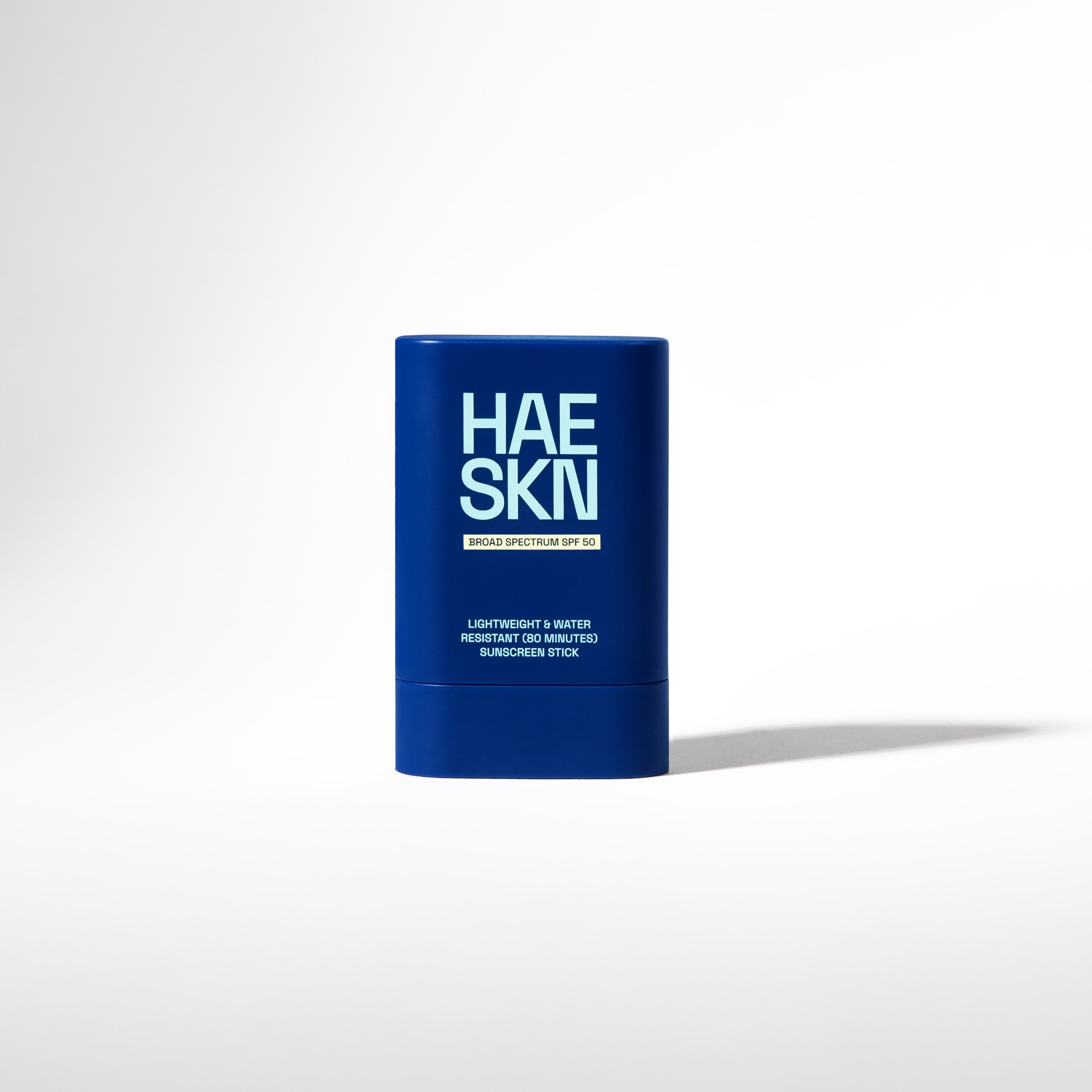
That is a logistics problem, not a chemistry problem. Reapplying a lotion mid-run, mid-hike, or between sets means stopping, finding a mirror or your hands free, working a cream into already-sweaty skin, and waiting for it to set, exactly the sequence of frictions that survey data shows people skip. This is why HAESKN builds its SPF 50 sun stick as a twist-up format: it requires no water, no mirror, and no rubbing in over sunscreen already on the skin, so a mid-activity touch-up takes seconds instead of a stop.
White Cast Is a Compliance Problem, Not a Cosmetic One
There's a second reapplication barrier that gets treated as a footnote when it is actually load-bearing: visible white cast, especially on medium, brown, and deep skin tones. When a sunscreen leaves a gray or ashy residue, people are less likely to apply a full, even layer, and even less likely to reapply mid-day where the residue is visible to others, according to SunSolve MD's breakdown of what causes sunscreen white cast. Mineral filters are the more common cause of white cast because zinc oxide and titanium dioxide particles sit on the skin's surface and scatter visible light, not just UV. That does not mean mineral sunscreen inherently looks chalky. Formulation, particle size, and tinting all affect the outcome. But it does mean finish is a real variable that determines whether someone actually completes the habit the Nambour trial credits with the wrinkle-prevention effect.
HAESKN's SPF 50 stick uses FDA-approved organic (chemical) filters, avobenzone, homosalate, octisalate, and octocrylene, specifically because a clear finish across skin tones, including deep tones, removes that particular reason to skip a layer. HAESKN does not use zinc oxide or titanium dioxide, so it carries the photodegradation consideration common to organic filters described above rather than the white-cast risk more common to mineral formulas. Neither trade-off is free; the honest comparison is which friction point matters more for a given person's routine, indoor versus outdoor, occasional versus daily, low sweat versus high sweat.
Practical Takeaways
- Daily use matters more than filter type. The trial evidence for wrinkle prevention comes from consistent daily application, not from choosing mineral over chemical or vice versa, per the Nambour trial.
- For desk-bound days, either filter type works. Pick based on skin sensitivity, finish preference, or personal comfort.
- For active, outdoor days, reapplication interval matters more. Set a timer for 2 hours per AAD reapplication guidance, and sooner after heavy sweating or water exposure. See How Often Should You Reapply Sunscreen During the Day? for the full schedule.
- Choose the format you will actually use mid-activity. A stick that needs no mirror and no rubbing over sweat-soaked skin removes the single biggest reason reapplication gets skipped.
- If white cast is stopping you from applying a full layer or reapplying in public, that is worth fixing. A clear, no-white-cast chemical formula like the HAESKN Sunscreen Stick SPF 50 solves for that specific friction point; a tinted or micronized mineral formula can solve it too.
FAQ
Does the SPF number matter as much as daily use?
Both matter, but they answer different questions. SPF measures protection against UVB-driven sunburn at a given application thickness. The Nambour trial's wrinkle-prevention data came from consistent use of a modest SPF 16 formula, which suggests frequency of application drove the outcome as much as strength of formula, per the original trial results. Current AAD guidance still recommends SPF 30 or higher for daily use.
Do chemical sunscreens stop working during a long outdoor session?
Not entirely, but some chemical filters, avobenzone in particular, do photodegrade with continued UV exposure, meaning their UV-absorbing capacity gradually declines during sustained sun exposure, according to stability research on sunscreen UV filters. This is one reason scheduled reapplication, not just morning application, is standard guidance for long outdoor sessions regardless of filter type.
Is mineral sunscreen automatically better for sensitive or acne-prone skin?
Not automatically. Mineral filters are generally considered less likely to irritate because they sit on the skin's surface rather than being absorbed, but individual tolerance varies by formula, not just by filter category. Anyone with diagnosed sensitivities should get a dermatologist's recommendation rather than choosing by filter type alone.
Why does white cast make some sunscreens harder to stick with?
A visible gray or ashy cast, most noticeable on medium to deep skin tones, discourages full-layer application and especially discourages a visible midday reapplication, according to SunSolve MD's analysis of white cast causes. Since the wrinkle-prevention benefit depends on consistent use, a finish someone avoids applying undermines the outcome regardless of how good the filter chemistry is on paper.
What's the single most useful habit for wrinkle prevention?
Apply a broad-spectrum SPF 30 or higher every morning, and actually reapply during long outdoor exposure. The Nambour trial and subsequent AAD survey data both point to the same conclusion: the habit, not the filter category, is what shows up in the outcome data.