
What's the Best Sunscreen to Reapply Between Padel Sets?
Reapply Sunscreen Between Padel Sets: Why a Stick Wins
A padel match can run an hour or longer in direct sun, according to AllForPadel, long enough for sunscreen to break down before the match ends. The fix is not more sunscreen at the start, it is a fast, mess-free way to reapply between sets. A broad-spectrum SPF stick beats lotion or spray for that job because it goes on over sweat, dries in seconds, and does not require a mirror or a towel.
Why Sunscreen Doesn't Survive a Full Padel Session
Sweat, friction from gripping the racket, and repeated wiping of the face and forearms all wear down a sunscreen film over the course of a match. The American Academy of Dermatology's baseline reapplication window is about two hours for undisturbed skin, according to Dr. Adam Friedman, professor and chair of dermatology at GW School of Medicine and Health Sciences. Friedman recommends starting with SPF 30 or higher for stronger protection, noting that "SPF only refers to UVB, the type [of sun rays] that burn" and that UVA, which is not blocked by SPF alone, is more closely tied to accelerated skin aging. That two-hour window assumes normal activity. Sweat and repeated hand contact shrink it, which is why the FDA's water-resistance testing standard caps labeled water resistance at 40 or 80 minutes even on formulas built for heavy activity, a distinction HAESKN's own guide to water-resistance labels breaks down in more depth.
Padel adds two specific stressors on top of ordinary sweat. Matches are broken into short bursts of sprinting and volleying rather than steady output, so players sweat in waves instead of a steady drip, and the glass walls that define the court concentrate players in a fixed, sun-exposed box rather than letting them move in and out of shade the way a runner might. AllForPadel notes that outdoor padel exposes players to UV radiation for the full duration of a match, and recommends avoiding the highest-intensity midday hours when possible, which is not always an option on a club's booking schedule.
The Glass Walls Don't Protect Your Skin
A common assumption is that the glass enclosing a padel court works like a sunscreen for the whole match. It does not. Padel court glass is selected for ball rebound and visibility, not UV filtering, and Migo Glass states that tinted court glass blocks roughly 50% of UV radiation while reducing glare. Fifty percent is a meaningful reduction, but it still leaves half the UV load reaching players on court, and untinted or fully open-sided courts offer none of that reduction at all. Treat the glass as a glare and wind break, not a substitute for sunscreen.
The stakes are not cosmetic. According to the Skin Cancer Foundation, over 90% of non-melanoma skin cancers are caused by sun exposure, as cited by BloqUV. Outdoor racket sports, where players are fixed in the sun for the length of a match with no dugout or sideline shade, are a direct match for that risk category.
Why a Stick Beats Lotion or Spray Between Sets
Reapplying sunscreen mid-match has a narrow window: the changeover between games, or the walk back to the baseline. A lotion needs clean, dry hands and a few seconds to rub in evenly, which is hard to manage with sweaty palms and a racket still in hand. A spray requires stopping to avoid inhaling it and still needs rubbing in for even coverage. A stick skips both problems. It glides directly onto damp or sweaty skin without needing hands to spread it, and a face-and-forearm touch-up takes about ten seconds.
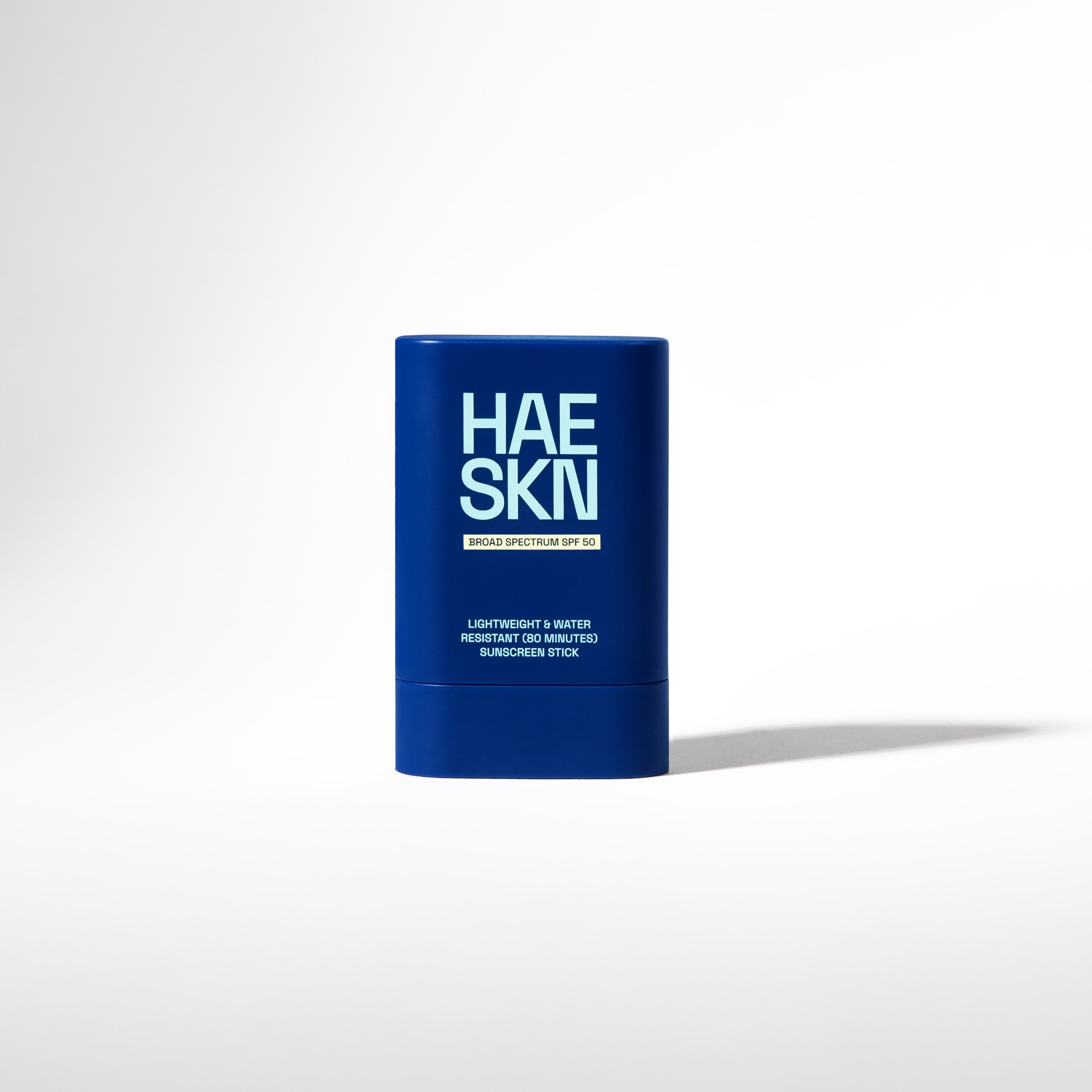
HAESKN publishes this guide and sells the HAESKN Sunscreen Stick SPF 50, an FDA-compliant SPF 50 broad-spectrum sunscreen in a portable stick format built for exactly this kind of one-handed, mid-session reapplication. It is a chemical (organic) filter formula, not mineral, which is what allows it to go on clear on every skin tone without the white cast associated with mineral sticks that rely on zinc oxide or titanium dioxide. Competing stick formats exist from brands like Supergoop! and EltaMD, and all three avoid the reapplication mess of lotion or spray. The category advantage is the format itself: what separates one stick from another is SPF level, filter type, and finish, covered below.
What to Look for in a Reapplication-Ready Sunscreen Stick
Judge any stick against the same four criteria, regardless of brand:
Criterion |
Why it matters for padel |
What to check on the label |
|---|---|---|
SPF 30 or higher, broad-spectrum |
Broad-spectrum is the only claim that covers both UVB (burn) and UVA (aging), per AAD guidance cited above |
"Broad Spectrum SPF 30" or higher on the Drug Facts panel |
Water/sweat resistance rating |
Padel produces sustained sweat during rallies, not a single splash |
Labeled 40-minute or 80-minute water resistance; reapply at or before that window closes |
Finish and filter type |
A greasy or white-cast finish discourages full-coverage reapplication between sets, which defeats the point |
Chemical (organic) filters trend clear on all skin tones; mineral filters (zinc oxide, titanium dioxide) trend visible unless finely milled |
Portable format |
If it is not in the bag, it does not get reapplied |
Stick, not a bottle that needs to stay in a locker |
HAESKN's SPF 50 stick meets the first three on its own Drug Facts label and FDA-compliant formulation; the fourth is inherent to the stick format itself, whichever brand a player chooses. What HAESKN does not publish is an independent, third-party water-resistance test beyond the FDA-required label claim, and players training in unusually humid climates should treat the 40 or 80-minute label window as a ceiling, not a target to stretch.
How Often to Reapply During a Padel Session
Follow the label's stated water-resistance window, not the generic two-hour rule, once sweating starts. A sunscreen labeled 80-minute water resistant should be touched up at the next changeover after that window closes, which in a competitive three-set match may mean two or three reapplications rather than one. For a casual hour-long social match played early or late in the day, one application before play plus one touch-up at the midpoint is a reasonable floor. Reapply forearms, the back of the neck, and ears in addition to the face. HAESKN's related guide on how often to reapply sunscreen during the day breaks down how sweat and water specifically shorten that window beyond the 2-hour baseline, and the brand's piece on why sunscreen stings your eyes when you sweat covers a related failure mode worth avoiding when reapplying around the eyes mid-match.
FAQ
How often should you reapply sunscreen during a padel match?
Reapply at or before the sunscreen's labeled water-resistance window closes, either 40 or 80 minutes once you start sweating, per the AAD-backed guidance cited above. A three-set match will typically need two or three touch-ups rather than one.
Do padel court glass walls block UV rays?
Partially. Migo Glass states that tinted court glass blocks roughly half of UV radiation, which still leaves meaningful exposure over a full match, and untinted or open-sided courts provide no reduction at all.
Is playing padel indoors a reason to skip sunscreen?
Indoor courts remove direct solar exposure, but if the court has glazed walls or skylights, some UVA can still pass through glass. Indoor players facing outdoor-facing glass should still apply a daily broad-spectrum SPF as a baseline precaution rather than assuming zero exposure.
Can you apply a sunscreen stick over sweat without wiping it off first?
Yes, that is the practical advantage of the stick format over lotion. A stick can be swiped directly over damp or sweaty skin between points without needing clean, dry hands to rub it in evenly.
Is SPF 30 enough for padel, or should you use SPF 50?
SPF 30 is the dermatologist-recommended floor for outdoor activity, but a higher SPF like 50 adds a margin of error for players who tend to under-apply or who play during peak midday hours between 12:00 and 16:00, when AllForPadel notes UV intensity is highest.
Pick a broad-spectrum SPF 30+ stick you will actually reach for between sets, keep it in your padel bag rather than a locker, and match your reapplication schedule to the label's water-resistance window rather than the generic two-hour rule. See the HAESKN Sunscreen Stick SPF 50 product page for the current Drug Facts label and pricing.
HAESKN Sunscreen Stick SPF 50
24.00 USD
Shop now
HAESKN SOLCHECK
15.00 USD
Shop now

HAESKN Sunscreen Stick SPF 50 - Save $4
44.00
Shop now