
Mineral or Chemical Sunscreen for Daily Use?
Both mineral and chemical sunscreens can deliver broad spectrum SPF 50 for daily wear, so the category word on the front of the bottle predicts very little about how protected you actually are. What decides the outcome is the active ingredient list on the Drug Facts panel, the tested water-resistance time printed on the front, and whether the format fits the routine you already have. Read those three things in that order and the mineral-versus-chemical question mostly resolves itself.
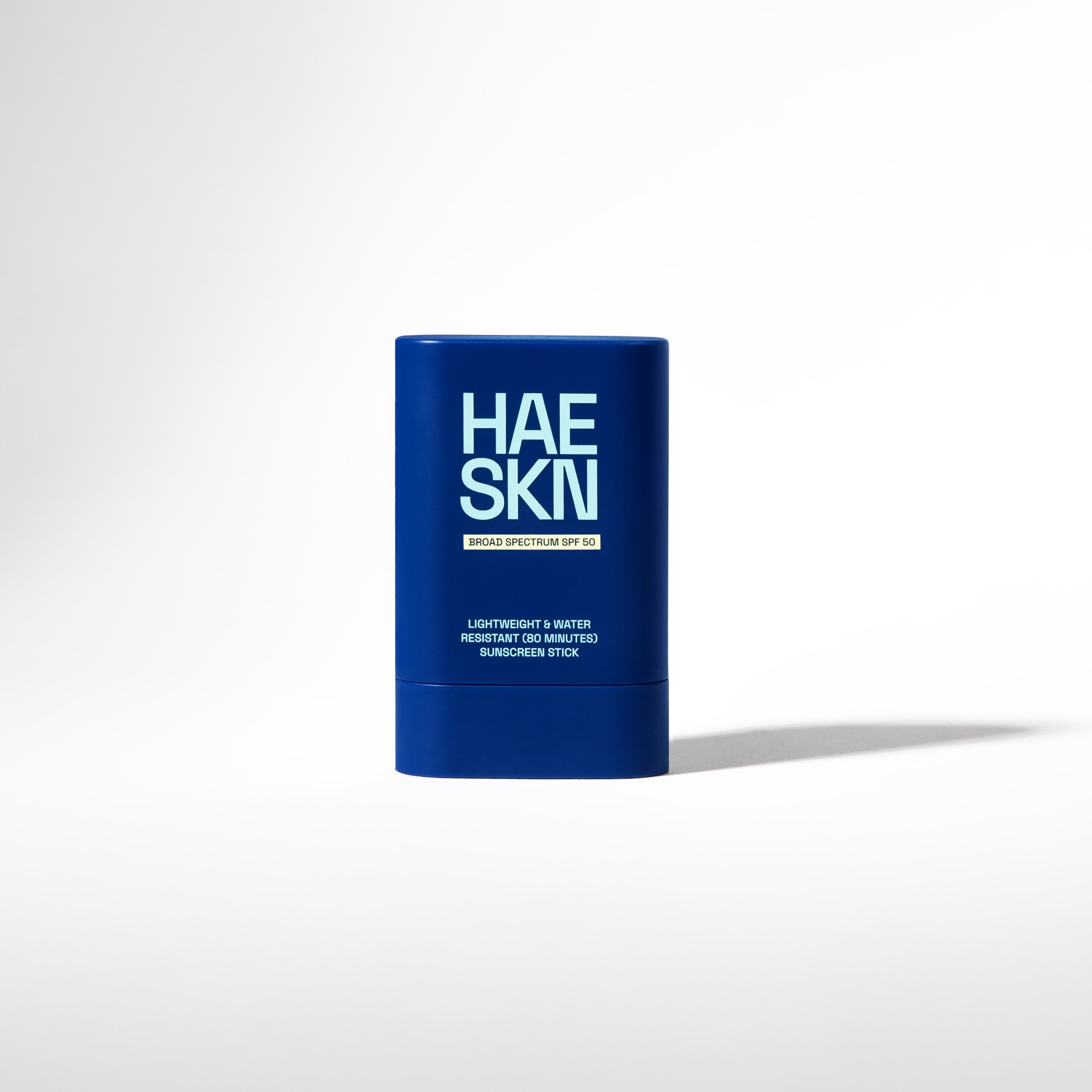
The useful daily sunscreen is the one whose specific filters, tested minutes, and format match the day you are about to have. We publish this guide at HAESKN and we sell the HAESKN Sunscreen Stick SPF 50, which uses FDA-approved chemical filters: avobenzone, homosalate, octisalate, and octocrylene. That puts us on one side of a debate we think is framed poorly, so here is the framing we use instead, including the places where our own product is the wrong answer.
What the FDA has actually decided
The regulatory picture is narrower than the marketing suggests. In its proposed order on over-the-counter sunscreens, the FDA listed zinc oxide and titanium dioxide as generally recognized as safe and effective (GRASE), proposed that aminobenzoic acid (PABA) and trolamine salicylate are not GRASE, and placed twelve other filters, including avobenzone, homosalate, octisalate, octocrylene, octinoxate, and oxybenzone, in a category requiring additional safety data before the agency will classify them.
That third category is where most of the confusion starts. The FDA's 2019 fact sheet describes those ingredients as needing more data before the agency can determine they would be GRASE. It is a statement about the completeness of the toxicology file, not a finding that the filters caused harm, and the agency has left them on the market while it waits.
The same document also settles a question about format: the FDA proposed oils, lotions, creams, gels, butters, pastes, ointments, and sticks as GRASE dosage forms, with sprays subject to particle-size and flammability testing and powders held back for insufficient data. Format has its own regulatory standing, separate from the filter debate.
Absorption, and what 0.5 ng/mL is for
The strongest evidence behind the safety concern comes from two maximal-use pharmacokinetic trials. In the first, Matta and colleagues (JAMA, 2019) randomized 24 healthy volunteers to one of four commercial sunscreens applied at 2 mg/cm² over 75% of body surface, four times a day for four days, with 30 blood samples drawn per participant over seven days. Avobenzone, oxybenzone, octocrylene, and ecamsule all exceeded 0.5 ng/mL in plasma after four applications on day one.
The 2020 follow-up extended the design to 48 participants and six filters, adding homosalate, octisalate, and octinoxate.
The number matters less than what it is for. FDA guidance treats 0.5 ng/mL as the systemic absorption level above which a sunscreen active should undergo additional nonclinical toxicology assessment, including carcinogenicity and reproductive studies. Crossing it starts a testing obligation, and the trial authors described their own result as preliminary evidence supporting further study, with the explicit caution that the findings do not mean people should stop using sunscreen.
Both trials measured plasma concentration alone, with no clinical outcome tracked. The dosing was also deliberately maximal: 2 mg/cm² across three quarters of the body, four times a day, which is far more product than most people apply in ordinary life.
Reef rules are written around named filters
Sunscreen laws are the clearest case of the category label failing. Hawaii Act 104 prohibits the sale, offer for sale, and distribution of sunscreen containing oxybenzone or octinoxate without a prescription, beginning January 1, 2021. The statute names two molecules. It says nothing about whether a formula calls itself mineral.
That distinction has consequences in both directions. A formula marketed as mineral can still list octinoxate among its actives and fall foul of the statute, while a chemical formula built without those two filters complies. Maui County then adds a second, stricter layer: Ordinance 5306 restricts non-mineral sunscreen in the county, with mineral defined around zinc oxide and titanium dioxide.
Our stick contains neither oxybenzone nor octinoxate, and we make no reef-safe claim, because the phrase has no legal definition in the United States. For Maui County or any water where a mineral-only rule applies, buy a mineral sunscreen instead of ours. We have written more about how those rules actually read in what "reef-safe" sunscreen actually means.
How water resistance actually gets certified
Nothing about being mineral or chemical makes a formula stay on wet skin. Water resistance comes from the film the whole formula forms, and it is verified by a specific protocol. Under 21 CFR 352.76, a 40-minute claim requires the labeled SPF to hold after two 20-minute periods of moderate activity in water separated by a rest period; the 80-minute claim requires four immersion cycles.
Eighty minutes is the ceiling. There is no tested tier above it, which means the label cannot tell you that one 80-minute formula outlasts another 80-minute formula on a hot run.
The American Academy of Dermatology adds three shelf-level rules that follow from the same regulation. Waterproof claims are no longer permitted, because sweat and water remove sunscreen from skin. "Sport" has no FDA definition and usually just signals a 40 or 80 minute water-resistance test, so check the printed number. And even on dry skin, reapplication every two hours still applies. Our own guide to how often to reapply during the day works through the sweat and water cases.
Where the mineral label does carry a signal
Reactive skin is the one place the category word earns its reputation. A review in Dermatitis reports that oxybenzone is the most frequently reported contact and photocontact allergen among all UV filters, and that the review found no reports of allergic or photoallergic contact dermatitis to the inorganic filters, zinc oxide and titanium dioxide. The same review notes octocrylene as a frequent photoallergen in a European multicentre photopatch study, with cross-reactivity to ketoprofen and benzophenone-3.
If you have reacted to a sunscreen before, a fragrance-free mineral formula is a sensible starting point, and it is the recommendation we would give even though we do not sell one. Filters are only part of the picture, since a formula's inactive ingredients can trigger reactions as well, which is why a fragrance-free label is worth checking alongside the actives line. HAESKN makes no sensitive-skin, hypoallergenic, or non-irritating claim about our stick, and a patch test on a small area is the honest first step with any new formula.
Four checks that beat the category label
- Read the actives line first. The Drug Facts panel names every UV filter in the product. That list tells you whether a formula is legal in Hawaii, whether it contains a filter you have reacted to before, and what the FDA has and has not classified.
- Confirm broad spectrum plus an SPF number. Broad spectrum is the UVA half of the promise. An SPF number on its own describes UVB protection.
- Look for printed water-resistance minutes. If no 40 or 80 appears on the front, no water resistance was tested, per 21 CFR 352.76.
- Match the format to the routine you actually keep. SPF tests certify a formula at 2 mg/cm², a dose almost nobody applies by eye. The format that gets you closest to a full, even application, and that you will carry and reuse at midday, does more for your protection than any argument about filter chemistry.
One corollary of the test dose: layering two different sunscreens does not add their SPF numbers together. Each product was certified at its own full dose, so half of one plus half of another leaves you under both labels. Applying enough of a single broad spectrum formula is the more reliable move.
Where our stick fits, and where it does not
The HAESKN Sunscreen Stick SPF 50 was designed around the reapplication problem. Its four organic filters stay clear on skin, which is why it does not leave the gray residue that sends deeper skin tones back to bare skin at midday, a trade-off we cover in our guide to sunscreens for brown skin with no white cast. The stick format runs one-handed over a hairline, ears, and the tops of the shoulders without needing clean palms.
It contains zero zinc oxide and zero titanium dioxide, so it is the wrong product for a mineral-only jurisdiction, and anyone who has been photopatch tested and advised to avoid organic filters should follow that advice over ours. For an outdoor routine where the real failure mode is skipping the second application, a portable clear stick is the format we built and the one we use.
If that describes your day, the HAESKN Sunscreen Stick SPF 50 is listed at $24. Read its Drug Facts panel first, exactly as we have asked you to read everyone else's.
FAQ
Is a chemical sunscreen safe to use on my face every day?
The FDA has not completed its safety determination for the organic filters, which is why they sit in the "additional data needed" category rather than the GRASE one, according to the FDA fact sheet. The absorption trials that raised the question measured plasma levels under maximal-use dosing and reported no clinical harm. If the open regulatory file bothers you, zinc oxide and titanium dioxide are the two filters the agency has proposed as GRASE, and switching is a reasonable personal choice.
Is SPF 50 worth choosing over SPF 30 for daily wear?
Both meet the broad spectrum standard, and the marginal difference in UVB filtration is smaller than most labels imply. The larger variable is dose: SPF is certified at 2 mg/cm², and most people apply less, which pulls real-world protection below the number on the tube. Choosing a higher SPF gives you a buffer against under-application, but it does not change the two-hour reapplication rule.
Do mineral sunscreens always leave a white cast?
Not always. Tinted and micronized zinc formulas reduce visible residue considerably. The residue exists because zinc oxide and titanium dioxide are particles that sit on the skin surface, which is the same property that makes them physically inert on skin, so finish and filter class are linked in a way that finish and SPF are not.
Does the SPF in my moisturizer or makeup count?
Treat it as a bonus rather than your protection. The same dose problem applies with more force: an SPF 30 foundation applied in a thin cosmetic layer delivers a fraction of its tested protection. If you are going to be outdoors for an extended stretch, apply a dedicated sunscreen at a full dose and let the makeup sit on top.