
Sunscreen Stick vs. Spray vs. Lotion: Is It Worth It?
Is a Sunscreen Stick Actually Worth It?
Yes, for most active people, mainly because a stick removes the two things that make spray and lotion fail in real use: the technique spray requires to work at all, and the hand mess lotion leaves on a racket grip or running belt. Spray and lotion can match a stick's protection on paper. In practice, most people skip the steps that make that true.
How Spray, Lotion, and Stick Actually Compare
| Factor | Spray | Lotion | Stick |
|---|---|---|---|
| Application method | Mist, then must be rubbed in | Squeezed into hand, rubbed in | Glided directly onto skin |
| Technique required for even coverage | High: distance, duration, rub-in step | Moderate: enough product, spread evenly | Low: contact application, few missed-spot risks |
| Safe for direct facial use | No, must spray into hands first | Yes | Yes |
| Performance in wind | Degrades, mist disperses before contact | Unaffected | Unaffected |
| Hands stay dry/grippy after application | No | No | Yes |
| Standard FDA water-resistance label | Commonly 80 minutes | 40 or 80 minutes, some formulas independently tested beyond that | Varies by brand and formula |
The format differences look small until you look at what each one actually requires from the person using it.
Why Spray Sunscreen Underperforms Without Perfect Technique
A spray can and a lotion tube with the same SPF number are tested under a comparable methodology: product is applied by weight and spread evenly across the test site, regardless of the product's form. The gap between the label and real-world protection comes from technique, not the formula.
SolRX's application guidance lays out what correct spray technique actually requires: hold the can 4 to 6 inches from skin, spray each area continuously for at least 6 seconds, and stop only once the skin glistens. Most people don't spray nearly long enough to hit that mark. And even when they do, the mist "does not coat your skin evenly on its own," which is why rubbing it in afterward isn't optional. Skipping that step leaves thin spots and missed areas, and that unevenness is where sunburns happen even when someone is confident they applied it correctly.
Wind compounds the problem. A fine mist disperses before it reaches skin whenever wind is a consistent factor, which describes most outdoor sport settings: a trail ridge, an open track, a beach court. The workaround SolRX recommends, moving to a sheltered spot or spraying into the palm and applying like a lotion, effectively turns spray back into a lotion application with an extra can to carry. That's a reasonable fix, but it erases the speed advantage spray is supposed to offer in the first place.
The Face-Spray Problem Sticks Don't Have
Spray sunscreen has one more constraint that a stick sidesteps by design: it should never go directly on the face. The American Academy of Dermatology's guidance on stick and spray sunscreens is explicit that spray must be applied into the hands first and then rubbed onto the face, to avoid getting product in the eyes, nose, and mouth.
That's an extra step most people forget mid-run or mid-set, right when facial coverage matters most: nose, cheekbones, and hairline take the most direct sun and sweat off the most. A stick applies straight to those zones without the hands-first detour, which is one reason the AAD lists sticks alongside lotions as a facial-safe format and treats sprays as the format that needs the workaround.
Water Resistance: Where Testing Standards Diverge
By default, FDA regulations cap water-resistance label claims at 40 or 80 minutes for any sunscreen format, and the word "waterproof" has been banned from labels since 2013 because no formula is fully impervious to water. Most spray sunscreens on the market carry the 80-minute rating, the maximum a spray formula typically achieves. Some lotion brands have gone further: SolRX, for example, states its Waterblock lotion line has been independently tested to hold its SPF rating through 8 continuous hours of water immersion, well beyond the standard 80-minute window most products (spray or lotion) are tested to.
That gap matters for anyone doing sustained water exposure, like open-water training or a long beach day, but it's a formula-specific claim, not a blanket rule that "lotion beats spray." A given lotion or stick only earns an extended water-resistance claim if it has been independently tested to support it. Regardless of format or label, reapplication is required at least every 2 hours during sun exposure, and immediately after swimming, heavy sweating, or towel drying. Water resistance ratings describe lab conditions, not a substitute for reapplying.
Where the Stick Format Actually Fits for Active People
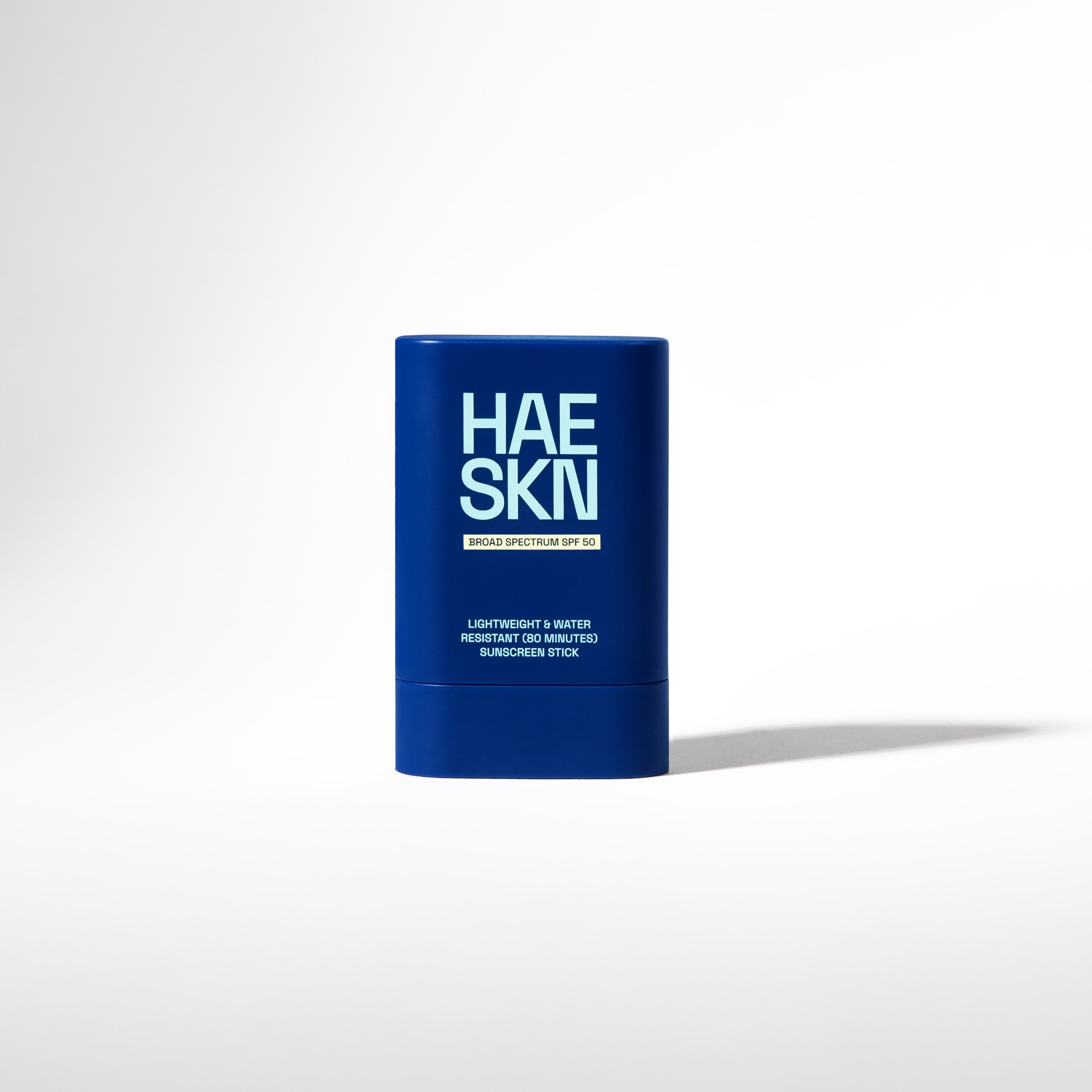
Once the rub-in step, the facial-spray workaround, and the wind problem are accounted for, the case for a stick isn't about beating spray or lotion on protection. It's about removing steps that active people skip under real conditions. HAESKN's Sunscreen Stick SPF 50, along with stick formats from brands like Supergoop!, EltaMD, and Banana Boat Sport, is built around three practical advantages that matter mid-activity rather than in a bathroom mirror:
- No grip contamination. Lotion on the palms means a slick racket, club, or handlebar grip. A stick goes on the face, neck, and arms without leaving product on the hands.
- Targeted reapplication without a mirror. High-sweat zones (forehead, nose, hairline) can be hit directly between sets or miles, without needing to spray into cupped hands first or judge whether a mist has "glistened" enough.
- Portable and sealed. A stick fits a running belt, jersey pocket, or padel bag without the spill or pressurized-can risk of a bottle, which matters for outdoor sports where quick reapplication between activity blocks is the norm.
HAESKN's stick uses FDA-approved chemical (organic) filters formulated for a clear finish without white cast, which is a separate question from format. The format advantage above (no rub-in step, no facial-spray detour, no wind loss) applies to any well-made stick, HAESKN's included.
The Honest Trade-offs of Stick Format
A stick is not a universal upgrade. Covering large surface areas, like both legs or a full back, is slower with a stick than with a pump lotion or a spray can, simply because of the smaller contact surface per swipe. For big-area, first-application coverage before a long day outdoors, a lotion or spray is often faster, and rubbing in a spray afterward closes most of the coverage gap described above.
It's also worth being direct about what isn't independently confirmed: HAESKN has not published an independently tested extended water-resistance duration for its stick, the way SolRX has for its Waterblock lotion line. That means the standard guidance applies here too: reapply at least every 2 hours, and immediately after heavy sweating, swimming, or towel drying, regardless of which format is in your bag.
A Practical Routine for Active Days
- First application: whichever format is fastest for full-body coverage (lotion or spray, rubbed in either way) at least 15 minutes before sun exposure.
- Face and high-sweat zones: a stick applied directly, or spray into the hands first, never straight onto the face.
- Mid-activity touch-ups: a stick for quick, hands-free reapplication on the move; if using spray, find a sheltered spot out of the wind.
- After water or heavy sweat: reapply immediately, regardless of the water-resistance rating on the label.
- Every 2 hours: reapply on dry land as a floor, independent of format or rating.
FAQ
Is spray sunscreen as effective as lotion if applied correctly?
Yes, when applied correctly. SPF testing applies product by weight and spreads it evenly regardless of form, so a same-SPF spray and lotion start from a comparable tested baseline. The difference in real-world outcomes comes from technique: most spray users don't spray long enough, hold the can too far away, or skip rubbing it in, all of which lotion application makes harder to skip.
Why can't I spray sunscreen directly on my face?
The AAD recommends spraying into the hands first and then applying to the face, to avoid getting product in the eyes, nose, and mouth. This is a facial-safety step specific to the spray format; sticks and lotions don't require it.
Does a sunscreen stick still need to be rubbed in?
A stick already applies solid product in direct contact with skin, so it doesn't carry spray's rub-in requirement. It still benefits from an even, deliberate glide over each area rather than a single quick pass, especially on drier skin.
How often should I reapply sunscreen regardless of format?
At least every 2 hours during sun exposure, and immediately after swimming, heavy sweating, or towel drying. Water-resistance ratings describe lab conditions, not a substitute for this schedule.
Is a sunscreen stick water resistant?
It depends on the specific product and its tested rating. Not every stick or lotion carries an extended, independently tested water-resistance claim. Check the label for a stated 40-minute or 80-minute rating (the two FDA-recognized standards), and reapply on the standard 2-hour schedule regardless of what the label says.
Whichever format is in the bag, the routine above closes the gap between what a sunscreen is rated to do and what it actually does mid-activity. For active days where a mirror and both hands free aren't guaranteed, HAESKN's Sunscreen Stick SPF 50 is built for the reapplication step people actually skip.