
Best Sunscreen for Active People, Ranked by Compliance
The best sunscreen for an active person is a broad-spectrum SPF 50 you can reapply one-handed, mid-activity, without leaving a visible layer on your skin. Sun protection research on athletes keeps landing on behavior rather than filter chemistry: in a study of 210 marathon runners, only 56.2% reported using sunscreen regularly, and almost all of them trained in clothing that left arms and legs exposed. That makes finish and format the criteria worth ranking on, which is why we put clear-finish sticks at the top of this list and score every product against a stated 40 or 80 minute water-resistance window.
Pick the product you will still be using in week ten of a training block. Filter type, price, and marketing language matter far less than whether the tube or stick in your pocket gets opened again two hours into a long day outside.
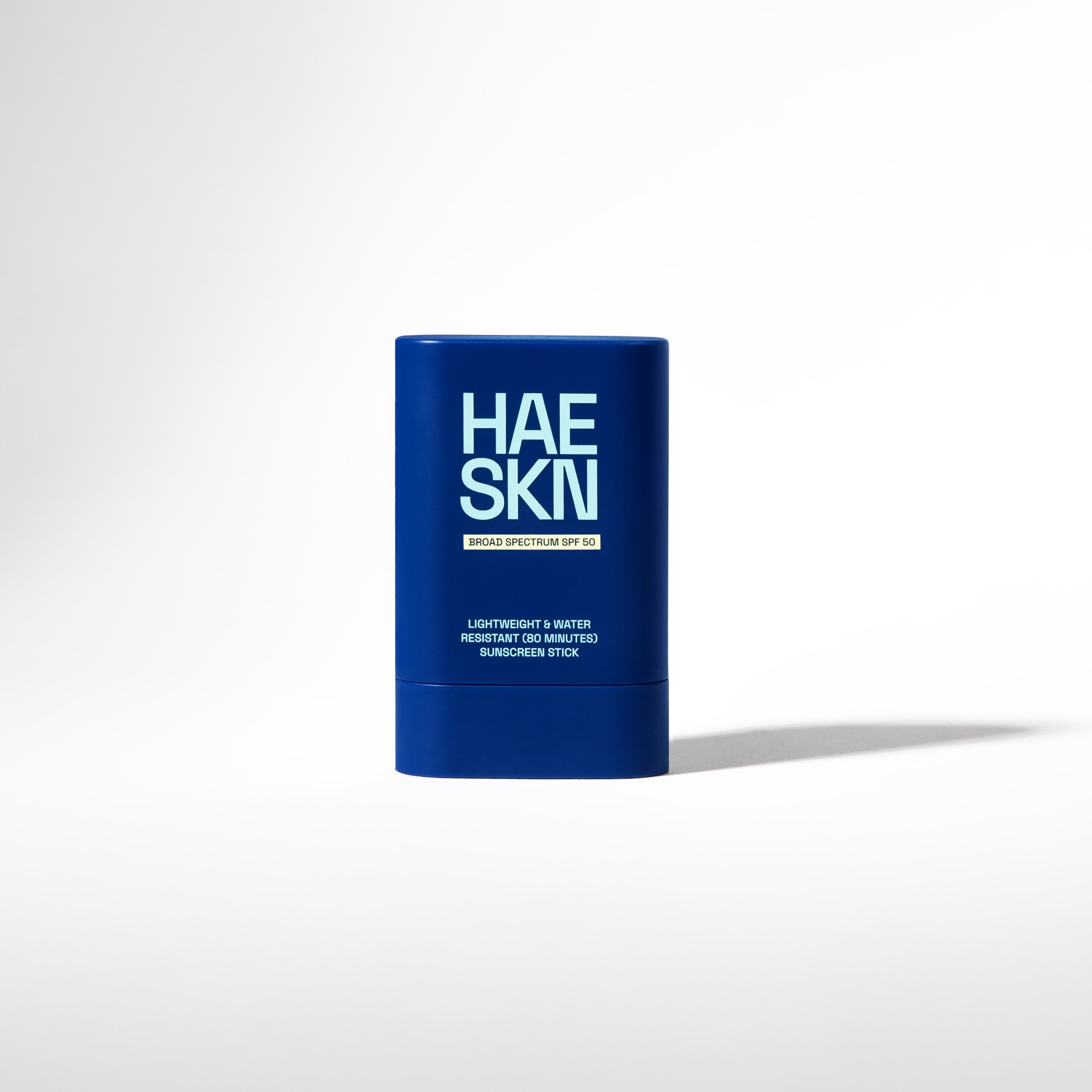
HAESKN publishes this guide and sells the HAESKN Sunscreen Stick SPF 50, which appears first in the ranking below. The criteria are stated before the list so you can check our placement against them, and we flag the one criterion where our own product is not scored.
What the research on athletes actually measured
The most-cited data point on active people and sun protection comes from Graz, Austria. Christina M. Ambros-Rudolph, MD, and colleagues at the Medical University of Graz evaluated 210 marathon runners (166 men and 44 women, ages 19 to 71) recruited at a local marathon, comparing them with age- and sex-matched controls (ScienceDaily summary).
Their findings, published in Archives of Dermatology in 2006: runners presented with more atypical melanocytic nevi, solar lentigines, and lesions suggestive of nonmelanoma skin cancer, and those findings correlated with increasing training intensity. During exercise, 96.7% wore shorts and 98.6% wore shirts that would not, or would only partially, cover the back and extremities. Regular sunscreen use was reported by 56.2% of runners. The authors' recommendation was practical: schedule training away from peak sun, wear adequate clothing, and use water-resistant sunscreens regularly (PubMed).
A 2023 narrative review in Cancers by Katarzyna Kliniec and colleagues at Wroclaw Medical University analyzed 62 articles on outdoor sports and skin cancer. Two mechanisms specific to exercise show up there: sweating-increased skin photosensitivity, and activity-induced immunosuppression, both associated with greater skin cancer risk. The review groups marathon runners with swimmers and surfers as populations where melanoma appears more commonly, and concludes that outdoor sports participants do not protect themselves adequately despite generally satisfactory knowledge of the risk (Cancers, 2023).
Both papers point at the same lever. Athletes generally understand the risk, and what varies between them is how many times a bottle gets opened during a season.
Worth stating the limits. The Graz study is observational, from one European city, in a mostly light-skinned cohort, and it cannot prove that sunscreen use would have changed those skin findings. The 2023 paper is a narrative review rather than a pooled analysis. Neither tells you which product to buy. Both tell you which product property to weight.
Our ranking criteria
We ranked on five things, in this order of weight:
- Finish on medium-to-deep skin. A visible gray or ashy layer is the most common reason a sunscreen gets left in a gym bag. This is a compliance variable before it is a cosmetic one.
- One-handed application in motion. Whether you can cover a face, ears, and the back of the neck without stopping, sitting down, or washing your hands afterward.
- A stated water-resistance window. The label must carry a tested 40 or 80 minute claim. This is a pass-or-fail check.
- Pocket portability. A product that fits a running belt, a racket bag pocket, or a jersey pocket gets reapplied. A 6 oz bottle in a car does not.
- Price transparency. A published price you can check.
Criterion 3 needs a caveat about our own entry. We are not quoting a water-resistance figure for the HAESKN stick in this guide, because we hold first-party product claims to label evidence and we are not sourcing that number here. Read the Drug Facts panel on your own unit, ours included, and treat the printed minutes as the only number that counts.
The ranking
1. HAESKN Sunscreen Stick SPF 50
Broad-spectrum SPF 50 in a pocket stick, formulated with four FDA-approved chemical filters: avobenzone, homosalate, octisalate, and octocrylene. No zinc oxide and no titanium dioxide, which is the formulation reason it goes on clear rather than leaving the pale layer mineral sticks tend to deposit. Listed at $24.00 on our product page. Made in the US as an FDA-compliant OTC drug product.
The finish claim comes out of our own field testing rather than a lab. Our cofounder tested 12 mineral sunscreen sticks, and all 12 left a visible white layer after roughly 30 minutes of activity. We saw the same failure again in runner testing with the HOKA Run Club ahead of the NYC Half Marathon, which is where the finish criterion moved to the top of this list.
It ranks first on criteria 1, 2, 4 and 5. On criterion 3 it is unscored here, as explained above. If a stated water-resistance number is your single deciding factor, one of the 80-minute products below is the defensible choice.
2. Supergoop! PLAY Everyday Sunscreen Stick SPF 50
Chemical-filter stick with a teardrop applicator for ears, nose bridge, and hairline. The retail listing states SPF 50, fragrance free, water- and sweat-resistant for up to 80 minutes, and a clear finish with no white cast (listing). It scores on all five criteria including the stated 80-minute window, and the shaped tip is genuinely better than a flat stick face for the bony spots runners and racket-sport players miss.
3. Supergoop! PLAY 100% Mineral Sunscreen Stick SPF 50
A 100% mineral zinc oxide option, water- and sweat-resistant up to 80 minutes, marketed for quick reapplication and safe for children 6 months and older per the manufacturer page. Choose it when you want zinc specifically, for example in reef-protected waters where non-mineral sunscreens are restricted. On criterion 1 it carries the usual trade-off of a high-percentage zinc formula, which is why it sits below the two clear sticks in a ranking that weights finish first.
4. EltaMD UV Sport SPF 50
A zinc oxide sport lotion rated water and sweat resistant for 80 minutes, sold in a face-and-body tube (retail listing). Strong on the label criterion and a reasonable pre-activity base layer. It ranks fourth because a tube fails criterion 2 and criterion 4: mid-session reapplication means greasy hands, and an 8 oz tube stays in the car.
| Product | Filter type | Stated water resistance | Format | Best for |
|---|---|---|---|---|
| HAESKN Sunscreen Stick SPF 50 | Chemical (avobenzone, homosalate, octisalate, octocrylene) | Check the Drug Facts panel on your unit | Pocket stick, $24 | Clear finish on every skin tone, reapplying in motion |
| Supergoop! PLAY Everyday Stick SPF 50 | Chemical | Up to 80 minutes | Stick, teardrop tip | Precision spots, stated label window |
| Supergoop! PLAY 100% Mineral Stick SPF 50 | Mineral (zinc oxide) | Up to 80 minutes | Stick | Zinc-only requirements, reef-restricted water |
| EltaMD UV Sport SPF 50 | Mineral (zinc oxide) | Up to 80 minutes | Lotion tube | Pre-activity base layer on the body |
Four products only. We listed items whose specifications we could read on a manufacturer page or a retail listing, and left out the sport sprays and sticks whose claims we could not verify at that level.
What the 40 and 80 minute numbers mean
Both numbers come from a standardized test, and neither describes your total time outdoors. The FDA requires water-resistance claims on the front label to state whether protection holds for 40 or 80 minutes while swimming or sweating, and it prohibits the words waterproof, sweatproof, and sunblock entirely (FDA).
The American Academy of Dermatology adds the part athletes skip: even if your skin stays dry, reapply every 2 hours, because UV breaks some filters down and others clump and lose effectiveness on the skin (AAD).
For a 90 minute session in heavy sweat, an 80-minute rating means one reapplication is already due before you finish. For a four-hour hike, you are looking at two or three. We go deeper on the timing in our guide to how often to reapply sunscreen during the day.
A routine that survives a training block
- Apply 15 minutes before you go out, to dry skin, and cover the spots clothing will not: ears, hairline, back of the neck, tops of shoulders, backs of the calves.
- Carry the reapplication product on your body, not in the bag you left at the trailhead.
- Set the interval by the harder of the two clocks: the label's 40 or 80 minute sweat window, or two hours dry.
- Reapply immediately after towel drying. Friction from a towel, a strap, or a racket grip removes film faster than the lab test that produced the number.
- Re-cover the face last, working outward from the nose, and press rather than drag if you are already sweating.
If you are choosing between formats rather than brands, our breakdown of stick versus spray versus lotion covers where each one fails in practice, and our no-white-cast picks for brown skin goes further into the filter chemistry behind finish.
FAQ
Does sweating make sunscreen less effective, or just wash it off?
Both effects appear in the literature, and they are separate problems. Physical removal by sweat and friction is the obvious one. The 2023 Cancers review also describes sweating-increased skin photosensitivity as a factor working against athletes, alongside activity-induced immunosuppression from sustained training (Cancers, 2023). Reapplication addresses the first. Only reducing exposure addresses the second.
Is SPF 50 necessary, or is SPF 30 enough for sport?
SPF 30 meets the general dermatology recommendation, and a higher SPF does not extend your reapplication interval. The practical argument for SPF 50 in sport is margin: almost nobody applies the full test-dose amount, and the higher number buys some headroom against under-application. It does not buy time.
Do I need a sport-specific sunscreen at all?
You need a broad-spectrum product with a stated water-resistance window and a format you will reuse mid-activity. "Sport" on the front of a bottle is a marketing category. The 40 or 80 minute line beside it is a tested claim (FDA), so read the label rather than the category name.
What about the parts of me clothing covers?
Check what the fabric actually blocks. In the Graz cohort, 96.7% of runners exercised in shorts and 98.6% in shirts that left the back and extremities partly or fully uncovered, which leaves the shoulders, upper arms and legs dependent on sunscreen (PubMed). Sun-protective fabric with a UPF rating changes that calculation for the areas it covers.
How do I know whether a stick leaves a cast on my skin tone?
Swipe it on the jaw, not the inner arm, and look at it in daylight after 20 to 30 minutes of movement rather than immediately. Every one of the 12 mineral sticks in our own field test looked acceptable at minute one and left a visible layer at roughly minute 30. The time delay is the test.
Ready to try the format the ranking is built around? The HAESKN Sunscreen Stick SPF 50 is $24, fits a running belt, and goes on clear. Check its Drug Facts panel when it arrives, the same way you should check any label in this list.