
Best Sunscreen for Marathon Training in 2026
Sun Protection That Lasts a Three-Hour Long Run
Marathon training asks a sunscreen to work far longer than any label is allowed to promise. US sunscreens can only claim 40 or 80 minutes of water resistance, and that ceiling was written around a swimming-pool test, so the right plan for a build is a high-SPF base applied before you leave, a stick you can carry for the face and shoulders, and a reapplication trigger tied to sweat rather than to distance. For a 90-minute weekday session one application plus a mid-run touch-up is usually enough. For a three-hour long run or a hot race, plan on two or three.
Pick the sunscreen you will actually reapply mid-session, then build the session around it. That is the whole answer, and it is unglamorous, because the failure in a marathon build is almost never the SPF number on the tube. It is the four-hour Sunday effort covered by a single 6 a.m. application.
We make an SPF 50 stick for exactly this window, so treat what follows as our working view rather than a neutral survey. The regulatory and dermatology material below is public and linked; the product part is ours.
What the 80-minute label actually measures
Water resistance in the US is a tested claim with only two permitted values. Under 21 CFR 201.327, a label may read "Water Resistant (40 minutes)" or "Water Resistant (80 minutes)", and nothing else. The FDA's compliance guide describes the protocol: subjects perform moderate activity in water for 20 minutes, rest and air-dry for 15, and repeat. Two cycles substantiate the 40-minute claim, four cycles the 80-minute claim. The SPF is then measured on that film.
For anyone training for a marathon, that 80 minutes reads as a labeling ceiling: the longest window a brand is permitted to print. The conditions behind it are pool immersion with no towel contact, a poor model for a runner in 28°C heat with a soaked singlet rubbing at the shoulders.
The American Academy of Dermatology adds the part most athletes skip: even a water-resistant product needs reapplication every two hours on dry skin, and the AAD notes that the FDA has never defined "sport" for sunscreen at all. A product marked "sport" is usually just telling you it passed the 40- or 80-minute test.
Can anything hold up for eight hours?
Some manufacturers do test beyond the regulatory window and publish the result. SolRX reports that its Waterblock lotions were run through eight hours of continuous water immersion with SPF monitored throughout, and that the SPF 30 formula measured SPF 35.83 at the end of the protocol. That figure is the company's own published account of an independent test rather than an FDA rating, and it cannot legally appear as a duration claim on the front of the bottle.
Read it as evidence that the 80-minute cap governs labels rather than film chemistry. Reapplication still applies. "80 minutes" tells you a product cleared a test bar, and stays silent about the hours after that.
How sweat raises the cost of the same UV dose
Sweat works against you twice. It lifts and redistributes the sunscreen film, and it appears to make the same UV dose bite harder. Moehrle and colleagues at the University of Tuebingen, publishing in Photodermatology, Photoimmunology & Photomedicine in 2000, measured minimal erythema dose before and after sweating provoked by sauna and by 15 minutes of jogging, and found a significant reduction in the UVB dose needed to produce erythema, with a decrease of up to 31.6% and a median of 15.8% in the sauna arm.
Endurance exposure stacks on top of that. A 2022 commentary in the Journal of Dermatology & Skin Science summarising sport-specific UV risk reports that Ironman triathlon participants have received UV radiation amounting to 8.3 times their minimal erythema dose, and that cyclists in one study exceeded international exposure limits by more than thirty times. The 2020 Sports Medicine - Open review by Alan Snyder and co-authors reaches the same broad conclusion about outdoor sport participants routinely exceeding recommended UV limits.
Runner behaviour compounds all of it. In a 2024 study of the 2023 Ultra Sierra Nevada race published in Science of the Total Environment, researchers surveyed 194 trail runners: 66.5% had been sunburned after outdoor sport in the previous year, and 49.7% said they did not reapply sunscreen at all.
Half of that surveyed group ran a multi-hour mountain race on a single application.
Matching the product to the session
A marathon build creates three separate exposure problems, and each wants a different answer.
Session |
Typical sun time |
What we use |
Reapply |
|---|---|---|---|
Weekday easy run, early or late |
40-60 min |
SPF 50 base on face, neck, shoulders, arms |
Not usually needed |
Tempo or interval session in heat |
60-90 min |
SPF 50 base, stick carried in a belt |
Once, at the recovery break |
Weekend long run, 2-4 hours |
120-240 min |
SPF 50 base plus stick, hat, and a planned stop |
Every 80-90 min of heavy sweating |
Race day |
3-5 hours |
Base 15-20 min before the corral |
Aid stations at roughly 90-minute intervals |
The base layer can be a lotion. Lotion is the cheapest way to get a full, even dose on legs, arms, and back before you leave the house, and the FDA test that produces the water-resistance number is run on that kind of film.
A stick solves the carrying half. It is a solid, so it goes in a shorts pocket or a hydration belt without leaking, and it lands where you aim it on skin that is already wet. That is why runners reach for sticks on the face, ears, and the back of the neck mid-session. Sprays are convenient but hard to dose accurately outdoors in wind, and the rub-in step still applies. We compared the three formats in detail in Sunscreen Stick vs. Spray vs. Lotion.
For the face, the pattern that survives sweat best in our own use is deliberate: a stripe down the nose, one horizontal pass across each cheekbone, one across the forehead below the hairline, and one over the tops of the ears. Ears are easy to skip when you are rushing out the door, and they sit in direct sun for the entire session.
Where our stick fits, and where it does not
The HAESKN Sunscreen Stick SPF 50 is a broad-spectrum SPF 50 stick built on four FDA-approved chemical filters: avobenzone, homosalate, octisalate, and octocrylene. There is no zinc oxide or titanium dioxide in it, which is why it goes on clear on every skin tone rather than leaving the grey film mineral sticks can leave on brown and deep skin. It is manufactured in the US as an OTC drug product and sells for $24.
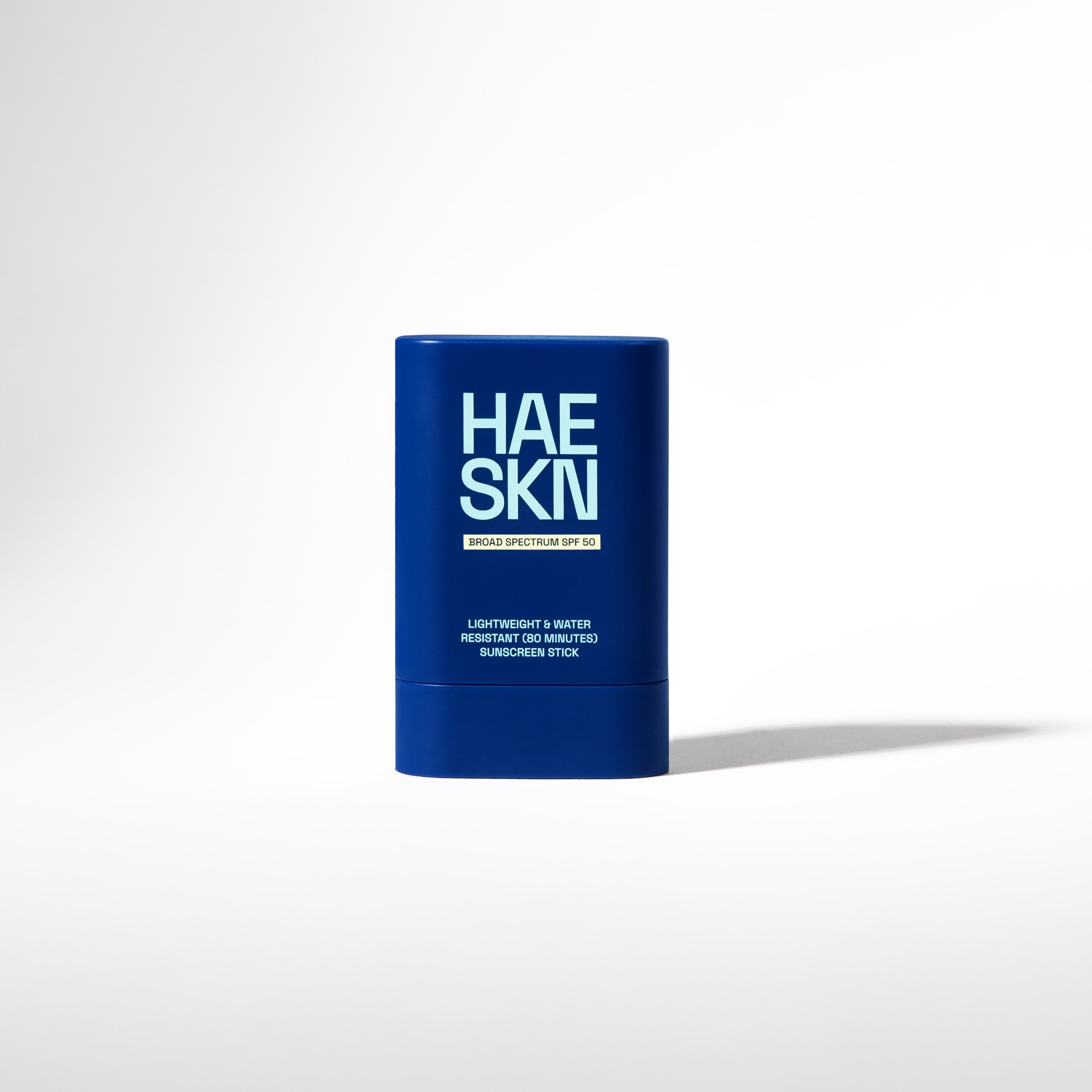
Honest limits, because a training block is a bad place for marketing optimism. We have not put our formula through an eight-hour immersion protocol like the one SolRX publishes, and we do not claim all-day protection from a single application. Whatever water-resistance time is printed on the Drug Facts panel of the stick in your pocket is the number that applies, and after that window of heavy sweating you reapply. We also make no claim that our stick is sweatproof or that it will not run into your eyes: sweat carries whatever is on your forehead downward, which is a physics problem we explain in Why Does Sunscreen Sting Your Eyes When You Sweat?.
SOLCHECK, our $15 UV detection sticker, exists for the part of this you cannot feel. It responds to UV exposure so you have a visual cue on a long run instead of a guess.
HAESKN Sunscreen Stick SPF 50
24.00 USD
Shop now
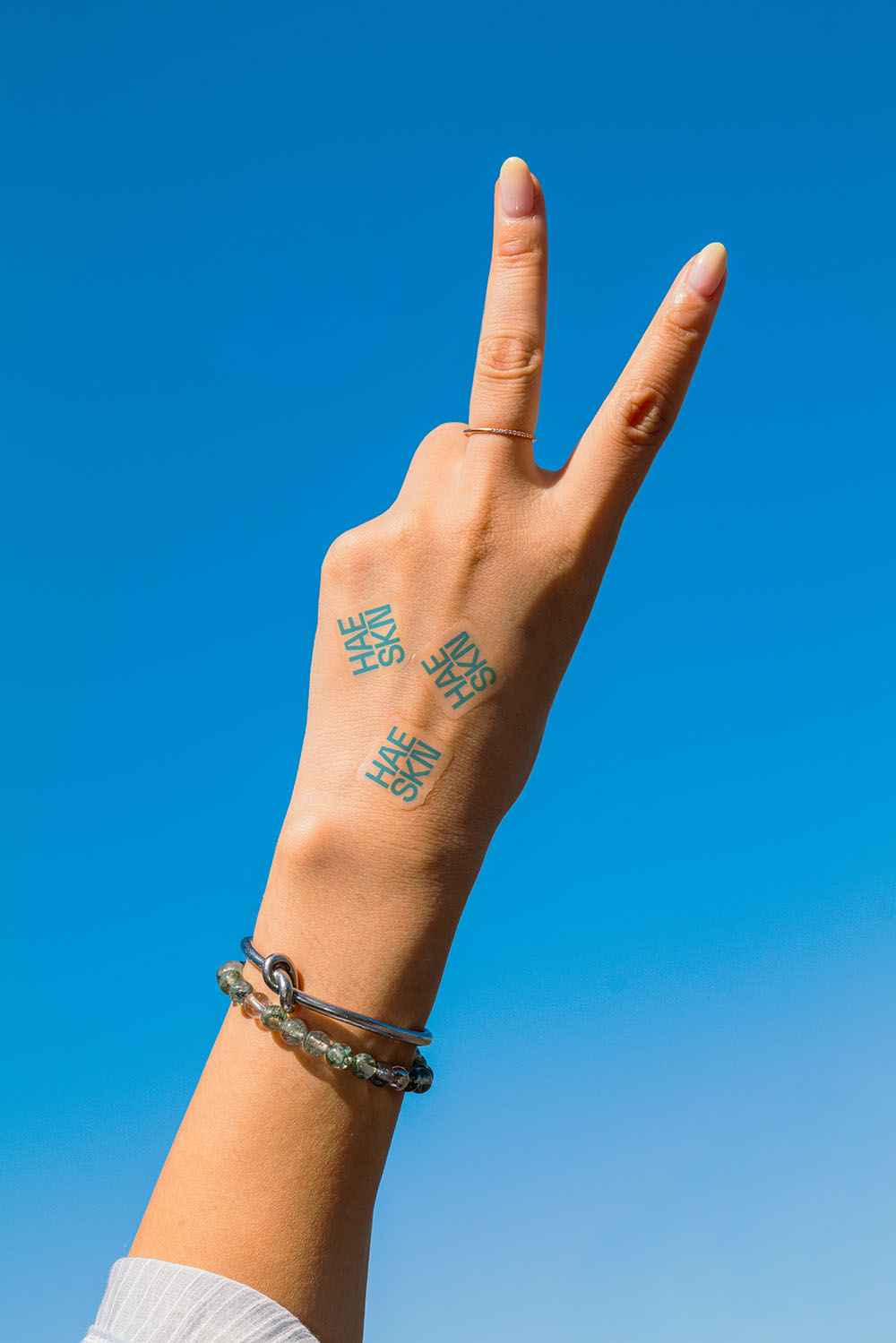
HAESKN SOLCHECK
15.00 USD
Shop now
If you want a side-by-side against other stick options, we ranked five of them in Best Sunscreen Sticks for Runners in 2026, including the ones we lose to on price.
Building the habit across sixteen weeks
Sunscreen fails in a marathon build the same way fuelling does. It works in week 3 when the weather is mild and the runs are short, then quietly collapses in week 11 when the long runs get long and the mornings get hot.
Three things that make it stick, from our own training and from what customers tell us:
Keep the stick with the kit, not in the bathroom. A stick in the same drawer as your watch and your gels gets used. One upstairs does not.
Tie reapplication to something already in the session. An aid station, a water fountain loop, the turnaround on an out-and-back. The AAD's two-hour rule is easy to honour when it maps onto a stop you were making anyway. Our reapplication timing guide walks through the sweat and water triggers.
Shift the hard sessions out of peak UV where the schedule allows. Sunscreen is one layer. A cap, a technical long-sleeve, and a 6:30 a.m. start do work that no formula does.
FAQ
Is SPF 50 enough for a marathon, or should I look for SPF 70 or higher?
SPF 50 is a sensible ceiling for practical purposes. A higher number does not extend how long the film survives; the reapplication schedule is identical. What higher SPF buys is margin against under-application, and most people apply less than the lab dose. Focus the effort on applying enough and reapplying on schedule rather than on the number.
Does a water-resistant sunscreen's clock start when I put it on?
No. Per the FDA test protocol, the 40 or 80 minutes counts time spent in water or sweating heavily, not elapsed time since application. On dry skin at rest, the AAD's every-two-hours guidance is the governing rule.
Should I use a different sunscreen on race day than in training?
Use the same one. Race morning is the worst possible time to discover a new formula that runs into your eyes or gums up under a heart-rate strap. Test the exact product and application pattern on at least two long runs in similar heat before you race it.
Can I skip sunscreen on cloudy or cold training days?
Cloud cover reduces UV inconsistently, and cool air does nothing to it. The trail-running data above showed two-thirds of surveyed athletes had been sunburned after outdoor sport in the past year, and much of that exposure is accumulated on days that did not feel dangerous. Cold-weather long runs at altitude are a particular gap.
How much sunscreen should a runner actually apply?
Cover every exposed surface until the skin looks evenly coated with no gaps, paying attention to ears, the back of the neck, the tops of the shoulders, and the strip of scalp along a part line. With a stick, that means several passes over the same area rather than one light swipe.
Ready to sort the carry problem? Our SPF 50 stick fits a shorts pocket and goes on clear mid-run, so the reapplication you planned is the one you actually make.