
Best Sunscreen Sticks for Runners in 2026, Ranked
TL;DR: For runners, the best sunscreen stick in 2026 is the one that still gets used at mile eight: a clear finish that does not go gray with sweat, a water-resistance window printed on the pack, and a twist-up you can work one-handed without breaking stride. We rank five SPF 50 sticks on those three criteria plus dose realism, and we publish the criteria before the list so every placement can be checked. HAESKN Sunscreen Stick SPF 50 leads on finish and mid-run reapplication; Neutrogena Beach Defense Stick SPF 50 leads on published water-resistance minutes.
Sun protection fails for runners at the reapplication step, almost never at the purchase step. Ambros-Rudolph and colleagues at the Medical University of Graz surveyed 210 marathon runners and found regular sunscreen use reported by only 56.2%, with the great majority training in shorts and short sleeves that leave shoulders and legs exposed. That is the number the whole category should be optimized against, and it is why we rank sticks by wearability and label transparency rather than by SPF number.
We are HAESKN. We publish this guide and we sell one of the sticks in it, so we state our criteria first, list what our own product does not publish, and link the evidence behind every number.
The four criteria, weighted in this order
1. Finish under sweat, across skin tones. A stick that turns visibly gray on the cheekbones gets skipped at the reapplication that matters. Our cofounder field-tested 12 mineral sunscreen sticks and all 12 left a visible white layer after roughly 30 minutes of activity, and the same failure showed up again in runner testing with the HOKA Run Club ahead of the NYC Half Marathon. We treat finish as a compliance variable, which is why it sits above the label spec.
2. A stated water-resistance window. US sunscreens may only claim water resistance in two tested increments. The FDA requires products labeled water resistant to state whether the SPF holds for 40 or 80 minutes of swimming or sweating, and the underlying protocol in 21 CFR 201.327 builds the water-resistance claim from repeated immersion-and-drying cycles with no toweling. A stick that prints one of those numbers is telling you something tested. A stick that stays quiet is telling you something too.
3. One-handed operation. Twist-up, cap that seats without two hands, barrel narrow enough for a shorts pocket or a vest sleeve. A runner mid-effort has one free hand and about eight seconds of patience.
4. Dose realism. Sticks deposit less per pass than any other format, so the pick has to survive the number of passes real coverage requires.
The dose problem printed on no stick
Novick and colleagues, reporting in Photodermatology, Photoimmunology & Photomedicine in 2015, measured what 52 participants actually laid down by format. Geometric mean application thickness came out at 1.1 mg/cm² for lotion, 1.6 for spray, and 0.35 for stick, against the 2 mg/cm² dose used to certify SPF in the lab.
The AAD's working answer is four back-and-forth passes over each area. Michelle Wong, a chemistry PhD who publishes as Lab Muffin Beauty Science, weighed what individual sticks deposit per pass and found four passes falls well short for the sticks she tested, with one product needing far more strokes to approach a full dose. Read that as a ranking input rather than a reason to abandon the format: a stick you will reapply at 0.35 mg/cm² three times during a long run puts more filter on your face over the session than a lotion you applied perfectly once and never touched again.
Two habits close most of the gap. Build the layer until the skin looks lightly coated instead of counting swipes, and go over the same area twice. We covered the format tradeoffs in more depth in our stick vs. spray vs. lotion comparison.
What the 40 and 80 minute numbers actually promise
The window counts time spent in water or sweating heavily, and it is not a countdown from the moment you apply. Neither number cancels the general interval: the American Academy of Dermatology advises reapplying approximately every two hours outdoors, even on cloudy days, and after swimming or sweating. The same page notes that a higher SPF does not extend how long a film survives, and that many people apply only 20-50% of the tested dose, which is what high SPF numbers are really compensating for.
For a runner the arithmetic is unforgiving. An 80-minute rating covers a tempo session. It expires around halfway through a three-hour long run, which means one reapplication on a two-hour effort and two on a three-hour one. Our reapplication timing guide works through how sweat and toweling reset that clock ahead of schedule.
Blair Murphy-Rose, MD, put the underlying principle plainly for The Skin Cancer Foundation: "The best sunscreen is the one you'll actually use", applied correctly and often enough.
The ranking
| # | Stick | Filter type | Stated water resistance | Finish note | Price |
|---|---|---|---|---|---|
| 1 | HAESKN Sunscreen Stick SPF 50 | Chemical (organic) | Read the current pack; we do not publish a minute claim here | Clear, no white cast across skin tones | $24 |
| 2 | Neutrogena Beach Defense Stick SPF 50 | Chemical | Water-resistant up to 80 minutes per retail listing | Beach-strength, heavier feel | Varies |
| 3 | Supergoop! Glow Stick SPF 50 | Chemical | Described as water- and sweat-resistant; minutes not stated on the product page | Dewy, glow-oriented | Varies |
| 4 | Neutrogena Ultra Sheer Mineral Stick SPF 50 | Mineral (zinc oxide) | Not stated on the listing reviewed | Mineral cast risk on deeper tones | Varies |
| 5 | Cetaphil Sheer Mineral Stick SPF 50 | Mineral (zinc + titanium dioxide) | Not stated on the listing reviewed | Fragrance-free; mineral cast risk | Varies |
1. HAESKN Sunscreen Stick SPF 50
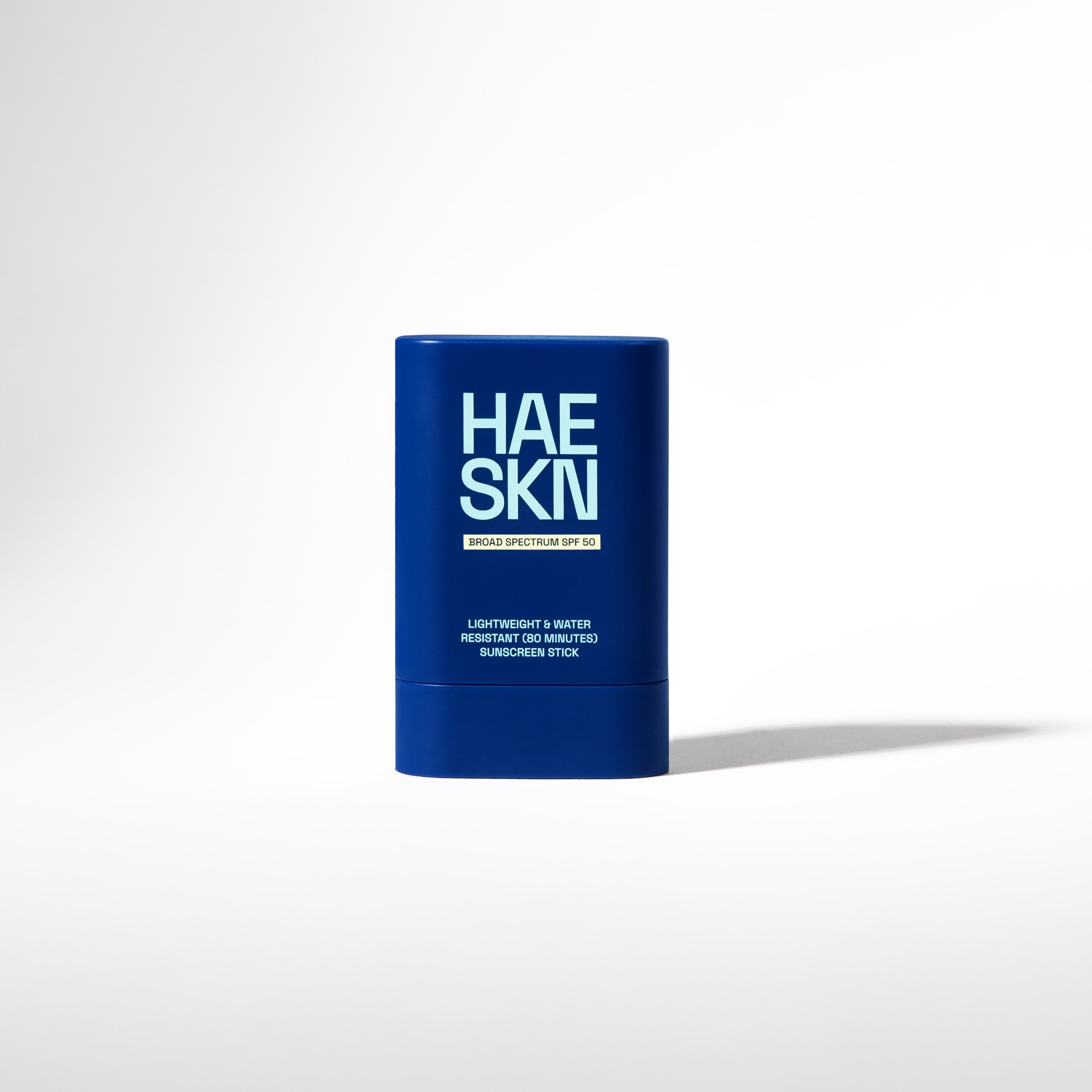
It ranks first on criteria 1, 3 and 4. The formula uses four FDA-approved organic filters, avobenzone, homosalate, octisalate and octocrylene, with no zinc oxide or titanium dioxide, and it dries down clear on every skin tone including deep tones. That is the specific property mineral sticks cannot offer, and it is the property that decides whether the third reapplication of a long run happens. The pocket-sized twist-up works one-handed, and at $24 it sits in the range where runners are willing to keep a second stick in a race vest.
Where it does not win: we do not publish filter percentages, and we are not printing a water-resistance minute figure in this guide, so check the Drug Facts panel on the pack you own and treat that as the governing number. We also make no dermatologist-tested, non-irritating, or reef-safe claim. If a labeled 80-minute figure is your single deciding filter, pick #2.
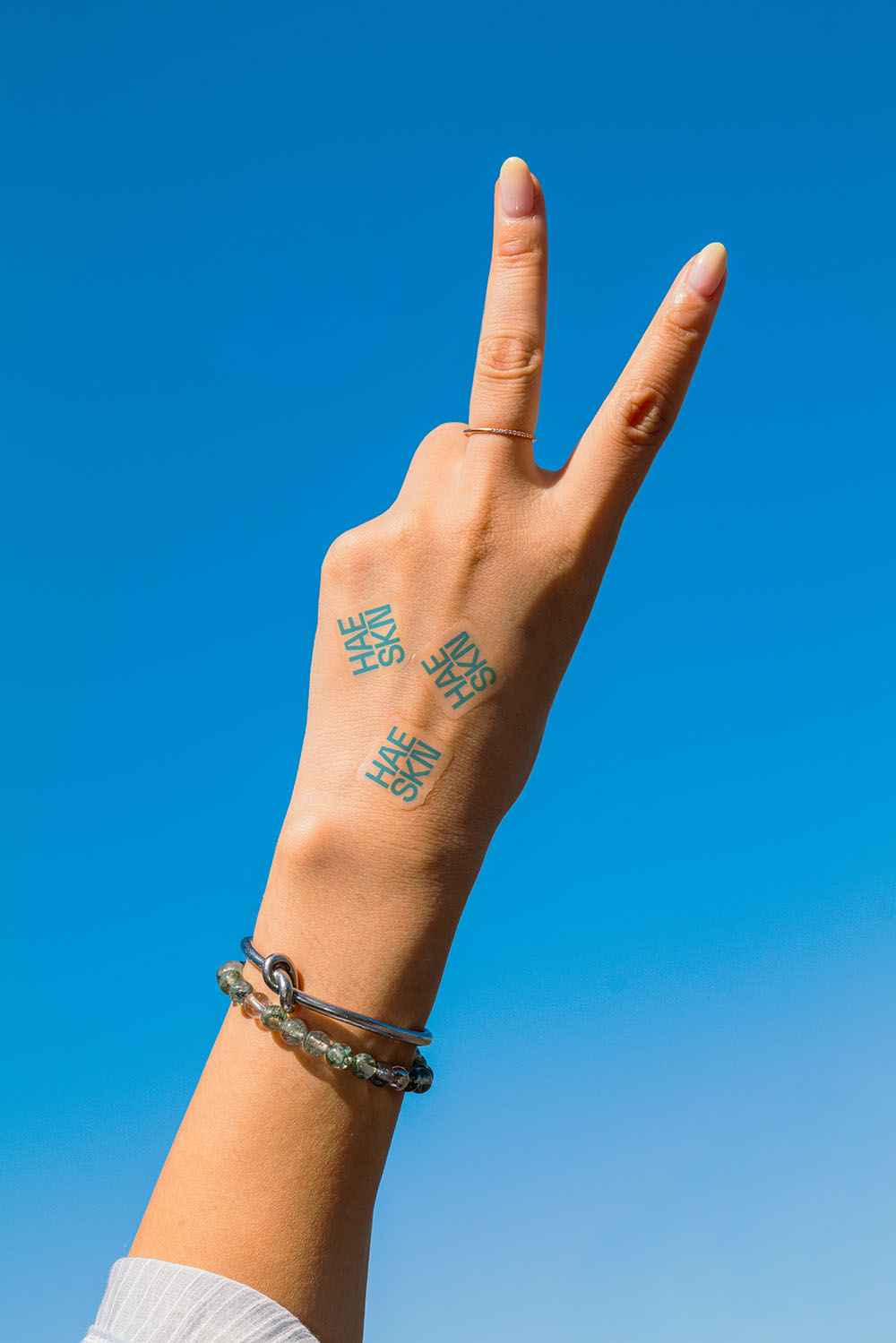
If you want a second signal for when UV is climbing rather than relying on feel, our SOLCHECK UV sticker changes color with ambient UV. It reports the environment and it cannot see the film on your face, so pair it with a timer rather than substituting it for one.
HAESKN Sunscreen Stick SPF 50
24.00 USD
Shop now
HAESKN SOLCHECK
15.00 USD
Shop now
2. Neutrogena Beach Defense Stick SPF 50
The strongest label transparency in this group. Its retail listing states broad-spectrum SPF 50 with water resistance up to 80 minutes, which puts a tested number against sweat exposure. The tradeoff is texture: it is built for beach conditions and reads heavier on the face than a daily-wear stick, which some runners notice under a hat brim or a sweatband. It ranks second because it wins criterion 2 outright and loses ground on criterion 1.
3. Supergoop! Glow Stick SPF 50
Supergoop describes this as a dry-oil stick with a water- and sweat-resistant formula and a dewy finish. The glow is the point of the product, and it is a reasonable face touch-up for an easy morning loop. For hard efforts it slips on two counts. The product page does not state which tested minute window applies, and a dewy dry-oil finish tends to migrate more readily once sweat starts sheeting, which is the mechanism behind sunscreen stinging your eyes mid-run.
4. Neutrogena Ultra Sheer Mineral Stick SPF 50
A zinc oxide stick, per its retail listing, positioned for sensitive skin. Mineral filters sit on the surface and scatter light, which is exactly why they show up as a gray or ashy layer on brown, dark, and deep skin, and increasingly on lighter skin once the layer is thick enough to be doing its job. The fourth-place finish reflects criterion 1 alone; the formulation itself is competent. Our no-white-cast ranking for brown skin covers the optics in detail.
5. Cetaphil Sheer Mineral Stick SPF 50
Zinc oxide and titanium dioxide, fragrance-free, in a compact 0.5 oz barrel per the same retail listing. The fragrance-free formulation is a genuine advantage for runners whose complaint is sting rather than cast. The two-mineral filter system makes it the highest cast risk of the five under a heavy application, and the small barrel means more passes to cover a face and both ears. Last on criteria 1 and 4, first if you specifically want a mineral stick.
A run-day SPF routine that survives contact with a training block
- Apply 15 minutes before you head out, while your skin is still cool and dry. Sweat-slick skin will not take an even film.
- Build the layer, do not count passes. Go over cheekbones, nose bridge, ears, hairline, and the back of the neck twice, then even it out with clean fingers.
- Cover the reflected-UV zones. Asphalt and concrete bounce UV upward onto the chin and the area under the nose, which a cap brim does not shade.
- Carry it on the run. A vest pocket or a shorts waistband keeps it in reach, and a stick left on the counter delivers a 0 mg/cm² dose.
- Reapply at the earlier of the label window or two hours, and sooner after you wipe your face with a sleeve or a towel. The FDA test protocol explicitly excludes toweling, so a wipe ends the window early.
- Do the same on cloudy and cold days. UV reaches you through cloud cover, and winter base-building sessions are long.
Limits of this ranking
We rank on published label facts, formulation type, and format ergonomics. We did not run a controlled head-to-head SPF or substantivity test across these five sticks, and no ranking here should be read as a clinical performance comparison. Retail listing text can change without notice, so verify the water-resistance line on the pack in your hand. Prices other than ours move by retailer and are left unstated rather than guessed.
Sunscreen is one layer of a sun-protection plan that also includes a brim, UPF sleeves on long exposure days, and dermatologist skin checks if you train outdoors year-round.
FAQ
How many sticks should I carry for a marathon?
One, if you apply properly at the start line and reapply once. Race-day exposure for most finishers runs three to five hours from wake-up to finish, which is two label windows. A single 0.5 to 1 oz stick handles face, ears and neck for that span with room to spare, provided you actually build the layer rather than swipe it.
Does sunscreen make me run hotter?
This worry comes up often, and the fix is mostly about timing. Applying while you are still cool indoors and letting the film set before you leave removes most of the tacky feeling people associate with running in sunscreen. If a product genuinely feels occlusive on you, that is a formulation mismatch worth solving by switching products rather than by skipping SPF.
Can I use a body stick on my face during a run?
Check the label for a face indication and for fragrance. Face skin around the eyes is where migrating sunscreen causes the most trouble at speed, and a fragranced body formula is more likely to sting. Keeping a dedicated face stick in the vest avoids the problem entirely.
Is SPF 50 overkill if I only run at 6 a.m.?
Dawn UV is low, then it climbs steadily once the sun clears the horizon, which matters on a summer long run that finishes at 8 or 9 a.m. Since the AAD notes that most people apply well under the tested dose, a higher SPF mainly buys margin against your own under-application rather than extra time outdoors.
What should I do about the tops of my ears and my part line?
Those are the two spots runners burn most and notice last, because a cap covers neither reliably. A stick is the easiest format for both: two passes along the top rim of each ear, and one down the part line before you put the cap on.
Ready to make reapplication the easy part of your run? See the HAESKN Sunscreen Stick SPF 50 or pair it with SOLCHECK for a visible UV cue on the route.