
Hate Greasy Sunscreen? How to Pick One That Isn't
TL;DR: If sunscreen feels greasy on you, change the formula and the format rather than your willpower. Look for a broad-spectrum SPF 30 or higher in an oil-free, gel, fluid, or stick texture with a stated water-resistance time on the front panel, and treat "non-comedogenic" as an unverified marketing term rather than a test result. A light texture only pays off if you still apply a full layer, because thin application is what actually costs you protection.
We hear this objection more than any other at HAESKN: people are not arguing with the dermatology. They simply hate the film. The good news is that the slick, heavy feeling comes from the carrier system a formulator chose, and carrier systems vary enormously between products that carry the identical SPF number.
So the answer to "what sunscreen should I use if I hate that greasy feeling" is a texture-and-format decision made at the shelf, and it takes about thirty seconds of label reading.
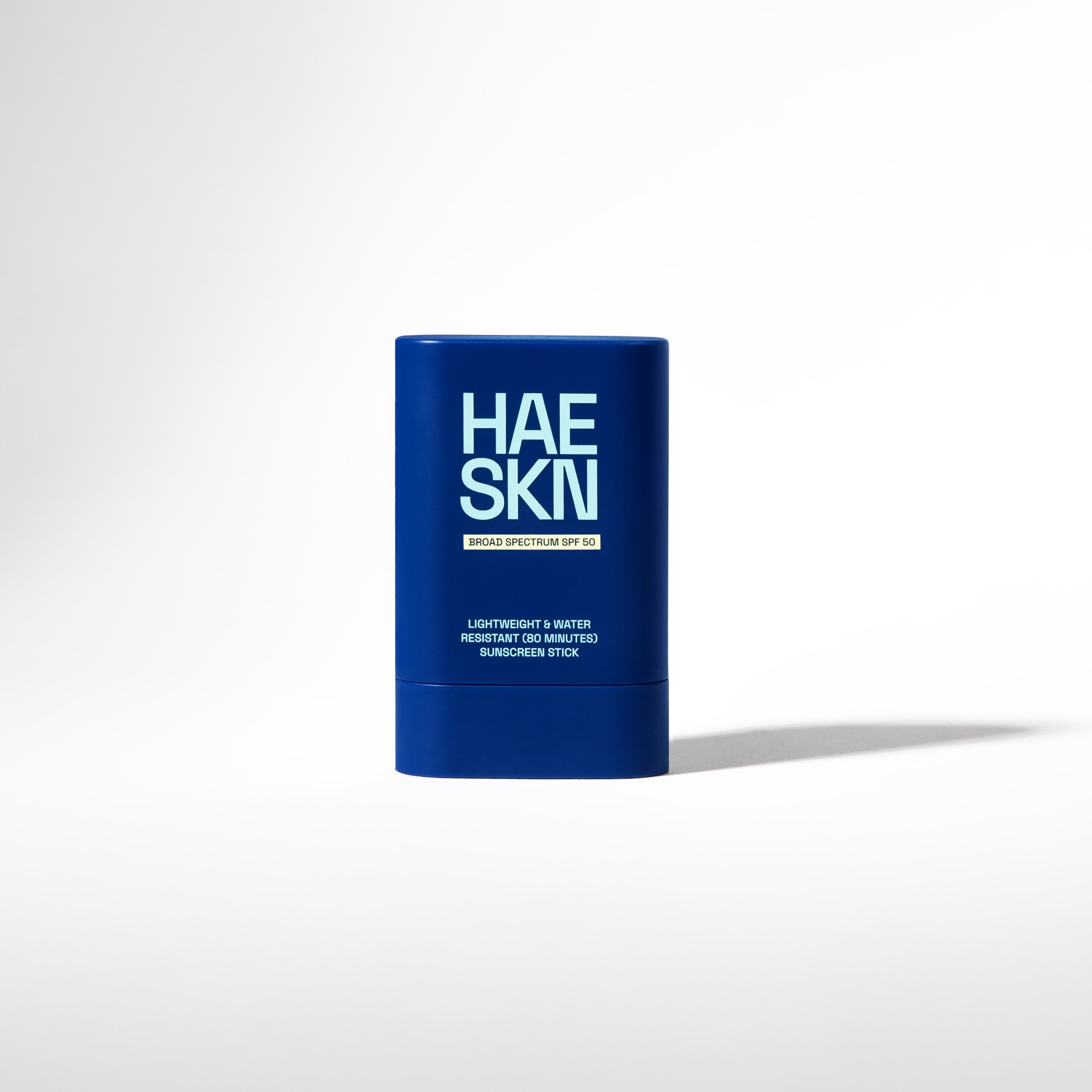
HAESKN publishes this guide and sells the HAESKN Sunscreen Stick SPF 50. This content is based on our own product information and public guidance.
Where the slick feeling actually comes from
UV filters do not spread themselves. Organic (chemical) filters are oil-soluble powders and liquids that have to be dissolved in emollients before they can form an even film, and mineral filters are solid particles that need a base to disperse into. In both cases, the "feel" you are judging is mostly the carrier, not the filter.
Three formulation choices drive the greasy sensation:
- Emollient load. More oil in the base means easier spreading and a heavier residual film.
- Occlusive film formers. Waxes and heavy esters help a product survive water and sweat, and they also sit on the surface longer.
- Delivery format. A lotion asks you to rub a large volume of emulsion into skin. A stick lays down a waxy film with almost no rub-in phase.
That last point matters for anyone with shine-prone skin, because most of the "greasy" complaint happens during the two minutes of rubbing in, not at hour three.
"Non-comedogenic" is a claim, not a test result
This is the label most people with oily skin reach for, and it carries less weight than it appears to. A 2025 review in JAAD Reviews traced the term back to the rabbit ear assay, in which a substance is applied to the inner ear of albino rabbits for two to four weeks and the skin is then examined for comedone formation. The same review reports that later work found inconsistent results when those ratings were applied to human skin, and that the absence of standardized testing and regulatory oversight lets companies label products "noncomedogenic" regardless of their actual potential to cause acne.
The review also flags a methodological problem worth understanding: much of the historical testing evaluated isolated ingredients rather than finished formulations. A raw oil behaves differently at 10% under occlusion than the same oil does at 2% inside a fully emulsified sunscreen.
None of that makes the label useless. It means "non-comedogenic" is a signal of formulator intent, and your own skin over two weeks is the real test.
Reading the label for a lighter finish
Two things on a US sunscreen label are legally defined and tested. Everything else is copywriting.
| What you see | Is it regulated? | What it tells you about feel |
|---|---|---|
| SPF number | Yes, by standardized FDA test | Nothing. SPF 50 can feel like water or like grease |
| Broad Spectrum | Yes, passes the UVA test | Nothing about texture |
| Water Resistant (40 or 80 minutes) | Yes, by immersion testing | Higher tier usually means a more occlusive film |
| "Sport" | No | Usually just shorthand for water resistance |
| Oil-free, matte, gel, lightweight | No | The most useful texture hints available, but unverified |
| Non-comedogenic | No | Formulator intent only |
The FDA requires water-resistance claims on the front label to state whether the product remains effective for 40 minutes or 80 minutes while swimming or sweating, and no sunscreen may be sold as waterproof, because all of them eventually wash off. The American Academy of Dermatology adds that the FDA has never defined "sport" for sunscreen, so a sport label usually just means the product will stay on wet skin for 40 or 80 minutes. Check the panel rather than the marketing.
Here is the trade-off to accept honestly. The film-forming systems that earn an 80-minute rating tend to feel more present on skin than a fast-drying daily fluid. If you want both, the format is what resolves it: a solid stick delivers a durable film without the volume of emulsion a lotion needs.
Light textures fail if you under-apply
A weightless sunscreen you spread thin is worse than a slightly richer one applied properly, and this is where most oily-skin routines quietly break down.
SPF is tested at 2 mg/cm2. A 2014 literature review by Petersen in Photodermatology, Photoimmunology & Photomedicine reported that sunscreen under natural conditions is applied at roughly 0.39 to 1.0 mg/cm2, which lowers the protection factor considerably.
A King's College London study put numbers on the consequence. Researchers measured DNA damage in volunteers at application thicknesses from 0.75 up to 2 mg/cm2 and found that an SPF 50 sunscreen applied in a typical way would at best provide 40% of the expected protection. Professor Antony Young, who reported the work, said the way sunscreen is applied "plays an important role in determining how effective it is." The study used 16 fair-skinned volunteers under simulated sunlight, so treat it as a mechanism demonstration rather than a population estimate.
The practical read: if you dislike the feel of a product, you will instinctively use less of it, and the SPF on the bottle stops describing what is on your face. Choosing a texture you genuinely like is a protection decision.
One related shortcut to drop. Bright Girl notes that foundation with SPF is not a substitute for dedicated sunscreen, because people apply too thin a layer of foundation to reach the SPF stated on the bottle. The same logic applies to a tinted moisturizer used as your only protection.
What we built into the HAESKN stick
Our SPF 50 stick uses four FDA-approved organic filters: avobenzone, homosalate, octisalate, and octocrylene. There is no zinc oxide or titanium dioxide in it, which is why it goes on clear and leaves no white cast on any skin tone, including deep tones.
The format was the point. A stick is applied by direct contact, so there is no palm-full of lotion to work in and no rub-in phase where skin feels coated. That also makes reapplication over sweat realistic on a run, on a court, or between meetings, which is the moment most people skip.
We do not make non-comedogenic, dermatologist-tested, or sensitive-skin claims for it, because we hold claims to product-specific evidence and we do not have that testing to point at. And a stick asks for a deliberate technique: several passes over each area, then blend, or you will lay down less product than a lotion would have given you.
The stick is listed at $24 on our product page.
If you are weighing formats more broadly, we compared them in stick vs. spray vs. lotion, and the white-cast question for medium and deep skin tones is covered in our no-white-cast guide.
A shine-free routine that still hits full protection
- Skip the heavy layer underneath. A rich occlusive moisturizer under sunscreen is often the real source of the slick feeling people blame on SPF.
- Apply to bare, dry skin. Wet or freshly moisturized skin thins the film and slows set time.
- Use enough. Roughly a nickel-sized amount for the face with a cream, or repeated passes with a stick until the area is visibly covered before you blend.
- Give it two minutes. Most textures that feel greasy at minute one have set by minute three. Judge the finish then.
- Reapply on the label's schedule. Per 21 CFR 201.327, water-resistant products must direct you to reapply after 40 or 80 minutes of swimming or sweating, immediately after towel drying, and at least every 2 hours.
- Blot, do not wipe. Pressing a tissue on shine removes surface oil while disturbing less of the film than rubbing does.
Our reapplication timing is unpacked further in how often to reapply during the day.
FAQ
Does a matte finish mean the sunscreen is protecting me less?
No. Finish comes from the carrier and any absorbent powders in the base, while protection comes from the filters and how thickly you apply them. A matte product applied at a proper dose outperforms a dewy one applied thinly.
Is mineral or chemical sunscreen better if my skin runs oily?
Neither category wins automatically. Mineral formulas often finish drier because the particles are absorbent, and they can also require a heavier base to spread. Judge the individual product, and if you have picked a mineral formula for a reason such as a reef-protected swim area, expect a visible finish on deeper skin tones.
Will sunscreen cause breakouts?
Any leave-on product can contribute to congestion for some people, and the labeling that claims to rule it out is unregulated according to the JAAD Reviews analysis. Trial one product at a time for two weeks and watch your own skin. Speak to a dermatologist if you are using acne medication.
Can I just wear a hat and skip sunscreen on my face?
A hat helps with direct overhead sun and does nothing for reflected UV from water, sand, snow, or pavement, and it leaves the jaw and neck exposed. The American Academy of Dermatology frames shade, protective clothing, and broad-spectrum sunscreen as layers used together rather than as alternatives.
How do I reapply without smearing makeup or ending up shiny?
Stick and powder formats are the practical answer, as Bright Girl recommends for on-the-go reapplication. Blot first, apply in short passes rather than dragging, and press rather than rub to blend.
If the greasy feeling has been the reason your SPF stays in a drawer, start with the format. Our SPF 50 stick was designed for exactly that objection, and whatever you choose, pick the one you will actually reapply.