
What to Look for in a Sunscreen for Outdoor Sports
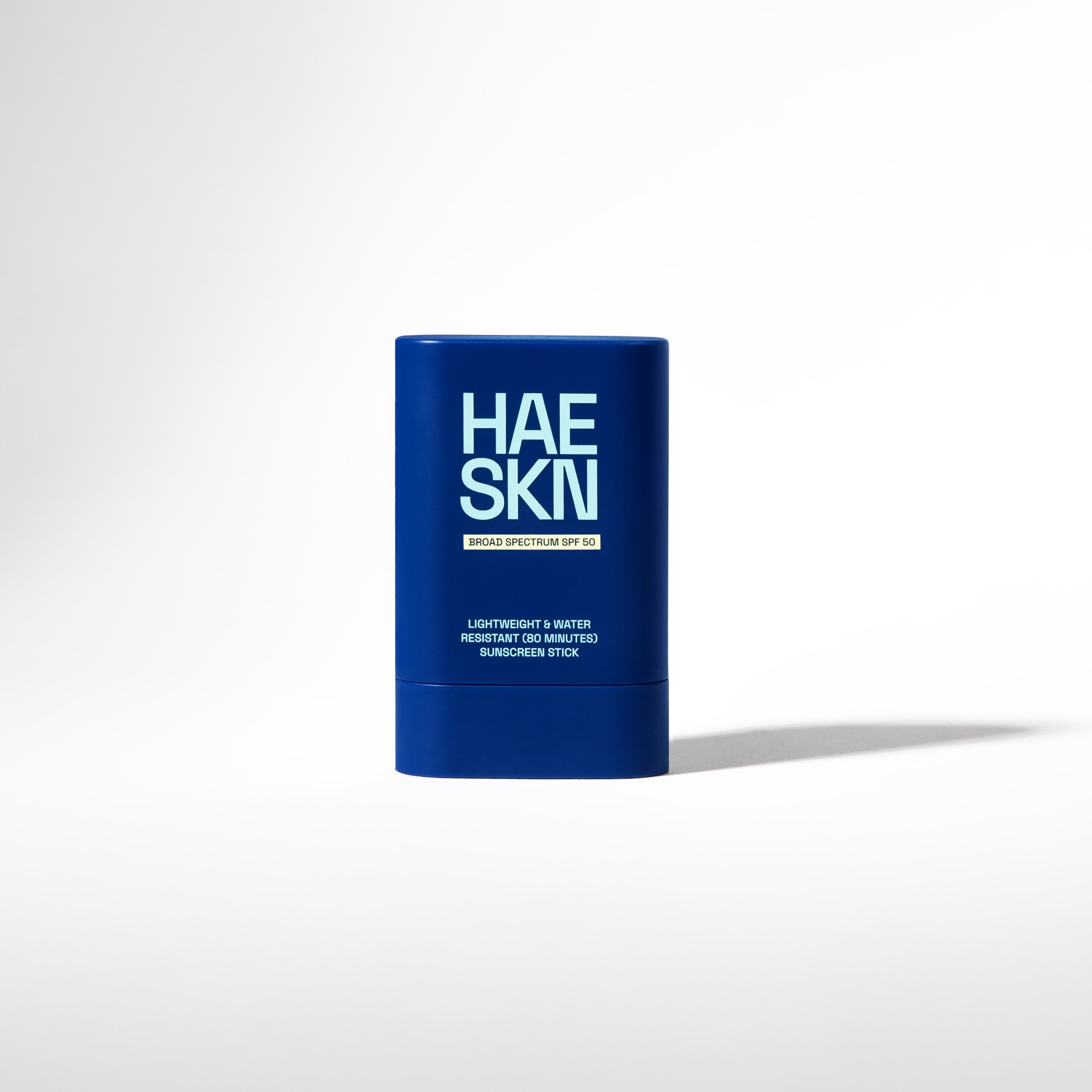
For outdoor sports, judge a sunscreen on six things in this order: broad-spectrum SPF 30 or higher, a water-resistance window printed as 40 or 80 minutes, whether the format reaches the spots people skip, whether you can reapply it one-handed mid-session, a finish you will not stop short of applying, and a separate SPF 30+ product for lips. Almost every claim worth trusting is printed on the Drug Facts panel, and the rest is about whether you will actually use the thing at minute 70. HAESKN publishes this guide and sells the HAESKN Sunscreen Stick SPF 50.
The reason to lead with coverage rather than SPF number is where skin cancers turn up. The American Academy of Dermatology estimates that one in five Americans will develop skin cancer in their lifetime, with roughly 9,500 diagnoses a day in the US. The FDA's own consumer guidance singles out the areas people routinely leave bare: ears, nose, lips, back of neck, hands, tops of feet, along the hairline, and exposed scalp. Those are precisely the parts of the body that an athlete in motion is least likely to re-cover.
The coverage map problem
Angela Casey, MD, a double board-certified dermatologist and Mohs surgeon, writes that a large share of the scalp and hairline cancers she treats occur in patients who applied sunscreen to the head and neck but stopped short of the hairline, because they did not want greasy sunscreen in their hair. That is a clinical observation from one practice rather than a controlled study, so read it as a hypothesis about behavior rather than measured incidence. It matches the failure mode most outdoor athletes recognize: the product stops where the mess starts.
Treat that as the first design requirement. A sport sunscreen has to be something you are willing to drag across your hairline, over your ears, and onto the back of your neck without ruining the next two hours.
Start with the panel: broad spectrum, SPF 30 or higher
Two phrases on the front of the pack carry regulatory weight. "Broad Spectrum" means the product passed the FDA's UVA test, and the agency's labeling rule ties that designation to a defined test rather than marketing judgment (FDA). The SPF number reflects UVB performance measured in a lab on an even, measured layer.
Dermatologists set the floor at broad-spectrum SPF 30 with water resistance for outdoor use, and the AAD notes that people who burn anyway usually did not reapply, used too little, or used an expired product. Going up to SPF 50 buys margin against thin application. It does not buy you extra hours.
A printed water-resistance window, 40 or 80 minutes
This is the single most useful number on a sport sunscreen, and it is the one most shoppers skim past.
Under the FDA rule, a water-resistance claim may only be stated as 40 minutes or 80 minutes, and the terms "waterproof" and "sweatproof" are prohibited outright (FDA). The 40-minute claim comes from a test sequence of two 20-minute water-activity periods separated by a 15-minute rest, with no toweling; the 80-minute claim requires four such immersion-drying cycles (21 CFR 201.327).
The same regulation dictates the reapply line every water-resistant sunscreen must print: after the labeled 40 or 80 minutes of swimming or sweating, immediately after towel drying, and at least every two hours. Wiping your face with a shirt sleeve at a changeover is the towel-drying case. Most people treat it as nothing.
A practical way to use the number: divide your session by it. A 90-minute trail run on an 80-minute product needs one reapplication built into the plan, and a 40-minute product needs two. We wrote out the timing logic in more detail in how often you should reapply sunscreen during the day.
If the back label says to use a water-resistant sunscreen when swimming or sweating, the product in your hand is not one.
Reaching the hairline, ears, and back of the neck
Format determines which body parts get covered, which is why we judge formats by the technique they demand rather than by lab specs alone.
| Area | Why it gets missed in sport | What actually works |
|---|---|---|
| Hairline and part line | Lotion drags and loads the hair | A dry-finish format you can run along the part in one pass; a brimmed hat when hair is thinning (AAD) |
| Ears, front and back | Out of sight, skipped at speed | The same facial product, traced around the rim and behind the lobe |
| Back of neck | Hidden by a collar or ponytail that moves | Applied before the hat and glasses go on |
| Hands | Assumed protected, rarely reapplied | A portable format kept in the kit bag |
| Lips | Removed by drinking within minutes | A dedicated SPF 30+ lip product |
Casey notes that she treats skin cancers on every part of the ear, front, back, top, bottom and inside, and that whatever product works for the face usually serves for the ears too. That argues for one product you carry rather than a shelf of specialists.
One-handed reapplication, mid-session
Reapplication is the step that fails, so weight the criterion accordingly. A product that requires clean dry hands, a rub-in phase, and thirty seconds of standing still is a product that gets skipped at a water stop.
What to check before you buy:
- Can you open and apply it with one hand, wearing a glove or holding a racket?
- Does it survive being stored in a hot car or a bag left in the sun? The FDA advises keeping sunscreen containers out of direct sun and wrapped or shaded in prolonged heat (FDA).
- Does it go on over sweat without sheeting off, or does it need a dry face you will not have?
- Will it fit in the pocket you actually run with?
The format comparison behind these questions is in sunscreen stick vs. spray vs. lotion.
Finish decides whether the last inch gets covered
Finish looks cosmetic and behaves functionally. A product that leaves a grey or chalky film on brown and deep skin gets applied thinly, or stopped at the jaw, or left out entirely before a group session. A product that feels slick gets kept away from the hairline and out of the eye zone.
Mineral filters sit on the skin as particles and are the usual source of visible cast. HAESKN Sunscreen Stick SPF 50 uses four FDA-approved chemical filters, avobenzone, homosalate, octisalate and octocrylene, with no zinc oxide or titanium dioxide, which is why it goes on clear across skin tones. We covered the filter chemistry behind cast in best sunscreens for brown skin with no white cast.
Whichever product you choose, verify the water-resistance minutes and the broad-spectrum line on that product's own Drug Facts panel, including ours. Filter choice tells you about finish. The panel tells you about performance.
Lips, eyelids, and hands need their own plan
Three areas resist the one-product answer.
Lips. Sunscreen applied to the face disappears from the lips through eating, drinking and talking, which is a constant during any session with a bottle in it. The AAD advises a lip balm or lipstick with SPF 30 or higher, and Cleveland Clinic notes that the lower lip is roughly 12 times more likely to be affected by lip skin cancer because it catches more direct light. HAESKN does not make a lip product, so buy one separately and keep it with your sunscreen.
Eyelids. Casey's clinical preference is a facial sunscreen with mineral actives around the eyes, on the grounds that minerals are less likely to sting. HAESKN's stick is a chemical-filter product and we make no eye-area or non-irritating claim for it. Sunglasses and a brimmed hat remain the guidance the AAD gives for eyelid skin.
Hands. Casey also reports that much of the hand damage she sees accumulates during driving. That mechanism has independent support: in a cross-sectional study of 29 vehicles published in JAMA Ophthalmology, Brian S. Boxer Wachler, MD, found side-window UV-A protection was lower and highly variable compared with windshields, which the author links to reported left-sided facial skin cancer patterns. The drive to the trailhead counts as exposure.
What the word "sport" means on a front label
Less than the graphic design implies. The AAD states plainly that the FDA has not defined "sport" for sunscreen; in practice it usually signals that the product is water resistant for 40 or 80 minutes, and the only way to know which is to read the label.
So ignore the front panel adjectives and read three lines on the back: broad spectrum, the SPF number, and the water-resistance minutes. Everything else on the front is styling.
Where HAESKN fits and where it does not
HAESKN Sunscreen Stick SPF 50 is a $24 SPF 50 stick, US manufactured as an FDA-compliant OTC drug, built for the reapplication problem: pocketable, operable with one hand, and clear on every skin tone including deep tones, which is what keeps the hairline and ear passes from getting skipped. HAESKN SOLCHECK is a $15 UV detection sticker for people who would rather have a cue than a guess.
Where it is not the answer: we do not make a lip SPF, we do not claim eye-area tolerability, and for Hawaii's Maui County, where non-mineral sunscreens are restricted, a mineral product is the one to pack. Our ranked comparisons against other sport options live in best sunscreen for active people, ranked by compliance.
HAESKN Sunscreen Stick SPF 50
24.00 USD
Shop now

HAESKN SOLCHECK
15.00 USD
Shop now
FAQ
How long before a session should I put sunscreen on?
Apply to dry skin about 15 minutes before going outdoors, per AAD guidance. For sport, that usually means applying before you dress and before the hat and glasses go on, so the hairline and neck are covered while your hands are still clean.
Does a hat replace sunscreen on the scalp?
For a hair-bearing scalp a wide-brimmed hat is a reasonable substitute, and the AAD offers it as an alternative for people with thinning hair: apply sunscreen to the scalp or wear a wide-brimmed hat. A running cap with open sides leaves the ears and the part line exposed, so it does not close the gap on its own.
Can I use the same product on my face and my ears?
Usually yes. Casey's guidance is that the product that suits your face typically works for the ears, front and back. The failure is not product choice but sequence, since ears get missed when they are covered by hair or a strap at the moment of application.
Is SPF 50 meaningfully better than SPF 30 for sport?
Both clear the dermatologist-recommended floor of SPF 30. The practical argument for 50 is margin, because the AAD notes that sunburn in sunscreen users typically traces to applying too little or not reapplying, and a higher starting number leaves more room for that error. The higher number does not extend the reapplication interval.
Does sunscreen kept in a hot kit bag still work?
Heat and direct sun are the conditions the FDA warns about, which is why labels must carry the instruction to protect the container from excessive heat and direct sun (FDA). Keep it shaded in the bag rather than on a car dashboard, and replace anything past its expiration date.
Run the six checks on whatever is already in your bag before you buy anything. If it fails on reapplication or finish, the [HAESKN Sunscreen Stick SPF 50](https://haeskn.com/products/haeskn-sunscreen-spf-50-bundle) is built for those two.